QUESTION IMAGE
Question
exponential - growth - and - decay
$g(t)$ increases by 9
$g(t)$ increases by 6
$g(t)$ decreases by 6
$g(t)$ increases by 3
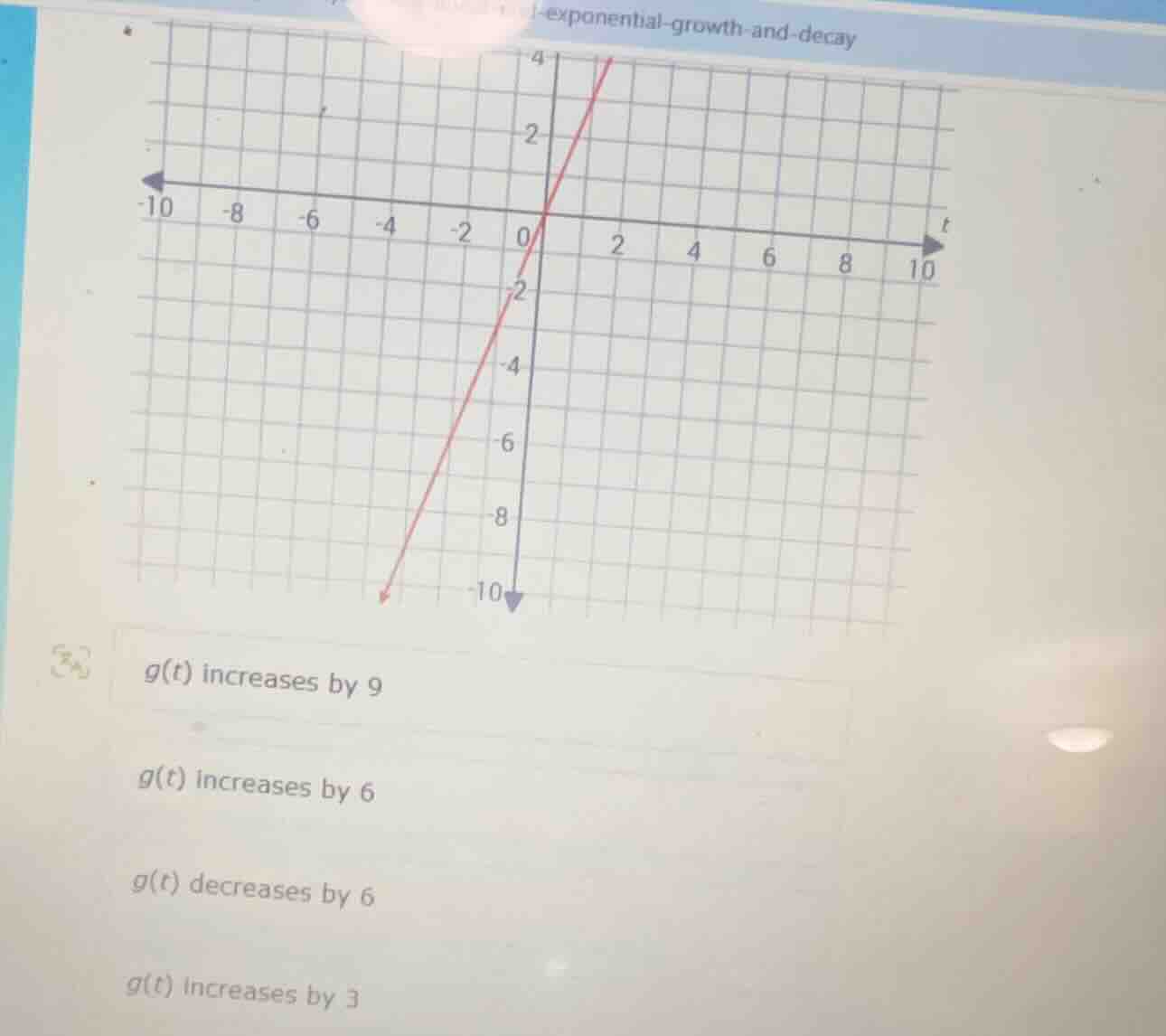
To solve this, we first determine the slope of the linear function \( g(t) \). The slope \( m \) is calculated as \( \frac{\Delta y}{\Delta t} \). From the graph, when \( t \) increases by 1 (e.g., from \( t = 0 \) to \( t = 1 \)), let's find the change in \( g(t) \). Looking at the line, when \( t = 0 \), \( g(0)=0 \) (wait, no, maybe better to take two points. Let's take \( t = -1 \) and \( t = 0 \)? Wait, the line passes through (0,0) and (1,3)? Wait, no, looking at the grid, each square is 1 unit. Let's take two points: (0,0) and (1,3)? Wait, no, the line has a steep slope. Wait, when \( t = 0 \), the value is 0? Wait, no, the red line crosses the origin (0,0). Then, when \( t = 1 \), what's \( g(1) \)? Let's see, from (0,0) to (1,3)? Wait, no, maybe the slope is 3? Wait, no, let's check the options. The options are about the increase in \( g(t) \) when \( t \) increases by 3? Wait, maybe the question is: when \( t \) increases by 3, how does \( g(t) \) change? Wait, the original problem might be: For the linear function \( g(t) \) represented by the graph, what happens to \( g(t) \) when \( t \) increases by 3? Wait, the options are: \( g(t) \) increases by 9, increases by 6, decreases by 6, increases by 3. Wait, let's find the slope. Let's take two points: (0,0) and (1,3) – no, wait, the line goes through (0,0) and (1,3)? Wait, no, looking at the graph, each vertical and horizontal grid is 1 unit. The red line has a slope of 3? Wait, no, when \( t = 0 \), the value is 0. When \( t = 1 \), the value is 3? Wait, no, maybe the slope is 3. So the equation is \( g(t)=3t \). So when \( t \) increases by 3, \( \Delta t = 3 \), so \( \Delta g(t)=m \times \Delta t = 3 \times 3 = 9 \). Wait, but that would be an increase of 9. But let's check again. Wait, maybe the slope is 3. So if \( t \) increases by 3, \( g(t) \) increases by \( 3 \times 3 = 9 \)? Wait, no, slope is \( \frac{\Delta g(t)}{\Delta t} \), so \( \Delta g(t)=m \times \Delta t \). If the slope \( m = 3 \), then when \( \Delta t = 3 \), \( \Delta g(t)=3 \times 3 = 9 \). So the correct option is " \( g(t) \) increases by 9". Wait, but let's confirm. Let's take \( t = 0 \), \( g(0)=0 \). Then \( t = 3 \), \( g(3)=3 \times 3 = 9 \). So the increase is \( 9 - 0 = 9 \). So the answer is " \( g(t) \) increases by 9".
- Identify the Function Type: The graph represents a linear function \( g(t) \), so it has a constant slope \( m \).
- Determine the Slope: The line passes through the origin \((0,0)\). By analyzing the graph (or using two points), the slope \( m = 3 \) (e.g., when \( t \) increases by 1, \( g(t) \) increases by 3).
- Analyze the Change in \( t \): If \( t \) increases by 3 (i.e., \( \Delta t = 3 \)), the change in \( g(t) \) is \( \Delta g(t) = m \times \Delta t \).
- Calculate the Change: Substitute \( m = 3 \) and \( \Delta t = 3 \):
\[
\Delta g(t) = 3 \times 3 = 9
\]
Thus, \( g(t) \) increases by 9 when \( t \) increases by 3.

Snap & solve any problem in the app
Get step-by-step solutions on Sovi AI
Photo-based solutions with guided steps
Explore more problems and detailed explanations
\( g(t) \) increases by 9 (the option: \( g(t) \) increases by 9)