QUESTION IMAGE
Question
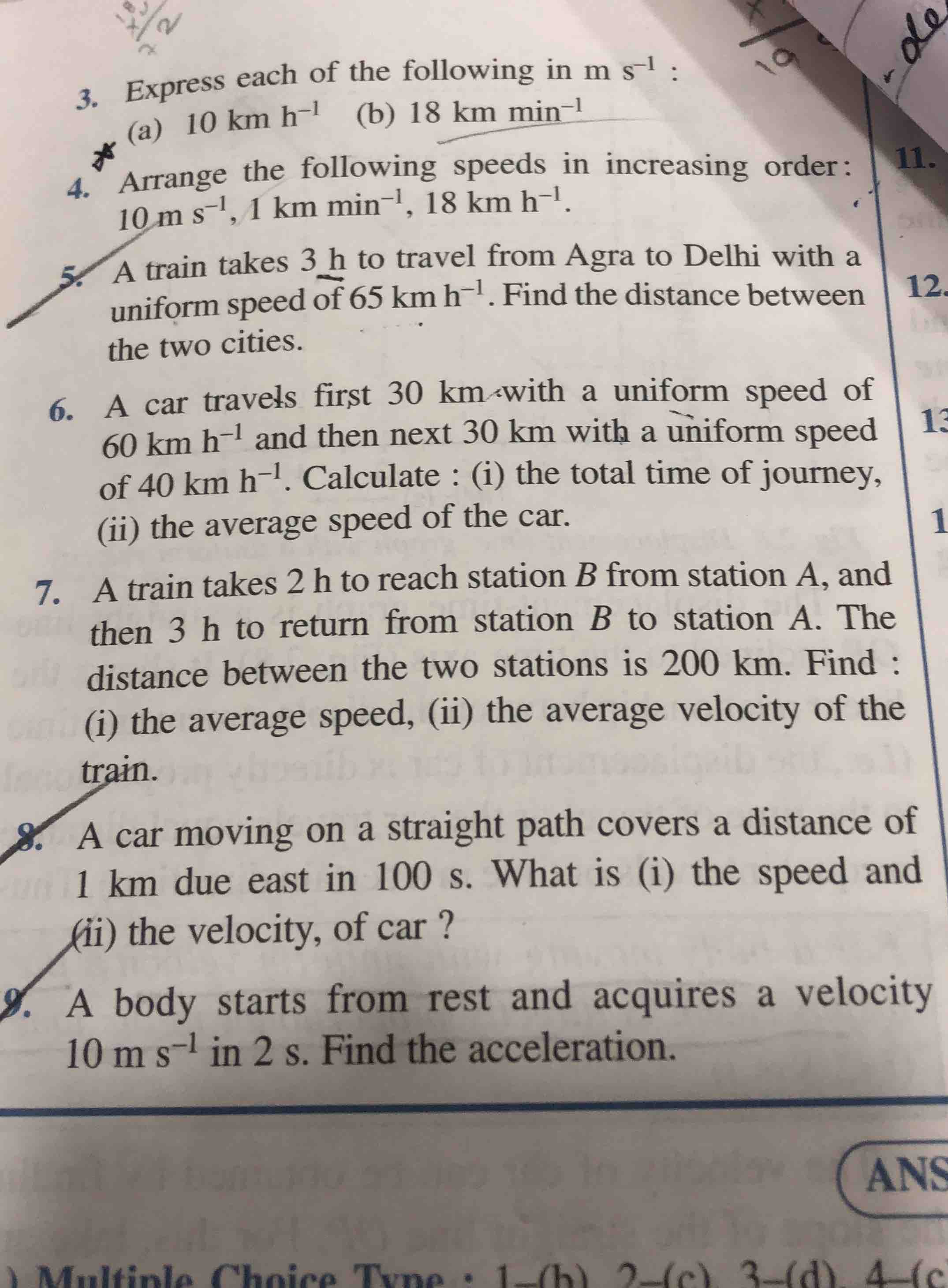
- express each of the following in m s⁻¹ :
(a) 10 km h⁻¹ (b) 18 km min⁻¹
- arrange the following speeds in increasing order :
10 m s⁻¹, 1 km min⁻¹, 18 km h⁻¹.
- a train takes 3 h to travel from agra to delhi with a uniform speed of 65 km h⁻¹. find the distance between the two cities.
- a car travels first 30 km with a uniform speed of 60 km h⁻¹ and then next 30 km with a uniform speed of 40 km h⁻¹. calculate : (i) the total time of journey, (ii) the average speed of the car.
- a train takes 2 h to reach station b from station a, and then 3 h to return from station b to station a. the distance between the two stations is 200 km. find : (i) the average speed, (ii) the average velocity of the train.
- a car moving on a straight path covers a distance of 1 km due east in 100 s. what is (i) the speed and (ii) the velocity, of car ?
- a body starts from rest and acquires a velocity 10 m s⁻¹ in 2 s. find the acceleration.
Question 3 (a)
Step1: Convert km to m and h to s
We know that \( 1 \text{ km} = 1000 \text{ m} \) and \( 1 \text{ h} = 3600 \text{ s} \). So, \( 10 \text{ km h}^{-1} = 10 \times \frac{1000 \text{ m}}{3600 \text{ s}} \)
Step2: Calculate the value
\( 10 \times \frac{1000}{3600} = \frac{10000}{3600} \approx 2.78 \text{ m s}^{-1} \)
Step1: Convert km to m and min to s
We know that \( 1 \text{ km} = 1000 \text{ m} \) and \( 1 \text{ min} = 60 \text{ s} \). So, \( 18 \text{ km min}^{-1} = 18 \times \frac{1000 \text{ m}}{60 \text{ s}} \)
Step2: Calculate the value
\( 18 \times \frac{1000}{60} = 18 \times \frac{50}{3} = 300 \text{ m s}^{-1} \)
Step1: Convert all speeds to \( \text{m s}^{-1} \)
- For \( 10 \text{ m s}^{-1} \), it is already in \( \text{m s}^{-1} \).
- For \( 1 \text{ km min}^{-1} \): \( 1 \text{ km} = 1000 \text{ m} \), \( 1 \text{ min} = 60 \text{ s} \), so \( 1 \times \frac{1000 \text{ m}}{60 \text{ s}} \approx 16.67 \text{ m s}^{-1} \)
- For \( 18 \text{ km h}^{-1} \): \( 18 \times \frac{1000 \text{ m}}{3600 \text{ s}} = 5 \text{ m s}^{-1} \)
Step2: Arrange in increasing order
Now we have speeds: \( 5 \text{ m s}^{-1} \) (18 km h⁻¹), \( 10 \text{ m s}^{-1} \), \( 16.67 \text{ m s}^{-1} \) (1 km min⁻¹)

Snap & solve any problem in the app
Get step-by-step solutions on Sovi AI
Photo-based solutions with guided steps
Explore more problems and detailed explanations
\( \approx 2.78 \text{ m s}^{-1} \)