QUESTION IMAGE
Question
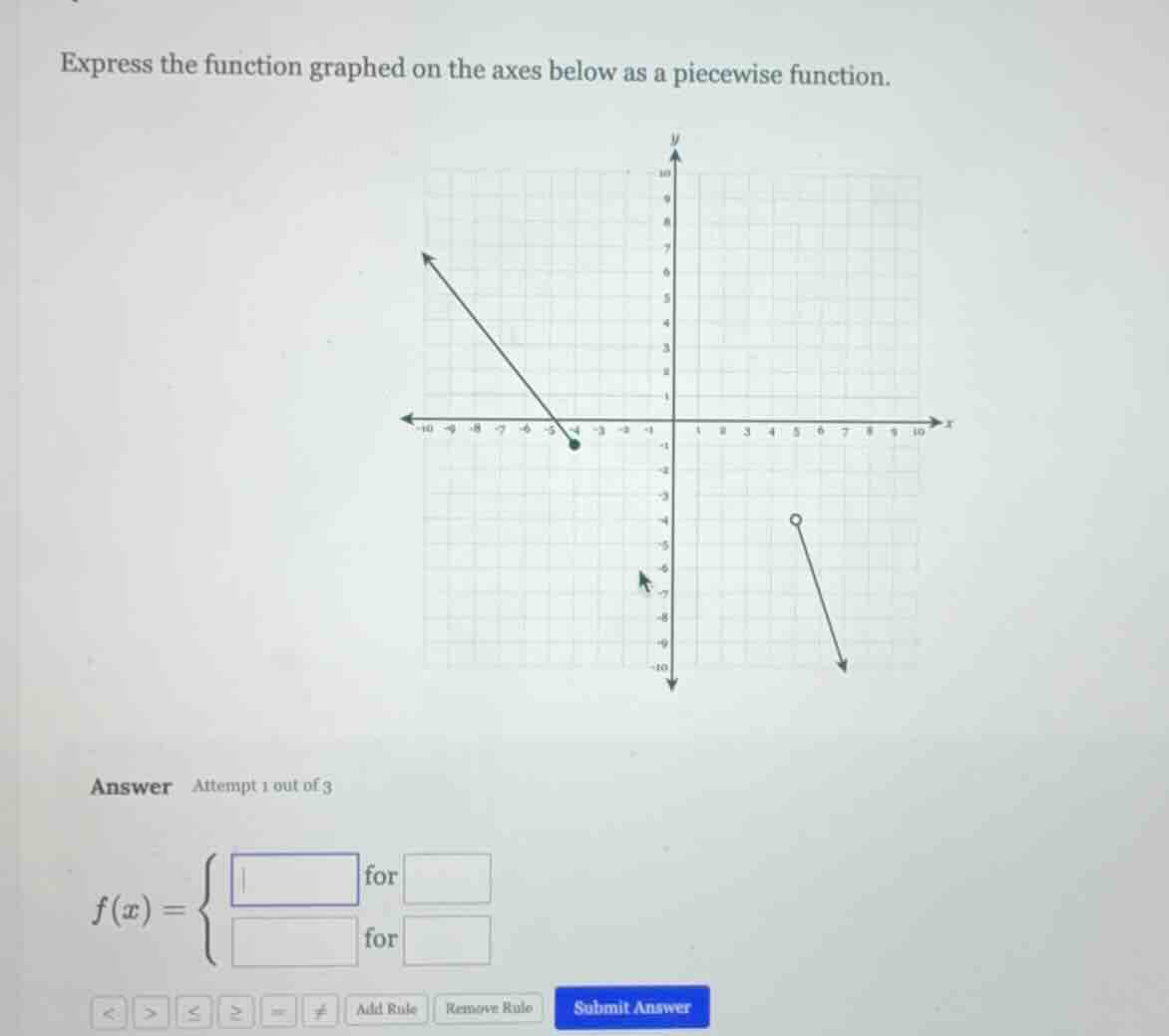
express the function graphed on the axes below as a piecewise function.
answer attempt 1 out of 3
$f(x)= \
$
Step1: Analyze the left line
The left line passes through \((-4, 0)\) and \((-8, 6)\) (we can find two points on the line). The slope \(m_1=\frac{y_2 - y_1}{x_2 - x_1}=\frac{6 - 0}{-8 - (-4)}=\frac{6}{-4}=-\frac{3}{2}\). Using point - slope form \(y - y_1=m(x - x_1)\) with \((x_1,y_1)=(-4,0)\), we get \(y-0 =-\frac{3}{2}(x + 4)\), which simplifies to \(y=-\frac{3}{2}x-6\). The domain for this line: the filled dot is at \(x=-4\) and the line extends to the left, so the domain is \(x\leq - 4\).
Step2: Analyze the right line
The right line has an open dot at \(x = 5\) (assuming the open dot is at \((5,-4)\)) and let's find another point. Let's say we take a point like \((7,-7)\). The slope \(m_2=\frac{-7-(-4)}{7 - 5}=\frac{-3}{2}\). Using point - slope form with \((x_1,y_1)=(5,-4)\), \(y+4=-\frac{3}{2}(x - 5)\), which simplifies to \(y=-\frac{3}{2}x+\frac{25}{2}-4=-\frac{3}{2}x+\frac{25 - 8}{2}=-\frac{3}{2}x+\frac{17}{2}\)? Wait, maybe a better way: Let's assume the open dot is at \((5, - 4)\) and the line goes down. Let's re - check. Wait, maybe the right line has a slope of \(-1\)? Wait, no, let's look at the grid. Wait, the left line: when \(x=-4\), \(y = 0\); when \(x=-8\), \(y = 6\). So slope is \(\frac{6-0}{-8 + 4}=\frac{6}{-4}=-\frac{3}{2}\). Equation: \(y=-\frac{3}{2}x-6\) (since when \(x=-4\), \(y=-\frac{3}{2}\times(-4)-6 = 6 - 6=0\), correct).
For the right line: the open dot is at \(x = 5\), let's say the point is \((5,-4)\) and another point is \((7,-7)\). The slope \(m=\frac{-7+4}{7 - 5}=\frac{-3}{2}\). Wait, no, maybe the right line has a slope of \(-1\)? Wait, maybe I made a mistake. Wait, the right line: let's assume the open dot is at \((5,-4)\) and the line passes through \((6,-5)\), \((7,-6)\) etc. So slope \(m=-1\). Wait, no, let's re - examine the graph. Wait, the left line: from the graph, the left line has a slope of \(-1\)? Wait, when \(x=-4\), \(y = 0\); when \(x=-5\), \(y = 1\)? No, the first point: the filled dot is at \((-4,-1)\)? Wait, maybe I misread the graph. Let's start over.
Looking at the graph: The left line: the filled dot is at \((-4,-1)\)? Wait, the y - axis: the left line crosses the x - axis at \(x=-4\) (y = 0) and goes up to the left. Wait, the grid: each square is 1 unit. Let's take two points on the left line: \((-4,0)\) and \((-8,6)\). So slope \(m=\frac{6 - 0}{-8-(-4)}=\frac{6}{-4}=-\frac{3}{2}\). Equation: \(y=-\frac{3}{2}x-6\) (since \(y=mx + b\), when \(x=-4\), \(y = 0\), so \(0=-\frac{3}{2}\times(-4)+b\), \(0 = 6 + b\), \(b=-6\)).
For the right line: the open dot is at \(x = 5\), let's say the point is \((5,-4)\) and another point is \((7,-7)\). Slope \(m=\frac{-7+4}{7 - 5}=\frac{-3}{2}\). Equation: using point \((5,-4)\), \(y+4=-\frac{3}{2}(x - 5)\), \(y=-\frac{3}{2}x+\frac{25}{2}-4=-\frac{3}{2}x+\frac{25 - 8}{2}=-\frac{3}{2}x+\frac{17}{2}\)? No, that doesn't seem right. Wait, maybe the right line has a slope of \(-1\). Let's assume the open dot is at \((5,-4)\) and the line goes to \((6,-5)\), so slope \(m=-1\). Equation: \(y+4=-(x - 5)\), \(y=-x + 1\). But when \(x = 5\), \(y=0\), no. Wait, maybe the right line: the open dot is at \((5,-4)\) and the line is \(y=-x - 1\)? No, when \(x = 5\), \(y=-6\). I think I made a mistake in the initial point selection.
Wait, let's look at the left line again. The left line: the filled dot is at \(x=-4\), \(y=-1\)? No, the y - axis: the left line is above the x - axis and the right line is below. Wait, the left line: passes through \((-4,0)\) and \((-8,6)\) (as per the grid: from \(x=-4\) (y = 0) to \(x=-8\) (y = 6), so the slope is \(\f…

Snap & solve any problem in the app
Get step-by-step solutions on Sovi AI
Photo-based solutions with guided steps
Explore more problems and detailed explanations
\(f(x)=
\)