QUESTION IMAGE
Question
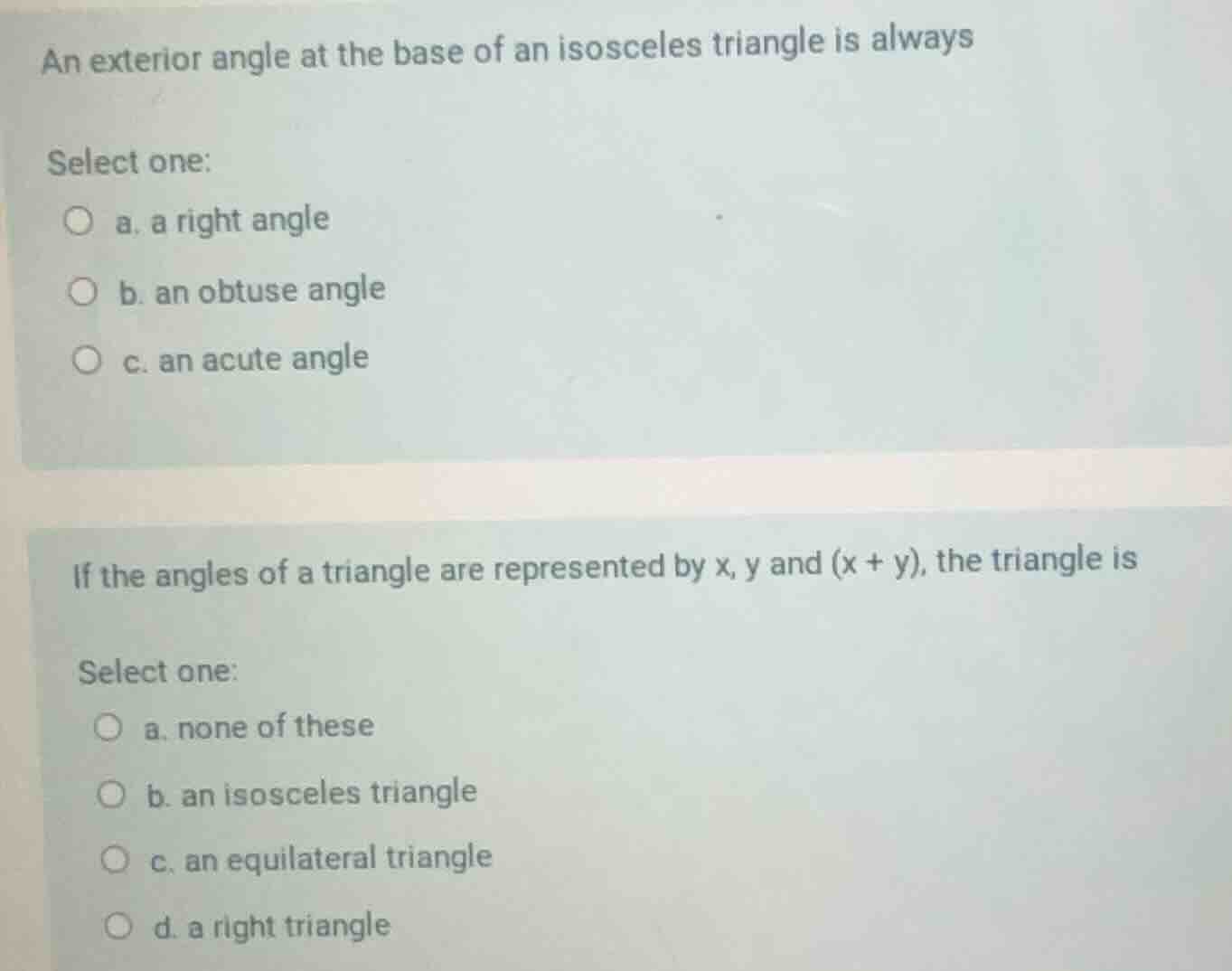
an exterior angle at the base of an isosceles triangle is always
select one:
a. a right angle
b. an obtuse angle
c. an acute angle
if the angles of a triangle are represented by x, y and (x + y), the triangle is
select one:
a. none of these
b. an isosceles triangle
c. an equilateral triangle
d. a right triangle
Step1: Analyze first triangle property
Let the base angles of the isosceles triangle be $\alpha$, so $\alpha < 90^\circ$ (since sum of triangle angles is $180^\circ$, two base angles can't be $\geq90^\circ$). The exterior angle at the base is $180^\circ - \alpha$. Since $\alpha < 90^\circ$, $180^\circ - \alpha > 90^\circ$, so it is obtuse.
Step2: Analyze second triangle angles
Sum of triangle angles is $180^\circ$. So $x + y + (x+y) = 180^\circ$. Simplify: $2(x+y)=180^\circ$, so $x+y=90^\circ$. One angle is $90^\circ$, so it is a right triangle.

Snap & solve any problem in the app
Get step-by-step solutions on Sovi AI
Photo-based solutions with guided steps
Explore more problems and detailed explanations
- b. an obtuse angle
- d. a right triangle