QUESTION IMAGE
Question
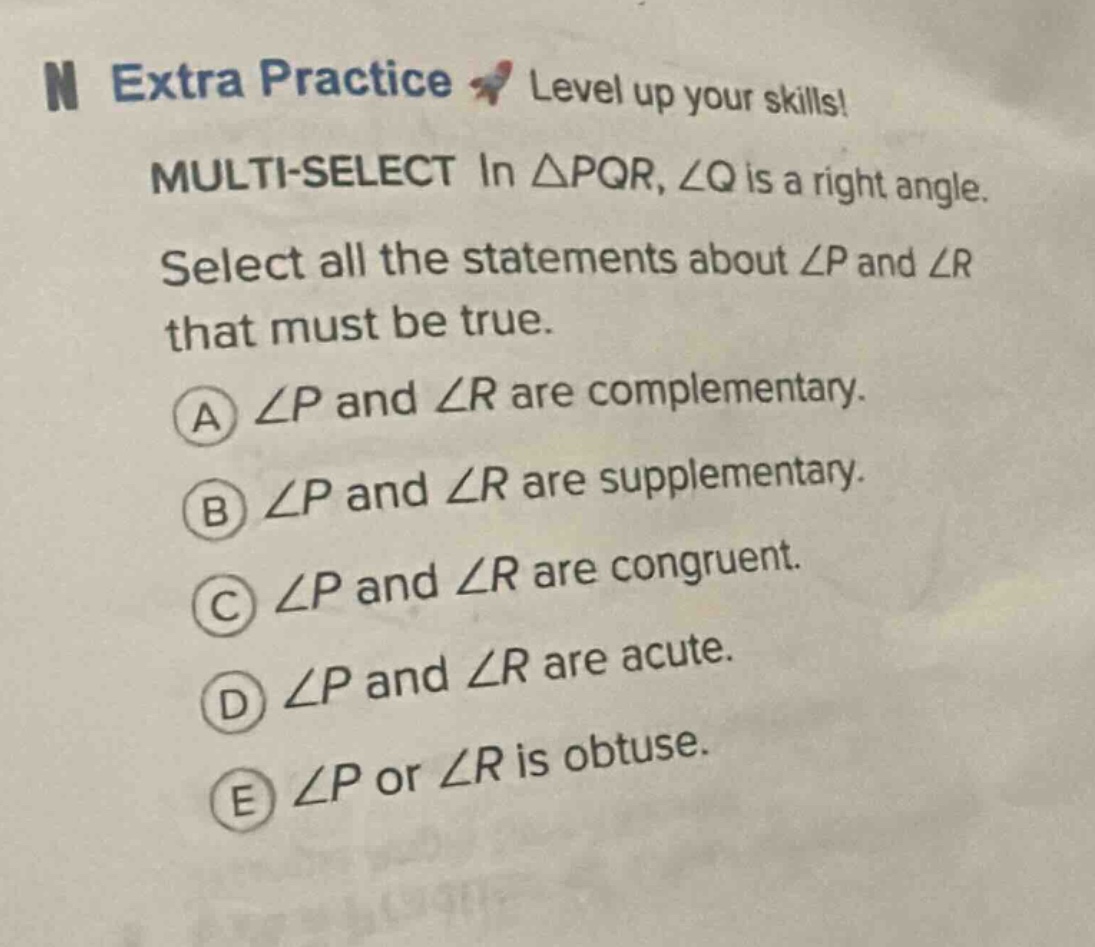
extra practice level up your skills!
multi-select in △pqr, ∠q is a right angle.
select all the statements about ∠p and ∠r
that must be true.
a ∠p and ∠r are complementary.
b ∠p and ∠r are supplementary.
c ∠p and ∠r are congruent.
d ∠p and ∠r are acute.
e ∠p or ∠r is obtuse.
Step1: Recall triangle angle sum
In any triangle, the sum of interior angles is \(180^\circ\). For \(\triangle PQR\), \(\angle Q = 90^\circ\), so \(\angle P+\angle Q+\angle R = 180^\circ\). Substituting \(\angle Q = 90^\circ\), we get \(\angle P+\angle R+90^\circ = 180^\circ\).
Step2: Analyze \(\angle P\) and \(\angle R\) sum
Simplify the equation: \(\angle P+\angle R=180^\circ - 90^\circ=90^\circ\).
- Complementary angles sum to \(90^\circ\), so \(\angle P\) and \(\angle R\) are complementary (A is true).
- Supplementary angles sum to \(180^\circ\), so B is false.
- Congruent angles have equal measure. There's no info that \(\angle P=\angle R\) (they sum to \(90^\circ\) but can be different, e.g., \(30^\circ\) and \(60^\circ\)), so C is false.
- Acute angles are less than \(90^\circ\). Since \(\angle P+\angle R = 90^\circ\), each must be less than \(90^\circ\) (D is true).
- Obtuse angles are greater than \(90^\circ\), but their sum is \(90^\circ\), so neither can be obtuse (E is false).

Snap & solve any problem in the app
Get step-by-step solutions on Sovi AI
Photo-based solutions with guided steps
Explore more problems and detailed explanations
A. \(\angle P\) and \(\angle R\) are complementary., D. \(\angle P\) and \(\angle R\) are acute.