QUESTION IMAGE
Question
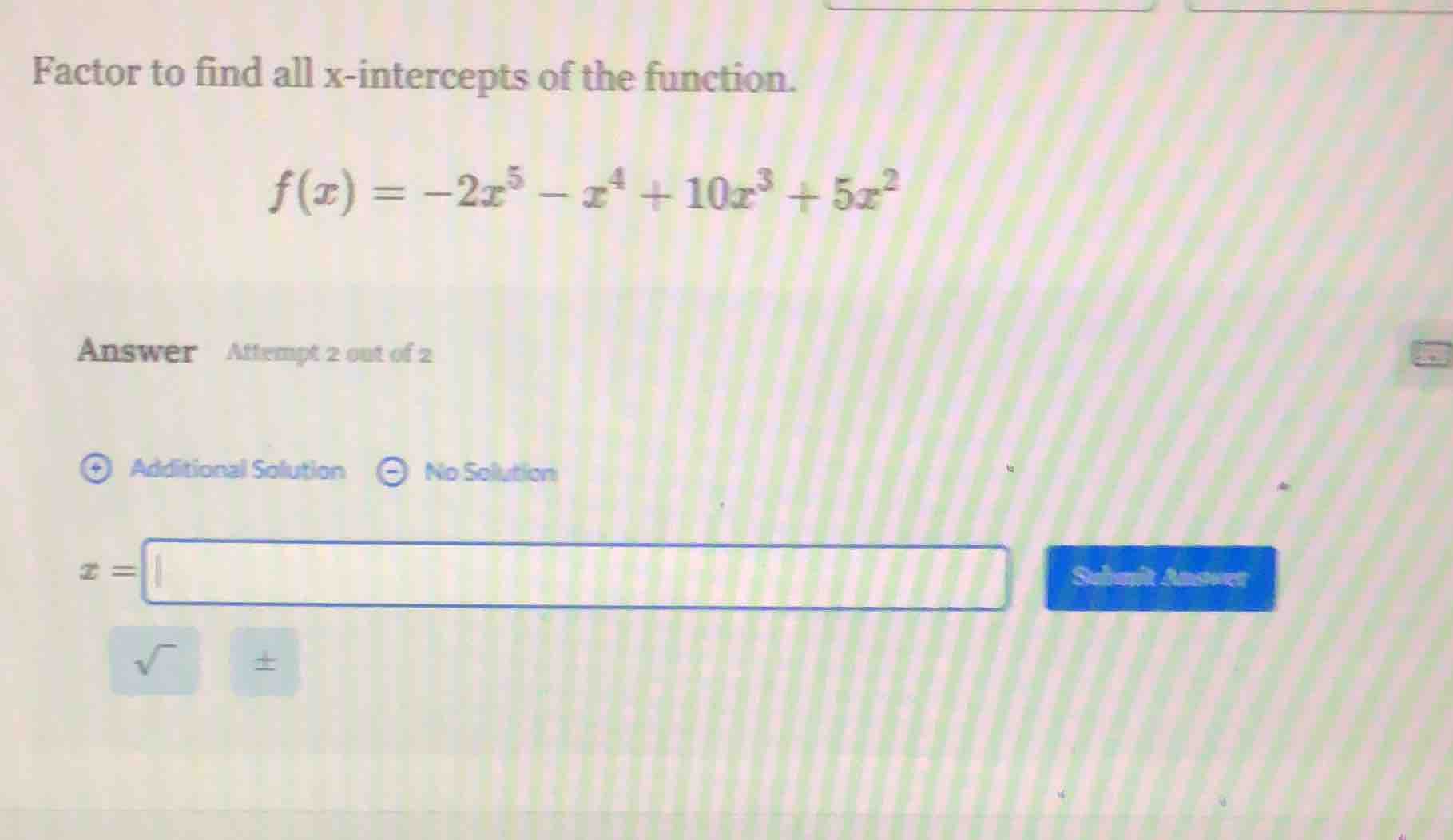
factor to find all x-intercepts of the function.\\(f(x) = -2x^5 - x^4 + 10x^3 + 5x^2\\)\
answer attempt 2 out of 2\
\\(\oplus\\) additional solution \\(\ominus\\) no solution\
\\(x = \square\\)\
\\(\sqrt{}\\) \\(\pm\\) \\(\text{submit answer}\\)
Step1: Factor out the GCF
First, factor out the greatest common factor (GCF) from the polynomial \( f(x) = -2x^5 - x^4 + 10x^3 + 5x^2 \). The GCF of the terms is \( -x^2 \) (we can also factor out \( x^2 \) first, but factoring out \( -x^2 \) might make the quadratic easier to factor later; alternatively, factor out \( x^2 \) first: \( f(x)=x^2(-2x^3 - x^2 + 10x + 5) \)). Wait, let's group the terms in the cubic part. Let's rewrite the polynomial as \( f(x)= -2x^5 - x^4 + 10x^3 + 5x^2 = -x^4(2x + 1) + 5x^2(2x + 1) \). Wait, actually, let's factor by grouping. Group the first two terms and the last two terms:
\( f(x)= (-2x^5 - x^4)+(10x^3 + 5x^2) \)
Factor out \( -x^4 \) from the first group and \( 5x^2 \) from the second group:
\( f(x)= -x^4(2x + 1) + 5x^2(2x + 1) \)
Now, factor out the common binomial factor \( (2x + 1) \):
\( f(x)= (2x + 1)(-x^4 + 5x^2) \)
Factor out \( -x^2 \) from the second factor:
\( f(x)= (2x + 1)(-x^2)(x^2 - 5) \)
Or, we can also factor out \( x^2 \) initially:
\( f(x)=x^2(-2x^3 - x^2 + 10x + 5) \)
Now, factor the cubic polynomial \( -2x^3 - x^2 + 10x + 5 \) by grouping. Group as \( (-2x^3 - x^2)+(10x + 5) \)
Factor out \( -x^2 \) from the first group and \( 5 \) from the second group:
\( -x^2(2x + 1) + 5(2x + 1) \)
Now, factor out \( (2x + 1) \):
\( (2x + 1)(-x^2 + 5) \)
So, putting it back with the \( x^2 \) we factored out initially:
\( f(x)=x^2(2x + 1)(-x^2 + 5) \)
We can rewrite \( -x^2 + 5 \) as \( 5 - x^2 \), which is a difference of squares: \( 5 - x^2 = (\sqrt{5} - x)(\sqrt{5} + x) \), but maybe we made a mistake in factoring. Wait, let's check the initial factoring again. Let's start over.
Given \( f(x) = -2x^5 - x^4 + 10x^3 + 5x^2 \)
Factor out \( -x^2 \) from all terms? Wait, no, the GCF of all terms is \( x^2 \) (since all terms have at least \( x^2 \)). Let's factor out \( x^2 \):
\( f(x) = x^2(-2x^3 - x^2 + 10x + 5) \)
Now, factor the cubic \( -2x^3 - x^2 + 10x + 5 \). Let's factor by grouping. Rearrange the terms: \( -2x^3 + 10x - x^2 + 5 \)
Group as \( (-2x^3 + 10x) + (-x^2 + 5) \)
Factor out \( -2x \) from the first group and \( -1 \) from the second group:
\( -2x(x^2 - 5) -1(x^2 - 5) \)
Now, factor out \( (x^2 - 5) \):
\( (x^2 - 5)(-2x - 1) \)
So, now the polynomial becomes:
\( f(x) = x^2(x^2 - 5)(-2x - 1) \)
We can factor out a negative sign from \( -2x -1 \) to get \( - (2x + 1) \), so:
\( f(x) = -x^2(x^2 - 5)(2x + 1) \)
Or, \( f(x) = x^2(5 - x^2)(2x + 1) \) (since \( - (x^2 - 5) = 5 - x^2 \))
Now, to find the x-intercepts, we set \( f(x) = 0 \):
\( x^2(2x + 1)(5 - x^2) = 0 \)
Set each factor equal to zero:
- \( x^2 = 0 \) gives \( x = 0 \) (double root)
- \( 2x + 1 = 0 \) gives \( x = -\frac{1}{2} \)
- \( 5 - x^2 = 0 \) gives \( x^2 = 5 \), so \( x = \sqrt{5} \) or \( x = -\sqrt{5} \)
So the x-intercepts are \( x = 0 \), \( x = -\frac{1}{2} \), \( x = \sqrt{5} \), and \( x = -\sqrt{5} \). But let's check the factoring again to make sure.
Wait, let's do the factoring step by step correctly:
Original function: \( f(x) = -2x^5 - x^4 + 10x^3 + 5x^2 \)
Factor out \( -x^2 \) from all terms? Wait, no, the coefficients are -2, -1, 10, 5. The GCF of the coefficients: GCF of 2,1,10,5 is 1, but the variable part is \( x^2 \) (since all terms have \( x^2 \) or higher). So factor out \( x^2 \):
\( f(x) = x^2(-2x^3 - x^2 + 10x + 5) \)
Now, factor the cubic \( -2x^3 - x^2 + 10x + 5 \). Let's use rational root theorem. Possible rational roots are \( \pm1, \pm5, \pm\frac{1}{2}, \pm\frac{5}{2} \). Let's test \( x = -\frac{1}{2} \):
\( -2(-\frac{1}{2})^3 - (-…

Snap & solve any problem in the app
Get step-by-step solutions on Sovi AI
Photo-based solutions with guided steps
Explore more problems and detailed explanations
The x-intercepts are \( x = 0 \), \( x = -\frac{1}{2} \), \( x = \sqrt{5} \), and \( x = -\sqrt{5} \). If we need to write them in the box (assuming multiple answers are allowed, maybe separated by commas), the answers are \( x = 0 \), \( x = -\frac{1}{2} \), \( x = \sqrt{5} \), \( x = -\sqrt{5} \). But let's confirm the factoring:
\( f(x) = x^2(2x + 1)(5 - x^2) = 0 \)
Solutions:
- \( x^2 = 0 \) ⇒ \( x = 0 \)
- \( 2x + 1 = 0 \) ⇒ \( x = -\frac{1}{2} \)
- \( 5 - x^2 = 0 \) ⇒ \( x = \pm\sqrt{5} \)
So the x-intercepts are \( 0 \), \( -\frac{1}{2} \), \( \sqrt{5} \), and \( -\sqrt{5} \).