QUESTION IMAGE
Question
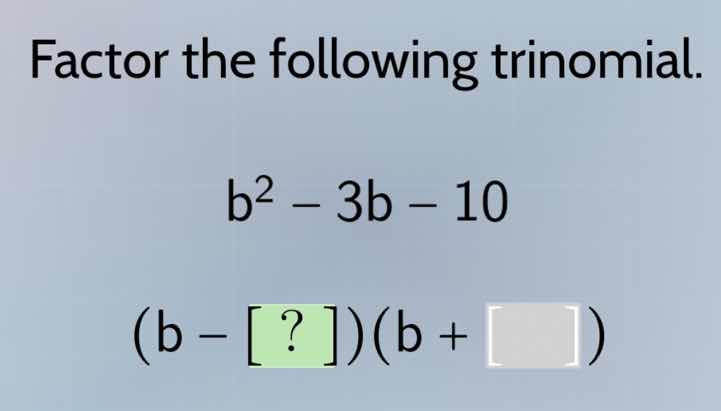
factor the following trinomial.
b² − 3b − 10
(b − ?)(b + )
Step 1: Identify the form of factoring
We need to factor the trinomial \(b^2 - 3b - 10\) into the form \((b - m)(b + n)\), where \(m\) and \(n\) are integers. When we expand \((b - m)(b + n)\), we get \(b^2+(n - m)b - mn\). Comparing this with \(b^2 - 3b - 10\), we have two equations: \(n - m=- 3\) and \(mn = 10\).
Step 2: Find integers m and n
We need to find two integers \(m\) and \(n\) such that their product is \(10\) and their difference (\(n - m\)) is \(-3\). Let's list the factor pairs of \(10\): \((1,10)\), \((2,5)\), \((-1,-10)\), \((-2,-5)\).
- For the pair \((2,5)\): If \(m = 5\) and \(n=-2\) (since we need \(n - m=-3\), let's check \(n - m=-2 - 5=-7
eq - 3\)). Wait, if we take \(m = 5\) and \(n = 2\), then \(n - m=2 - 5=-3\) and \(mn=5\times2 = 10\). Perfect!
Step 3: Substitute m and n into the factors
So, \(m = 5\) and \(n=-2\). So the factored form is \((b - 5)(b+(- 2))=(b - 5)(b - 2)\)? Wait, no, wait. Wait the form is \((b - m)(b + n)\). Wait, let's re - check. Wait, when we have \((b - m)(b + n)=b^2+(n - m)b - mn\). We have \(b^2-3b - 10\), so \(n - m=-3\) and \(mn = 10\). Let's solve for \(m\) and \(n\) from \(n=m - 3\). Substitute into \(mn = 10\): \(m(m - 3)=10\), \(m^2-3m - 10 = 0\). Factoring this quadratic: \(m^2-3m - 10=(m - 5)(m + 2)=0\). So \(m = 5\) or \(m=-2\). If \(m = 5\), then \(n=5 - 3 = 2\)? Wait no, wait \(n - m=-3\) so \(n=m - 3\). If \(m = 5\), \(n=5-3 = 2\)? But then \(mn=5\times2 = 10\). But then \((b - m)(b + n)=(b - 5)(b + 2)\). Wait, but when we expand \((b - 5)(b + 2)=b^2+2b-5b - 10=b^2-3b - 10\), which is correct. Wait, the original form was \((b - [?])(b + [\square])\). So if we have \((b - 5)(b + 2)\), then the first blank is \(5\) and the second is \(2\). Wait, maybe I made a mistake in the sign earlier. Let's re - do the expansion. \((b - m)(b + n)=b^2+nb - mb - mn=b^2+(n - m)b - mn\). We have \(b^2-3b - 10\), so \(n - m=-3\) and \(-mn=-10\) (since the constant term is \(-10\)), so \(mn = 10\). So we need two numbers that multiply to \(10\) and add up to \(-3\) (wait, no: \(n - m=-3\), so \(n=m - 3\). And \(mn = 10\). So substituting \(n=m - 3\) into \(mn = 10\) gives \(m(m - 3)=10\), \(m^2-3m - 10 = 0\). Factoring: \(m^2-3m - 10=(m - 5)(m + 2)=0\), so \(m = 5\) or \(m=-2\). If \(m = 5\), then \(n=5 - 3 = 2\). Then \((b - 5)(b + 2)=b^2+2b-5b - 10=b^2-3b - 10\), which is correct. So the first blank (the one in \(b - [?]\)) is \(5\) and the second blank (in \(b + [\square]\)) is \(2\).

Snap & solve any problem in the app
Get step-by-step solutions on Sovi AI
Photo-based solutions with guided steps
Explore more problems and detailed explanations
The first blank (the green one) is \(5\) and the second blank (the white one) is \(2\). So the factored form is \((b - 5)(b + 2)\), so the value in the green box is \(5\) and the value in the white box is \(2\).