QUESTION IMAGE
Question
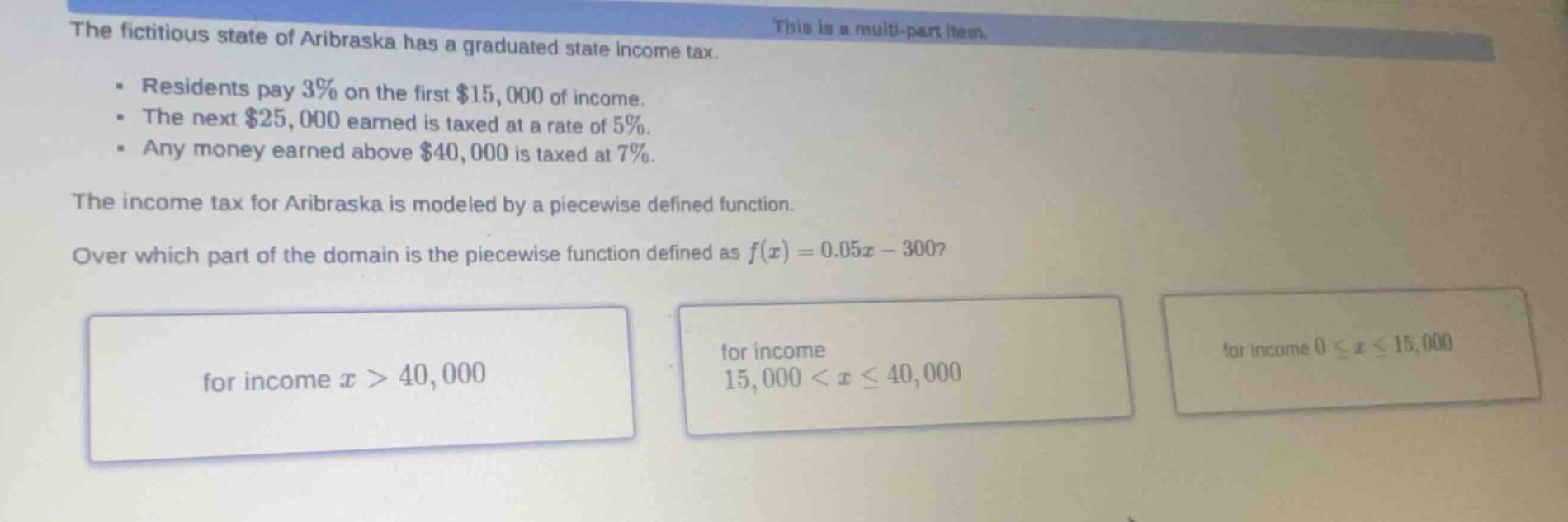
the fictitious state of aribraska has a graduated state income tax.
- residents pay 3% on the first $15,000 of income.
- the next $25,000 earned is taxed at a rate of 5%.
- any money earned above $40,000 is taxed at 7%.
the income tax for aribraska is modeled by a piecewise defined function.
over which part of the domain is the piecewise function defined as $f(x) = 0.05x - 300$?
options:
- for income $x > 40,000$
- for income $15,000 < x \leq 40,000$
- for income $0 \leq x \leq 15,000$
Step1: Calculate tax for first bracket
Tax for $0 \leq x \leq 15,000$: $f(x) = 0.03x$
Step2: Derive tax for second bracket
For $15,000 < x \leq 40,000$, total tax = tax on first $15,000$ + tax on amount over $15,000$
$f(x) = 0.03(15000) + 0.05(x - 15000)$
Simplify: $f(x) = 450 + 0.05x - 750 = 0.05x - 300$
Step3: Verify third bracket tax
For $x > 40,000$, total tax = tax on first $40,000$ + tax on amount over $40,000$
Tax on first $40,000$: $0.03(15000) + 0.05(25000) = 450 + 1250 = 1700$
$f(x) = 1700 + 0.07(x - 40000) = 0.07x - 2800 + 1700 = 0.07x - 1100$

Snap & solve any problem in the app
Get step-by-step solutions on Sovi AI
Photo-based solutions with guided steps
Explore more problems and detailed explanations
for income $15,000 < x \leq 40,000$