QUESTION IMAGE
Question
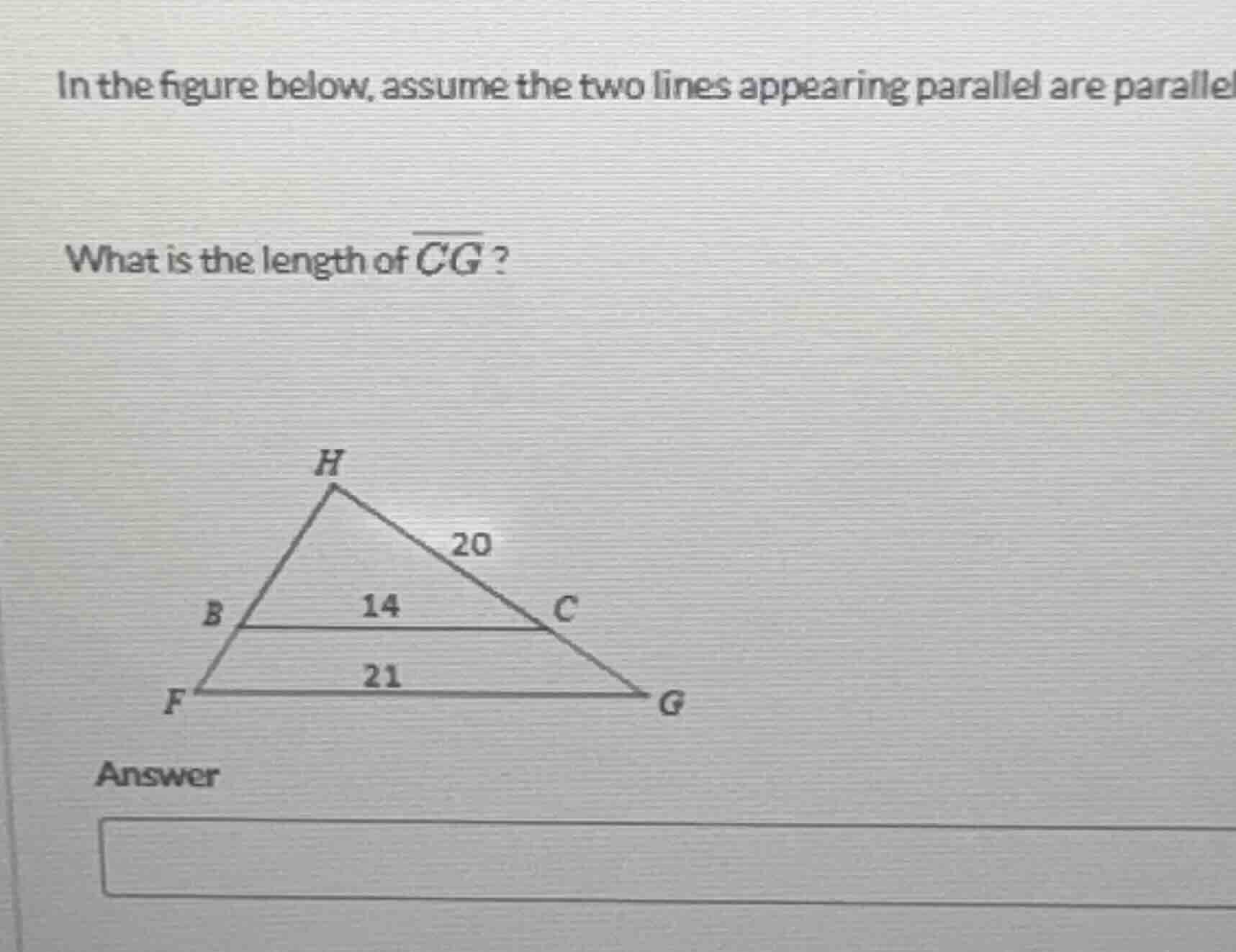
in the figure below, assume the two lines appearing parallel are parallel. what is the length of \\(\overline{cg}\\)?
Step1: Identify Similar Triangles
Since \( BC \parallel FG \), triangles \( HBC \) and \( HFG \) are similar by the Basic Proportionality Theorem (Thales' theorem). For similar triangles, the ratios of corresponding sides are equal. Let \( CG = x \), then \( HG=HC + CG=20 + x \). The ratio of \( BC \) to \( FG \) should equal the ratio of \( HC \) to \( HG \). So, \(\frac{BC}{FG}=\frac{HC}{HG}\).
Step2: Substitute Values
We know \( BC = 14 \), \( FG = 21 \), \( HC = 20 \), and \( HG=20 + x \). Substituting these values into the proportion: \(\frac{14}{21}=\frac{20}{20 + x}\). Simplify \(\frac{14}{21}\) to \(\frac{2}{3}\), so we have \(\frac{2}{3}=\frac{20}{20 + x}\).
Step3: Cross - Multiply and Solve
Cross - multiplying gives \( 2(20 + x)=3\times20 \). Expand the left side: \( 40+2x = 60 \). Subtract 40 from both sides: \( 2x=60 - 40=20 \). Divide both sides by 2: \( x = 10 \).

Snap & solve any problem in the app
Get step-by-step solutions on Sovi AI
Photo-based solutions with guided steps
Explore more problems and detailed explanations
The length of \(\overline{CG}\) is 10.