QUESTION IMAGE
Question
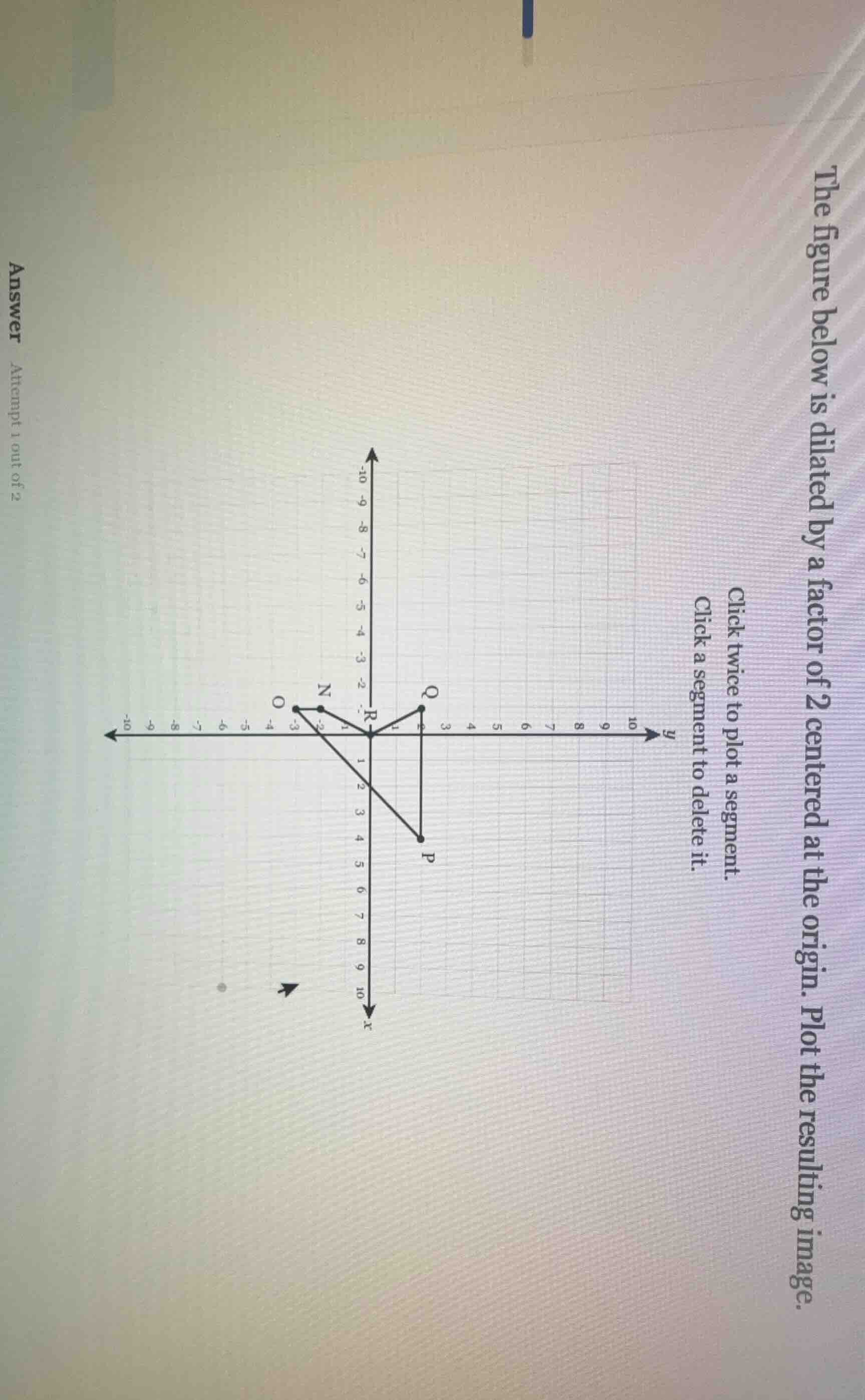
the figure below is dilated by a factor of 2 centered at the origin. plot the resulting image.
click twice to plot a segment.
click a segment to delete it.
Step1: Identify coordinates of original points
First, we find the coordinates of points \( Q \), \( P \), \( R \), \( N \), \( O \) from the graph.
- \( Q \): \( (1, 2) \) (Wait, looking at the graph, let's re - check. Wait, the x - axis and y - axis: Let's assume the origin is \( R(0,0) \)? Wait, no, the graph has \( R \) at (0,0), \( Q \) at (1, 2)? Wait, no, maybe I misread. Wait, the x - axis is vertical? Wait, no, the standard coordinate system: x - axis horizontal, y - axis vertical. Wait, in the given graph, the x - axis is the vertical axis (labeled x) and y - axis is horizontal (labeled y). So we need to swap the coordinates. Let's re - define:
Let's take the horizontal axis as y - axis and vertical as x - axis. So for a point, the first coordinate is x (vertical), second is y (horizontal).
- \( Q \): x = 1, y = 2 (so coordinates \( (1, 2) \) in (x,y) where x is vertical, y is horizontal)
- \( P \): x = 4, y = 2 (coordinates \( (4, 2) \))
- \( R \): \( (0, 0) \)
- \( N \): x=-2, y = - 2 (coordinates \( (-2,-2) \))
- \( O \): x=-3, y=-3 (coordinates \( (-3,-3) \))
Step2: Apply dilation factor 2 centered at origin
The rule for dilation centered at the origin with factor \( k \) is \( (x,y)\to(kx,ky) \).
- For \( Q(1,2) \): New coordinates \( (1\times2,2\times2)=(2,4) \)
- For \( P(4,2) \): New coordinates \( (4\times2,2\times2)=(8,4) \)
- For \( R(0,0) \): New coordinates \( (0\times2,0\times2)=(0,0) \)
- For \( N(-2,-2) \): New coordinates \( (-2\times2,-2\times2)=(-4,-4) \)
- For \( O(-3,-3) \): New coordinates \( (-3\times2,-3\times2)=(-6,-6) \)
Step3: Plot the new points
Now, we plot the points \( (2,4) \) (new \( Q' \)), \( (8,4) \) (new \( P' \)), \( (0,0) \) (new \( R' \)), \( (-4,-4) \) (new \( N' \)), \( (-6,-6) \) (new \( O' \)) and connect the segments as in the original figure.
(Note: Since this is a plotting problem, the key is to find the new coordinates by multiplying each coordinate of the original points by 2 (dilation factor) and then plot them. )

Snap & solve any problem in the app
Get step-by-step solutions on Sovi AI
Photo-based solutions with guided steps
Explore more problems and detailed explanations
To solve the dilation of the figure by a factor of 2 centered at the origin, follow these steps:
Step 1: Identify Original Coordinates (with x as vertical, y as horizontal axis)
- \( Q(1, 2) \)
- \( P(4, 2) \)
- \( R(0, 0) \)
- \( N(-2, -2) \)
- \( O(-3, -3) \)
Step 2: Apply Dilation Rule (\((x,y)\to(2x,2y)\))
- \( Q'=(1\times2,2\times2)=(2,4) \)
- \( P'=(4\times2,2\times2)=(8,4) \)
- \( R'=(0\times2,0\times2)=(0,0) \)
- \( N'=(-2\times2,-2\times2)=(-4,-4) \)
- \( O'=(-3\times2,-3\times2)=(-6,-6) \)
Step 3: Plot the New Points
Plot the points \( Q'(2,4) \), \( P'(8,4) \), \( R'(0,0) \), \( N'(-4,-4) \), \( O'(-6,-6) \) and connect the segments in the same order as the original figure.