QUESTION IMAGE
Question
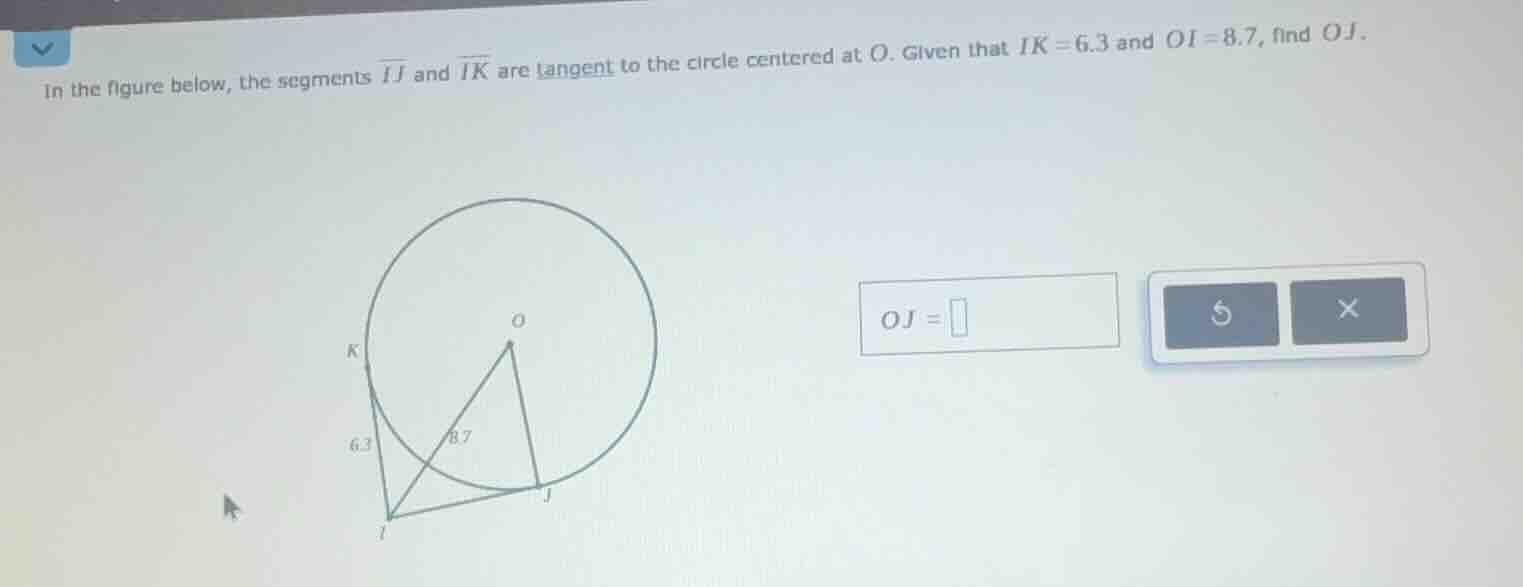
in the figure below, the segments (overline{ij}) and (overline{ik}) are tangent to the circle centered at (o). given that (ik = 6.3) and (oi = 8.7), find (oj).
Step1: Recall tangent - radius property
A tangent to a circle is perpendicular to the radius at the point of tangency. So, \(OK\perp IK\) and \(OJ\perp IJ\). Also, since \(IJ\) and \(IK\) are both tangents from the same external point \(I\) to the circle centered at \(O\), we know that \(IK = IJ\) and \(OK=OJ\) (radii of the same circle). Triangle \(OKI\) is a right - triangle with right angle at \(K\).
Step2: Apply Pythagorean theorem
In right - triangle \(OKI\), we know that \(OI\) is the hypotenuse, \(IK\) is one leg, and \(OK\) (which is equal to \(OJ\)) is the other leg. By the Pythagorean theorem, for a right - triangle with hypotenuse \(c\) and legs \(a\) and \(b\), \(c^{2}=a^{2}+b^{2}\). Here, \(c = OI = 8.7\), \(a=IK = 6.3\), and \(b = OK=OJ\). So we can solve for \(b\) using the formula \(b=\sqrt{c^{2}-a^{2}}\).
Substitute \(c = 8.7\) and \(a = 6.3\) into the formula:
First, calculate \(c^{2}=(8.7)^{2}=75.69\) and \(a^{2}=(6.3)^{2}=39.69\).
Then, \(c^{2}-a^{2}=75.69 - 39.69=36\).
Now, \(b=\sqrt{36}=6\). Since \(OJ = OK=b\), we have \(OJ = 6\).

Snap & solve any problem in the app
Get step-by-step solutions on Sovi AI
Photo-based solutions with guided steps
Explore more problems and detailed explanations
\(6\)