QUESTION IMAGE
Question
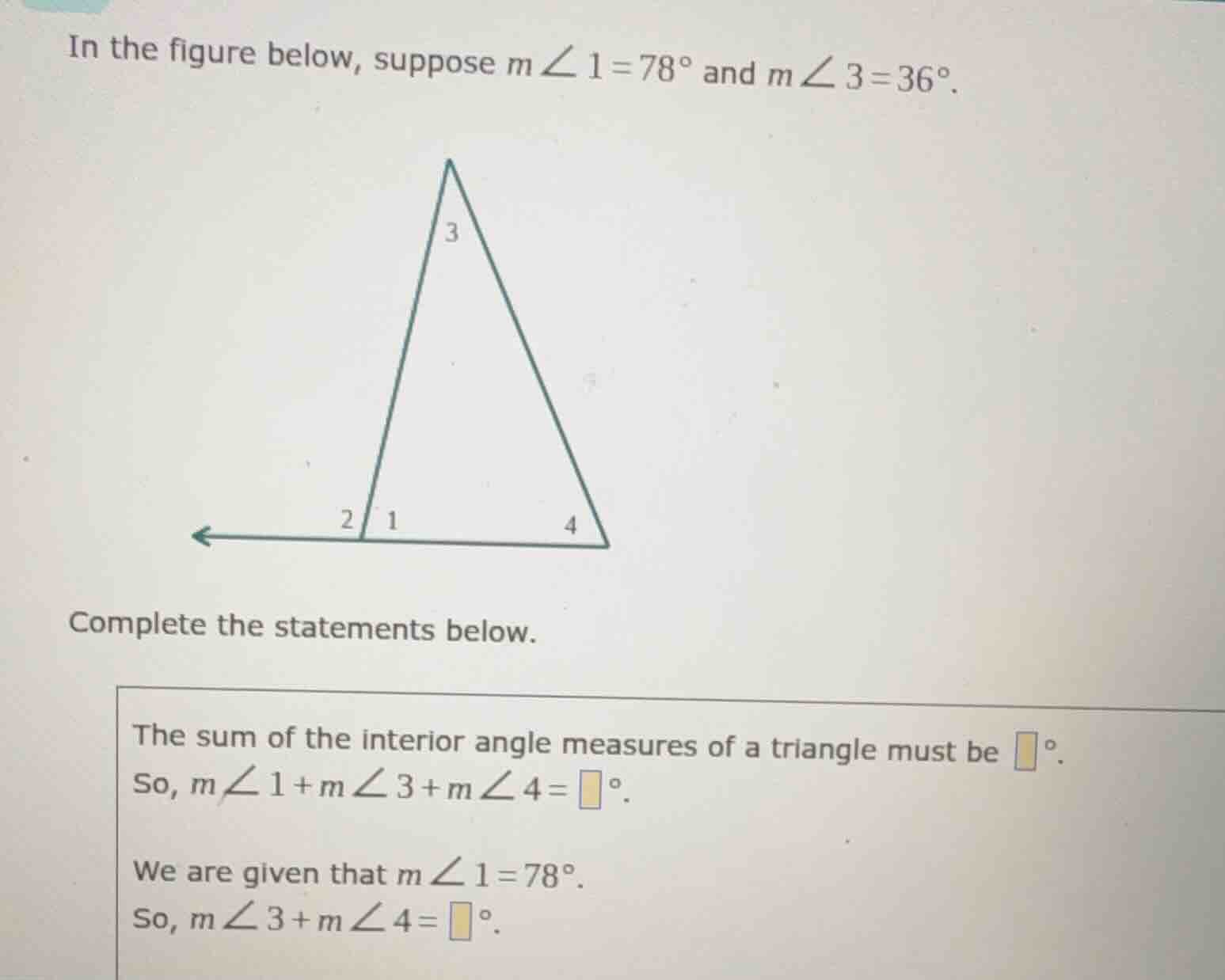
in the figure below, suppose ( mangle1 = 78^circ ) and ( mangle3 = 36^circ ).
complete the statements below.
the sum of the interior angle measures of a triangle must be (square^circ).
so, ( mangle1 + mangle3 + mangle4 = square^circ ).
we are given that ( mangle1 = 78^circ ).
so, ( mangle3 + mangle4 = square^circ ).
Step1: Recall triangle angle sum
The sum of interior angles of a triangle is \(180^\circ\). So, \(m\angle1 + m\angle3 + m\angle4 = 180^\circ\).
Step2: Substitute known angle
Given \(m\angle1 = 78^\circ\) and \(m\angle3 = 36^\circ\), substitute into the sum: \(78^\circ + 36^\circ + m\angle4 = 180^\circ\), but for \(m\angle3 + m\angle4\), we use \(180^\circ - m\angle1\). So \(m\angle3 + m\angle4 = 180^\circ - 78^\circ = 102^\circ\). Wait, no, first part: sum of triangle angles is \(180\), so first blank \(180\), second blank \(180\), third blank: \(180 - 78 = 102\)? Wait, no, let's re - check.
Wait, the first statement: "The sum of the interior angle measures of a triangle must be \(\square^\circ\)." By triangle angle sum theorem, it's \(180\). So first blank \(180\). Then "So, \(m\angle1 + m\angle3 + m\angle4=\square^\circ\)." Since they are interior angles of a triangle, it's also \(180\). Then "We are given that \(m\angle1 = 78^\circ\). So, \(m\angle3 + m\angle4=\square^\circ\)." Using \(m\angle1 + m\angle3 + m\angle4 = 180^\circ\), subtract \(m\angle1\) from both sides: \(m\angle3 + m\angle4=180^\circ - 78^\circ = 102^\circ\). Wait, but also we know \(m\angle3 = 36^\circ\), so \(36^\circ + m\angle4=102^\circ\), but the question here is about \(m\angle3 + m\angle4\), so using the triangle sum.
So step by step:
- Triangle angle sum is \(180^\circ\). So first blank: \(180\).
- So \(m\angle1 + m\angle3 + m\angle4 = 180^\circ\). Second blank: \(180\).
- Given \(m\angle1 = 78^\circ\), then \(m\angle3 + m\angle4=180^\circ - 78^\circ = 102^\circ\). Third blank: \(102\).
Wait, but let's confirm. The triangle angle sum theorem states that the sum of the interior angles of a triangle is \(180\) degrees. So \(\angle1\), \(\angle3\), \(\angle4\) are the three interior angles of the triangle (from the figure, \(\angle1\) is at the base, \(\angle3\) at the top, \(\angle4\) at the other base). So their sum is \(180\). Then, to find \(m\angle3 + m\angle4\), we subtract \(m\angle1\) from \(180\), so \(180 - 78 = 102\).

Snap & solve any problem in the app
Get step-by-step solutions on Sovi AI
Photo-based solutions with guided steps
Explore more problems and detailed explanations
The first blank: \(180\), the second blank: \(180\), the third blank: \(102\)
(If we consider the blanks in order:
- The sum of the interior angle measures of a triangle must be \(\boldsymbol{180}^\circ\).
- So, \(m\angle1 + m\angle3 + m\angle4=\boldsymbol{180}^\circ\).
- We are given that \(m\angle1 = 78^\circ\). So, \(m\angle3 + m\angle4=\boldsymbol{102}^\circ\).)