QUESTION IMAGE
Question
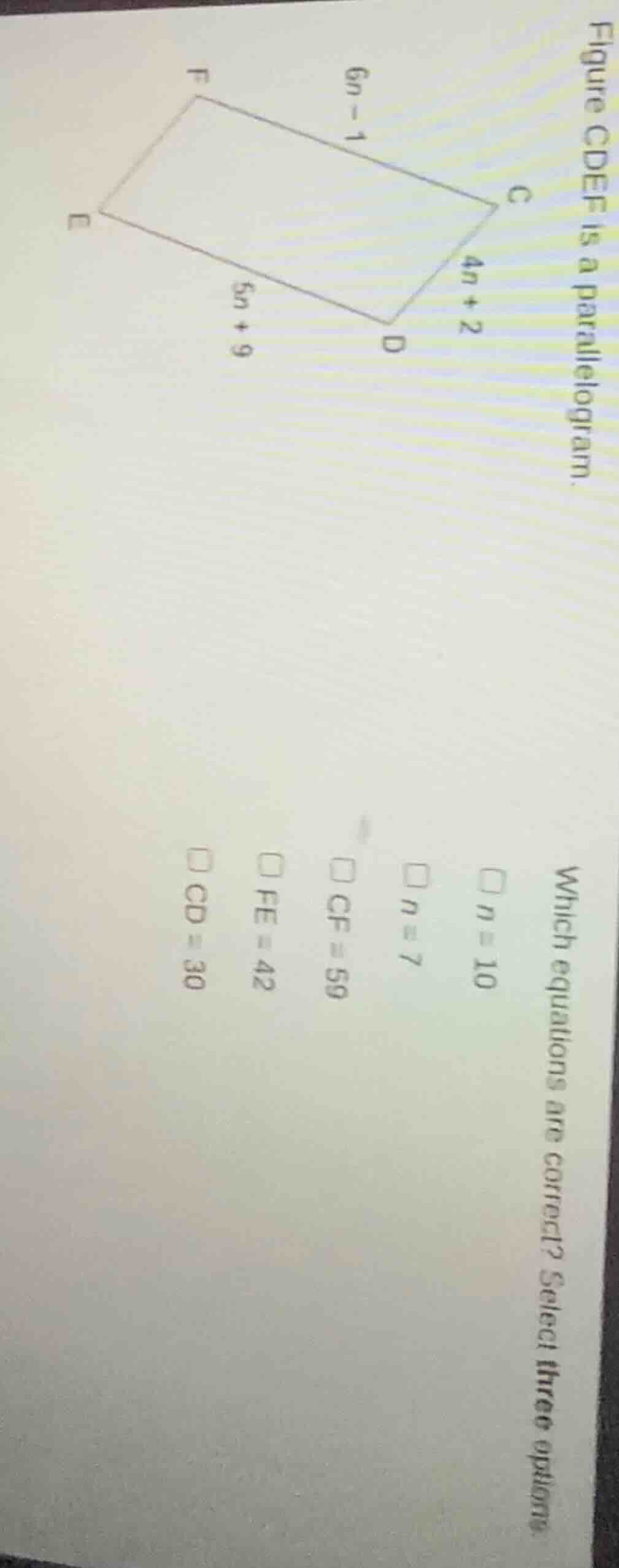
figure cdef is a parallelogram.
which equations are correct? select three options.
□ n = 10
□ n = 7
□ cf = 59
□ fe = 42
□ cd = 30
Step1: Recall properties of parallelograms
In a parallelogram, opposite sides are equal. So, \( CF = DE \) and \( CD = FE \), also \( CF = 6n - 1 \), \( DE = 5n + 9 \), \( CD = 4n + 2 \), \( FE = 6n - 1 \)? Wait, no, looking at the figure, \( CF \) and \( DE \) are opposite sides, \( CD \) and \( FE \) are opposite sides. So \( CF = DE \) (since \( CF = 6n - 1 \), \( DE = 5n + 9 \)) and \( CD = FE \) ( \( CD = 4n + 2 \), \( FE \) should be equal to \( CD \) or \( CF \)? Wait, let's correct: In parallelogram \( CDEF \), opposite sides are equal. So \( CD = FE \) and \( CF = DE \). So \( CD = 4n + 2 \), \( FE \) is... Wait, the sides: \( CF = 6n - 1 \), \( DE = 5n + 9 \), so \( CF = DE \) (opposite sides). So set \( 6n - 1 = 5n + 9 \).
Step2: Solve for \( n \)
\( 6n - 1 = 5n + 9 \)
Subtract \( 5n \) from both sides: \( 6n - 5n - 1 = 9 \)
\( n - 1 = 9 \)
Add 1 to both sides: \( n = 10 \)? Wait, no: \( 6n - 5n = 9 + 1 \) → \( n = 10 \)? Wait, \( 6n -1 =5n +9 \) → \( n = 10 \). Wait, but let's check the other option \( n =7 \). Wait, maybe I mixed up the sides. Wait, maybe \( CD \) and \( FE \) are opposite, and \( CF \) and \( DE \) are opposite. Wait, the labels: \( CDEF \), so vertices are \( C, D, E, F \), so sides: \( CD \), \( DE \), \( EF \), \( FC \). So \( CD \parallel EF \) and \( CD = EF \); \( DE \parallel FC \) and \( DE = FC \). So \( CD = 4n + 2 \), \( EF = \)? Wait, the side \( EF \) is labeled as... Wait, the figure has \( CD = 4n + 2 \), \( CF = 6n -1 \), \( DE = 5n +9 \), \( FE \) is... Wait, maybe \( CD = FE \) and \( CF = DE \). So \( CD = 4n + 2 \), \( FE \) should be equal to \( CD \), and \( CF = 6n -1 \), \( DE = 5n +9 \), so \( CF = DE \) → \( 6n -1 = 5n +9 \). Solving: \( 6n -5n = 9 +1 \) → \( n =10 \). Wait, but let's check \( n =7 \): if \( n=7 \), \( 6n -1 =41 \), \( 5n +9=44 \), not equal. If \( n=10 \), \( 6n -1=59 \), \( 5n +9=59 \), so that works. Then \( CD =4n +2 =4*10 +2=42 \)? Wait, no, \( CD =4n +2 \), if \( n=10 \), \( CD=42 \), but \( FE \) should be equal to \( CD \), so \( FE=42 \). Wait, but the options: \( FE=42 \) is an option. Also, \( CF=6n -1=59 \) (since \( n=10 \), \( 6*10 -1=59 \)), so \( CF=59 \) is an option. Also, \( n=10 \) is an option. Wait, but let's check \( n=7 \): \( 6*7 -1=41 \), \( 5*7 +9=44 \), not equal. So \( n=10 \) is correct. Then \( CD=4n +2=4*10 +2=42 \)? Wait, no, the option \( CD=30 \): if \( n=7 \), \( CD=4*7 +2=30 \), so \( CD=30 \) when \( n=7 \). Wait, maybe I mixed up the opposite sides. Let's re-express: Maybe \( CD \) and \( FE \) are opposite, and \( CF \) and \( DE \) are opposite. Wait, maybe the sides: \( CD = 4n +2 \), \( FE = 6n -1 \) (opposite), and \( CF = 6n -1 \)? No, the labels: \( CF \) is from \( C \) to \( F \), \( DE \) is from \( D \) to \( E \), so \( CF \parallel DE \) and \( CF = DE \). \( CD \) is from \( C \) to \( D \), \( FE \) is from \( F \) to \( E \), so \( CD \parallel FE \) and \( CD = FE \). So \( CD = FE \) → \( 4n + 2 = 6n -1 \) (if \( FE = 6n -1 \))? Wait, that would be another equation. Let's check both possibilities.
Case 1: \( CF = DE \) ( \( CF = 6n -1 \), \( DE = 5n +9 \) )
\( 6n -1 = 5n +9 \) → \( n=10 \)
Then \( CD =4n +2=42 \), \( FE = CD=42 \) (since \( CD=FE \)), \( CF=6n -1=59 \), \( DE=5n +9=59 \). So options: \( n=10 \), \( FE=42 \), \( CF=59 \).
Case 2: \( CD = FE \) ( \( CD=4n +2 \), \( FE=6n -1 \) )
\( 4n +2 =6n -1 \) → \( -2n = -3 \) → \( n=1.5 \), which is not an option (options are \( n=10 \), \( n=7 \)). So Case 1 is correct.
Now check \( n=7 \): If \( n=7 \), \( CD=4*7 +2=30 \), then \( FE \) sho…

Snap & solve any problem in the app
Get step-by-step solutions on Sovi AI
Photo-based solutions with guided steps
Explore more problems and detailed explanations
n = 10, FE = 42, CF = 59 (the options corresponding to these are the correct ones: n = 10, FE = 42, CF = 59)