QUESTION IMAGE
Question
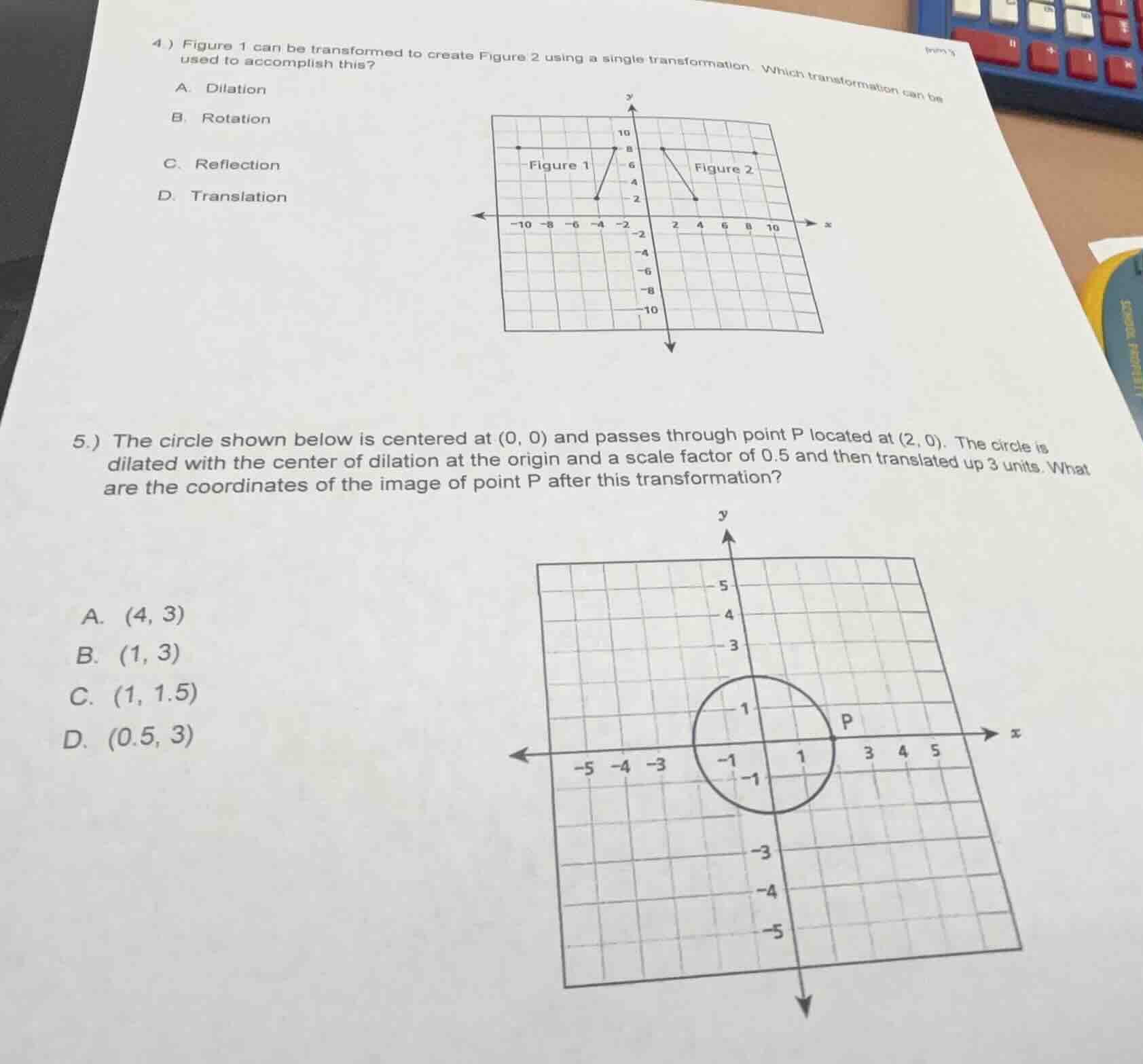
4 ) figure 1 can be transformed to create figure 2 using a single transformation. which transformation can be used to accomplish this?
a. dilation
b. rotation
c. reflection
d. translation
5.) the circle shown below is centered at (0, 0) and passes through point p located at (2, 0). the circle is dilated with the center of dilation at the origin and a scale factor of 0.5 and then translated up 3 units. what are the coordinates of the image of point p after this transformation?
a. (4, 3)
b. (1, 3)
c. (1, 1.5)
d. (0.5, 3)
Question 4
To determine the transformation from Figure 1 to Figure 2, we analyze each option:
- Dilation: Changes size, but both figures appear same size. Eliminate A.
- Rotation: Would involve turning around a point, but the figures are mirror - like across the y - axis. Eliminate B.
- Reflection: A reflection over the y - axis would map Figure 1 to Figure 2, as the shape is mirrored across the vertical line \(x = 0\) (the y - axis).
- Translation: Moves the figure without changing orientation or flipping, but these figures are flipped. Eliminate D.
Step1: Apply Dilation
The center of dilation is the origin \((0,0)\) and the scale factor is \(0.5\). For a point \((x,y)\) under dilation with scale factor \(k\) centered at the origin, the new coordinates are \((kx,ky)\). The original point \(P\) is \((2,0)\), so after dilation, the coordinates become \((2\times0.5,0\times0.5)=(1,0)\).
Step2: Apply Translation
We translate the point up 3 units. When translating a point \((x,y)\) up \(n\) units, the new \(y\) - coordinate is \(y + n\) and the \(x\) - coordinate remains the same. So for the point \((1,0)\), after translating up 3 units, the new coordinates are \((1,0 + 3)=(1,3)\).

Snap & solve any problem in the app
Get step-by-step solutions on Sovi AI
Photo-based solutions with guided steps
Explore more problems and detailed explanations
C. Reflection