QUESTION IMAGE
Question
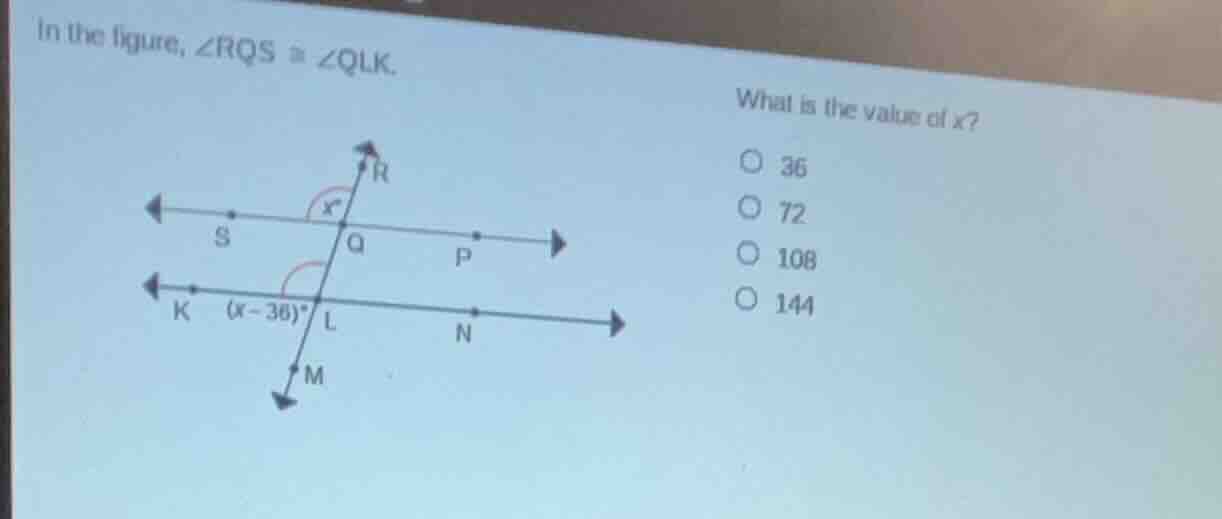
in the figure, $\angle rqs \cong \angle qlk$. what is the value of $x$? \bigcirc 36 \bigcirc 72 \bigcirc 108 \bigcirc 144
Step1: Identify the relationship
Since \( \angle RQS \cong \angle QLK \), the lines \( SP \) and \( KN \) are parallel (by the converse of the corresponding angles theorem), and the transversal is \( RM \). Also, \( \angle RQS = x \) and \( \angle QLK=(x - 36)^\circ \), but wait, actually, \( \angle RQS \) and the angle adjacent to \( \angle QLK \) (linear pair) might be supplementary? Wait, no, let's re - examine. Wait, \( \angle RQS \) and \( \angle QLK \) are equal, and also, \( \angle RQS \) and the angle \( (x - 36)^\circ \) form a linear pair? Wait, no, looking at the diagram, \( \angle RQS=x \) and the angle at \( L \) is \( (x - 36)^\circ \), but since \( \angle RQS\cong\angle QLK \), and also, \( \angle RQS \) and the angle supplementary to \( (x - 36)^\circ \)? Wait, no, maybe I made a mistake. Wait, actually, \( \angle RQS \) and \( \angle QLK \) are equal, and also, \( \angle RQS \) and the angle \( (x - 36)^\circ \) are same - side interior angles? No, wait, let's think again. Since \( \angle RQS\cong\angle QLK \), and if we consider the lines \( SP \) and \( KN \) cut by transversal \( RM \), then \( \angle RQS \) and \( \angle QLN \) would be corresponding angles, but here \( \angle QLK=(x - 36)^\circ \), and \( \angle QLK \) and \( \angle QLN \) are supplementary (linear pair). Wait, maybe the correct relationship is that \( x+(x - 36)=180 \)? Wait, no, because \( \angle RQS\cong\angle QLK \), so \( x=(x - 36) \)? No, that can't be. Wait, I think I misread the diagram. Wait, the angle at \( Q \) is \( x \), and the angle at \( L \) is \( (x - 36)^\circ \), and since \( \angle RQS\cong\angle QLK \), and also, \( \angle RQS \) and the angle \( (x - 36)^\circ \) are supplementary? Wait, no, let's start over.
Wait, the problem says \( \angle RQS\cong\angle QLK \). So \( \angle RQS = \angle QLK \). But also, \( \angle RQS \) and the angle adjacent to \( \angle QLK \) (let's call it \( \angle QLN \)) are supplementary if \( SP\parallel KN \), but since \( \angle RQS=\angle QLK \), then \( \angle RQS+\angle QLN = 180^\circ \), and \( \angle QLN = 180-(x - 36) \). But since \( \angle RQS = \angle QLK=x - 36 \)? No, no, the angle at \( Q \) is \( x \), so \( \angle RQS=x \), and \( \angle QLK=x - 36 \). But the problem states \( \angle RQS\cong\angle QLK \), so \( x=x - 36 \)? That's impossible. Wait, I must have misidentified the angles. Wait, maybe the angle at \( L \) is \( (x - 36)^\circ \), and \( \angle RQS \) and \( \angle QLK \) are equal, and also, \( \angle RQS \) and \( (x - 36)^\circ \) are supplementary. Wait, that makes sense. Because if two lines are parallel, same - side interior angles are supplementary. Wait, let's assume that \( SP\parallel KN \) (because \( \angle RQS\cong\angle QLK \), corresponding angles, so lines are parallel). Then \( \angle RQS \) and \( \angle QLK \) are corresponding angles, but also, \( \angle RQS \) and the angle \( (x - 36)^\circ \) are same - side interior angles? No, wait, \( \angle QLK=(x - 36)^\circ \), and \( \angle RQS=x \), and since \( \angle RQS\cong\angle QLK \), then \( x+(x - 36)=180 \)? Wait, no, if they are equal and supplementary, then \( x=x - 36 \) and \( x+(x - 36)=180 \), which is a contradiction. Wait, I think the correct relationship is that \( x=(180-(x - 36)) \)? No, let's look at the answer choices. Let's test the answer choices.
If \( x = 108 \), then \( x-36=72 \), and \( 108 + 72=180 \). Wait, that works. Wait, maybe \( \angle RQS \) and \( (x - 36)^\circ \) are supplementary. Because if \( \angle RQS\cong\angle QLK \), and \( \angle QLK \) and \(…

Snap & solve any problem in the app
Get step-by-step solutions on Sovi AI
Photo-based solutions with guided steps
Explore more problems and detailed explanations
108