QUESTION IMAGE
Question
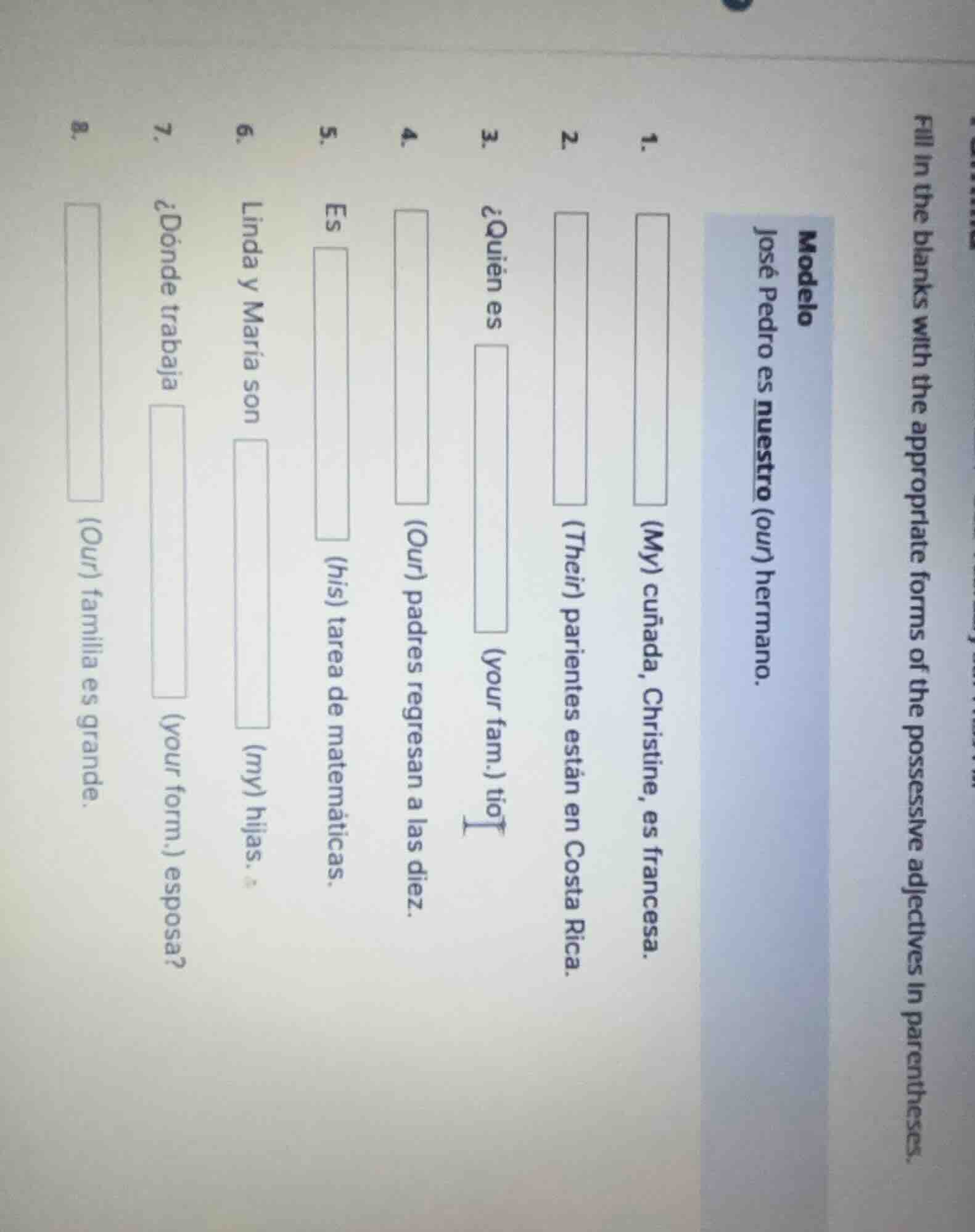
fill in the blanks with the appropriate forms of the possessive adjectives in parentheses.
modelo
josé pedro es nuestro (our) hermano.
- (my) cuñada, christine, es francesa.
- (their) parientes están en costa rica.
- ¿quién es (your fam.) tío?
- (our) padres regresan a las diez.
- es (his) tarea de matemáticas.
- linda y maría son (my) hijas.
- ¿dónde trabaja (your form.) esposa?
- (our) familia es grande.
To solve this, we need to use the correct possessive adjectives in Spanish. Let's go through each blank:
1.
The parenthesis says "(My)". In Spanish, for a feminine singular noun (cuñada), the possessive adjective is "mi".
So: Mi cuñada, Christine, es francesa.
2.
The parenthesis says "(Their)". For plural nouns (parientes), the possessive adjective is "sus".
So: Sus parientes están en Costa Rica.
3.
The parenthesis says "(your fam.)". For a masculine singular noun (tío) and informal "your (familiar)", we use "tu".
So: ¿Quién es tu tío?
4.
The parenthesis says "(Our)". For plural nouns (padres), the possessive adjective is "nuestros".
So: Nuestros padres regresan a las diez.
5.
The parenthesis says "(his)". For a feminine singular noun (tarea), the possessive adjective is "su" (since "his" for feminine singular in Spanish uses "su").
So: Es su tarea de matemáticas.
6.
The parenthesis says "(my)". For plural feminine nouns (hijas), the possessive adjective is "mis".
So: Linda y María son mis hijas.
7.
The parenthesis says "(your form.)". For a feminine singular noun (esposa) and formal "your", we use "su".
So: ¿Dónde trabaja su esposa?
8.
The parenthesis says "(Our)". For a feminine singular noun (familia), the possessive adjective is "nuestra".
So: Nuestra familia es grande.
Final Answers (filled blanks):
- Mi
- Sus
- tu
- Nuestros
- su
- mis
- su
- Nuestra

Snap & solve any problem in the app
Get step-by-step solutions on Sovi AI
Photo-based solutions with guided steps
Explore more problems and detailed explanations
To solve this, we need to use the correct possessive adjectives in Spanish. Let's go through each blank:
1.
The parenthesis says "(My)". In Spanish, for a feminine singular noun (cuñada), the possessive adjective is "mi".
So: Mi cuñada, Christine, es francesa.
2.
The parenthesis says "(Their)". For plural nouns (parientes), the possessive adjective is "sus".
So: Sus parientes están en Costa Rica.
3.
The parenthesis says "(your fam.)". For a masculine singular noun (tío) and informal "your (familiar)", we use "tu".
So: ¿Quién es tu tío?
4.
The parenthesis says "(Our)". For plural nouns (padres), the possessive adjective is "nuestros".
So: Nuestros padres regresan a las diez.
5.
The parenthesis says "(his)". For a feminine singular noun (tarea), the possessive adjective is "su" (since "his" for feminine singular in Spanish uses "su").
So: Es su tarea de matemáticas.
6.
The parenthesis says "(my)". For plural feminine nouns (hijas), the possessive adjective is "mis".
So: Linda y María son mis hijas.
7.
The parenthesis says "(your form.)". For a feminine singular noun (esposa) and formal "your", we use "su".
So: ¿Dónde trabaja su esposa?
8.
The parenthesis says "(Our)". For a feminine singular noun (familia), the possessive adjective is "nuestra".
So: Nuestra familia es grande.
Final Answers (filled blanks):
- Mi
- Sus
- tu
- Nuestros
- su
- mis
- su
- Nuestra