QUESTION IMAGE
Question
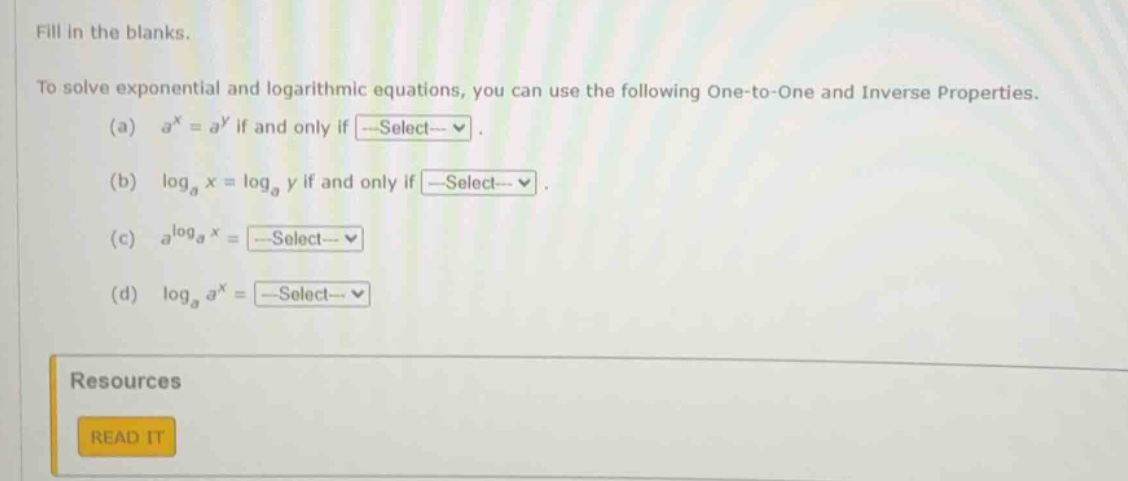
fill in the blanks.
to solve exponential and logarithmic equations, you can use the following one - to - one and inverse properties.
(a) (a^{x}=a^{y}) if and only if (\text{--select--}).
(b) (log_{a}x = log_{a}y) if and only if (\text{--select--}).
(c) (a^{log_{a}x}=\text{--select--})
(d) (log_{a}a^{x}=\text{--select--})
resources
read it
Part (a)
Step1: Recall Exponential One - to - One Property
For an exponential function \(y = a^{x}\) where \(a>0,a
eq1\), if \(a^{x}=a^{y}\), then the exponents must be equal. This is because the exponential function with base \(a(a > 0,a
eq1)\) is one - to - one, meaning that it never takes the same value twice. So if \(a^{x}=a^{y}\), then \(x = y\) (with the domain restrictions that \(a^{x}\) and \(a^{y}\) are well - defined, i.e., \(x,y\in\mathbb{R}\) when \(a > 0,a
eq1\)).
Step1: Recall Logarithmic One - to - One Property
The logarithmic function \(y=\log_{a}x\) (\(a > 0,a
eq1,x>0\)) is a one - to - one function. If \(\log_{a}x=\log_{a}y\), then the arguments of the logarithms must be equal. This is because if two logarithmic values with the same base are equal, the quantities we are taking the logarithm of (the arguments) must be equal (and also positive, since the domain of \(\log_{a}u\) is \(u>0\)). So if \(\log_{a}x=\log_{a}y\), then \(x = y\) (and \(x>0,y>0\)).
Step1: Recall Inverse Property of Exponential and Logarithmic Functions
The exponential function \(f(x)=a^{x}\) and the logarithmic function \(g(x)=\log_{a}x\) are inverse functions of each other. By the definition of inverse functions, if we compose an exponential function with a logarithmic function (in the correct order), we get the identity function. That is, for \(a>0,a
eq1\) and \(x > 0\), \(a^{\log_{a}x}=x\). This is because \(\log_{a}x\) is the exponent to which we raise \(a\) to get \(x\), and when we raise \(a\) to that exponent, we get back \(x\).

Snap & solve any problem in the app
Get step-by-step solutions on Sovi AI
Photo-based solutions with guided steps
Explore more problems and detailed explanations
\(x = y\)