QUESTION IMAGE
Question
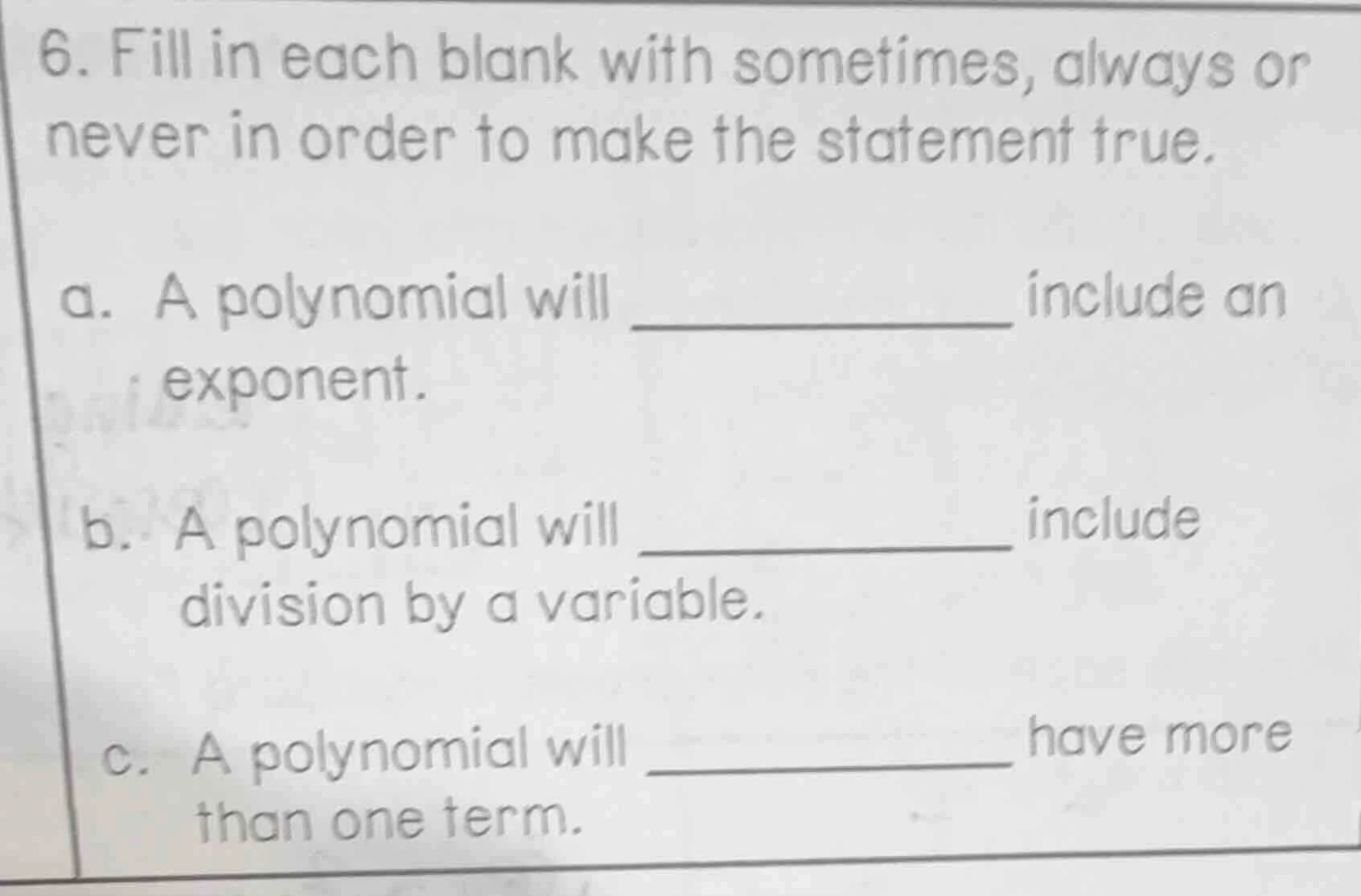
- fill in each blank with sometimes, always or never in order to make the statement true.
a. a polynomial will ____________ include an exponent.
b. a polynomial will ____________ include division by a variable.
c. a polynomial will ____________ have more than one term.
Part a
Step1: Recall polynomial definition
A polynomial is an expression like \(a_nx^n + a_{n - 1}x^{n - 1}+\dots+a_1x + a_0\), where exponents are non - negative integers. A constant polynomial (e.g., \(5\)) can be written as \(5x^0\), so it has an exponent (of \(0\)). But wait, actually, a constant term is a polynomial with exponent \(0\) on the variable. However, if we consider a single constant, it is a polynomial, and it has an exponent (even if the exponent is \(0\)). But also, polynomials can have terms with exponents (like \(3x^2\)) or just constants (which have exponent \(0\)). Wait, actually, every polynomial term has an exponent (including \(0\) for constants). Wait, no, a constant is a polynomial, and it can be thought of as having an exponent of \(0\) on the variable. But is there a polynomial that doesn't have an exponent? Let's see: a polynomial is a sum of terms of the form \(ax^n\) where \(n\) is a non - negative integer. So even a constant term \(c\) is \(cx^0\), so it has an exponent. Wait, but maybe the question is considering non - constant polynomials? No, the definition of a polynomial includes constants. Wait, but actually, a constant polynomial has an exponent (of \(0\)) on the variable. But let's think again: a polynomial can be a single constant (like \(7\)), which is \(7x^0\), so it has an exponent. Or a term like \(3x\) (exponent \(1\)), or \(2x^2\) (exponent \(2\)). Is there a polynomial that does not have an exponent? No, because even the constant term has an exponent of \(0\). Wait, but maybe the question is phrased a bit differently. Wait, no, actually, every polynomial term has an exponent (including \(0\) for constants). But wait, maybe the question is considering if a polynomial "will sometimes include an exponent". Wait, no, let's re - examine. A polynomial is composed of terms with non - negative integer exponents. A constant polynomial (e.g., \(5\)) has an exponent of \(0\) on the variable. A linear polynomial like \(3x + 5\) has terms with exponents \(1\) and \(0\). So in all cases, a polynomial will always have an exponent (since even constants have an exponent of \(0\) on the variable). Wait, but that seems contradictory to my initial thought. Wait, no, the exponent can be \(0\). So the answer for part a is "always"? Wait, no, wait: a constant is a polynomial, and it has an exponent (of \(0\)). So every polynomial has at least one term with an exponent (including \(0\)). So a polynomial will always include an exponent (since even the constant term has an exponent of \(0\)). Wait, but maybe the question is thinking of non - zero exponents? No, the definition of a polynomial allows exponents of \(0\). So the correct answer for part a is "always"? Wait, no, let's check again. The definition of a polynomial: an expression consisting of variables and coefficients, that involves only the operations of addition, subtraction, multiplication, and non - negative integer exponents of variables. So each term in a polynomial has a non - negative integer exponent. So even a constant term is \(ax^0\), so it has an exponent. So a polynomial will always include an exponent (in the form of the exponent on the variable in each term, including \(0\) for constants).
Wait, maybe I made a mistake. Let's take a constant polynomial, say \(4\). It can be written as \(4x^0\), so it has an exponent (of \(0\)). A linear polynomial like \(5x\) has an exponent of \(1\). A quadratic polynomial like \(3x^2+2x + 1\) has exponents \(2\), \(1\), and \(0\). So in all cases, a polynomial has terms with exponents (including \(0\)). S…
Step1: Recall polynomial definition
A polynomial is an expression of the form \(a_nx^n + a_{n - 1}x^{n - 1}+\dots+a_1x + a_0\), where the operations are addition, subtraction, and multiplication of variables with non - negative integer exponents, and coefficients. Division by a variable would result in a term like \(\frac{1}{x}=x^{- 1}\), and since the exponent \(- 1\) is negative, expressions with division by a variable are not polynomials. So a polynomial will never include division by a variable.
Step2: Conclusion
By the definition of a polynomial (which does not allow negative exponents, and division by a variable leads to negative exponents), a polynomial will never include division by a variable.
Part c
Step1: Recall polynomial examples
A polynomial can be a monomial (a single term), like \(5\) (which is \(5x^0\)), \(3x\), or \(2x^2\). It can also be a binomial (two terms, like \(3x + 5\)) or a trinomial (three terms, like \(x^2+2x + 1\)). So a polynomial can have one term (a monomial) or more than one term. So a polynomial will sometimes have more than one term (because it can have one term, or two or more terms).
Step2: Conclusion
Since polynomials can be monomials (one term) or polynomials with more than one term (like binomials, trinomials, etc.), a polynomial will sometimes have more than one term.

Snap & solve any problem in the app
Get step-by-step solutions on Sovi AI
Photo-based solutions with guided steps
Explore more problems and detailed explanations
s:
a. always
b. never
c. sometimes