QUESTION IMAGE
Question
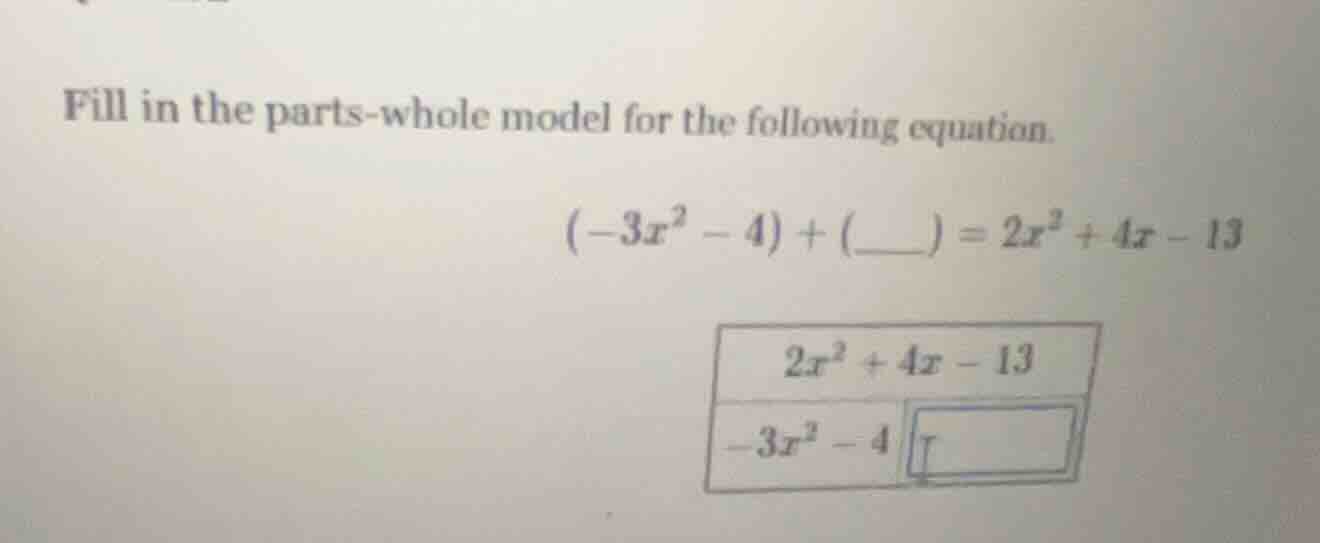
fill in the parts - whole model for the following equation.
$(-3x^{2}-4)+(\underline{quadquad}) = 2x^{2}+4x - 13$
\boxed{\
}
Step1: Let the unknown polynomial be \( A \)
We have the equation \((-3x^{2}-4)+A = 2x^{2}+4x - 13\), so we need to solve for \( A \) by subtracting \((-3x^{2}-4)\) from both sides.
Step2: Subtract \((-3x^{2}-4)\) from \( 2x^{2}+4x - 13 \)
Using the rule of subtracting polynomials (subtracting a polynomial is adding its opposite), we get:
\( A=(2x^{2}+4x - 13)-(-3x^{2}-4) \)
\( = 2x^{2}+4x - 13 + 3x^{2}+4 \)
Step3: Combine like terms
For the \( x^{2} \) terms: \( 2x^{2}+3x^{2}=5x^{2} \)
For the constant terms: \( - 13 + 4=-9 \)
The \( x \) term remains \( 4x \)
So \( A = 5x^{2}+4x - 9 \)

Snap & solve any problem in the app
Get step-by-step solutions on Sovi AI
Photo-based solutions with guided steps
Explore more problems and detailed explanations
\( 5x^{2}+4x - 9 \)