QUESTION IMAGE
Question
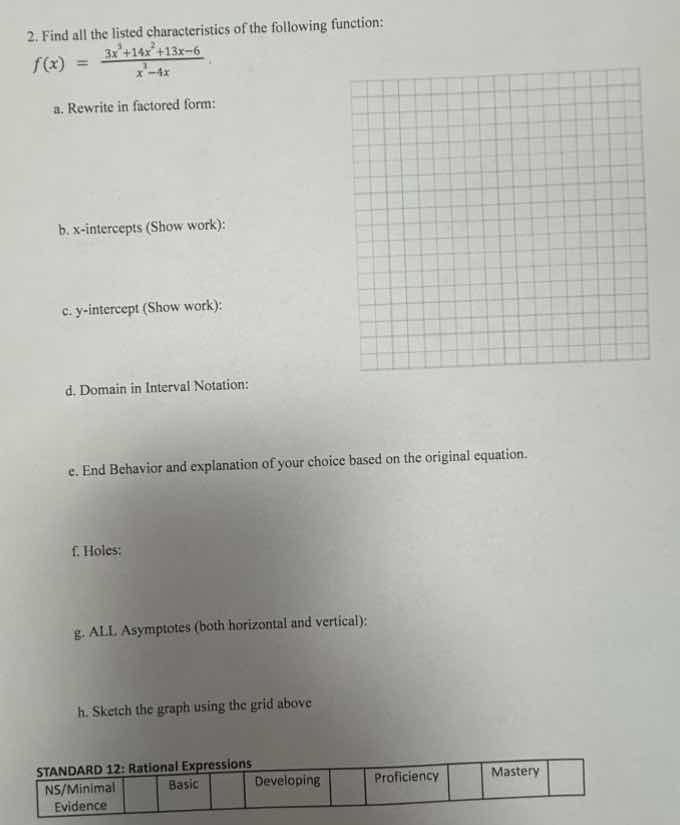
- find all the listed characteristics of the following function:$f(x) = \frac{3x^3+14x^2+13x-6}{x^3-4x}$a. rewrite in factored form:b. x-intercepts (show work):c. y-intercept (show work):d. domain in interval notation:e. end behavior and explanation of your choice based on the original equation.f. holes:g. all asymptotes (both horizontal and vertical):h. sketch the graph using the grid abovestandard 12: rational expressions
Step1: Factor numerator
First, factor the cubic numerator $3x^3+14x^2+13x-6$. Use rational root theorem: possible roots are $\pm1,\pm2,\pm3,\pm6,\pm\frac{1}{3},\pm\frac{2}{3}$. Test $x=\frac{1}{3}$:
$3(\frac{1}{3})^3+14(\frac{1}{3})^2+13(\frac{1}{3})-6 = \frac{1}{9}+\frac{14}{9}+\frac{39}{9}-\frac{54}{9}=0$.
So $(3x-1)$ is a factor. Perform polynomial division or use synthetic division:
$3x^3+14x^2+13x-6=(3x-1)(x^2+5x+6)=(3x-1)(x+2)(x+3)$
Step2: Factor denominator
Factor the denominator $x^3-4x$ by factoring out $x$ first, then difference of squares:
$x^3-4x=x(x^2-4)=x(x-2)(x+2)$
Step3: Write factored form
Combine factored numerator and denominator:
$f(x)=\frac{(3x-1)(x+2)(x+3)}{x(x-2)(x+2)}$
Step4: Find x-intercepts
Set numerator (excluding common factors) to 0:
$(3x-1)(x+3)=0$
Solve for $x$:
$3x-1=0 \implies x=\frac{1}{3}$; $x+3=0 \implies x=-3$
Step5: Find y-intercept
Set $x=0$ in original function. Note: original function is undefined at $x=0$, so:
$f(0)=\frac{3(0)^3+14(0)^2+13(0)-6}{0^3-4(0)}=\frac{-6}{0}$, which is undefined.
Step6: Find domain
Denominator cannot be 0. Solve $x(x-2)(x+2)=0$: $x=0,2,-2$. Exclude these values from all real numbers:
Domain: $(-\infty,-2)\cup(-2,0)\cup(0,2)\cup(2,\infty)$
Step7: Analyze end behavior
Compare degrees of numerator and denominator: both are degree 3. The leading coefficient ratio is $\frac{3}{1}=3$.
As $x\to\infty$, $f(x)\to3$; as $x\to-\infty$, $f(x)\to3$.
Step8: Find holes
Identify common factor in numerator and denominator: $(x+2)$. Set common factor to 0: $x=-2$.
Find y-coordinate of hole by canceling common factor and substituting $x=-2$:
$f(x)=\frac{(3x-1)(x+3)}{x(x-2)}$, so $f(-2)=\frac{(3(-2)-1)(-2+3)}{(-2)(-2-2)}=\frac{(-7)(1)}{(-2)(-4)}=-\frac{7}{8}$
Step9: Find asymptotes
- Vertical asymptotes: Set remaining denominator factors to 0: $x(x-2)=0 \implies x=0, x=2$
- Horizontal asymptote: Since degrees are equal, horizontal asymptote is $y=3$

Snap & solve any problem in the app
Get step-by-step solutions on Sovi AI
Photo-based solutions with guided steps
Explore more problems and detailed explanations
a. Factored form: $\boldsymbol{f(x)=\frac{(3x-1)(x+2)(x+3)}{x(x-2)(x+2)}}$
b. x-intercepts: $\boldsymbol{(-3,0)}$ and $\boldsymbol{(\frac{1}{3},0)}$
c. y-intercept: $\boldsymbol{\text{Does not exist (function is undefined at } x=0\text{)}}$
d. Domain: $\boldsymbol{(-\infty,-2)\cup(-2,0)\cup(0,2)\cup(2,\infty)}$
e. End Behavior: As $x\to\infty$ and $x\to-\infty$, $\boldsymbol{f(x)\to3}$. Explanation: Numerator and denominator have the same degree (3), so end behavior is determined by the ratio of leading coefficients $\frac{3}{1}=3$.
f. Holes: $\boldsymbol{(-2, -\frac{7}{8})}$
g. Asymptotes: Vertical asymptotes $\boldsymbol{x=0}$ and $\boldsymbol{x=2}$; Horizontal asymptote $\boldsymbol{y=3}$
h. Graph sketch guidelines:
- Plot x-intercepts $(-3,0)$ and $(\frac{1}{3},0)$
- Mark hole at $(-2, -\frac{7}{8})$ with an open circle
- Draw vertical dashed lines at $x=0$ and $x=2$, horizontal dashed line at $y=3$
- For $x<-3$: function approaches $y=3$ as $x\to-\infty$, crosses $x=-3$ to enter the region between $x=-3$ and $x=-2$
- Between $x=-3$ and $x=-2$: function moves from 0 to the hole at $(-2, -\frac{7}{8})$
- Between $x=-2$ and $x=0$: function approaches $-\infty$ as $x\to0^-$
- Between $x=0$ and $x=\frac{1}{3}$: function approaches $+\infty$ as $x\to0^+$, crosses $(\frac{1}{3},0)$
- Between $x=\frac{1}{3}$ and $x=2$: function approaches $-\infty$ as $x\to2^-$
- For $x>2$: function approaches $3$ from above as $x\to\infty$