QUESTION IMAGE
Question
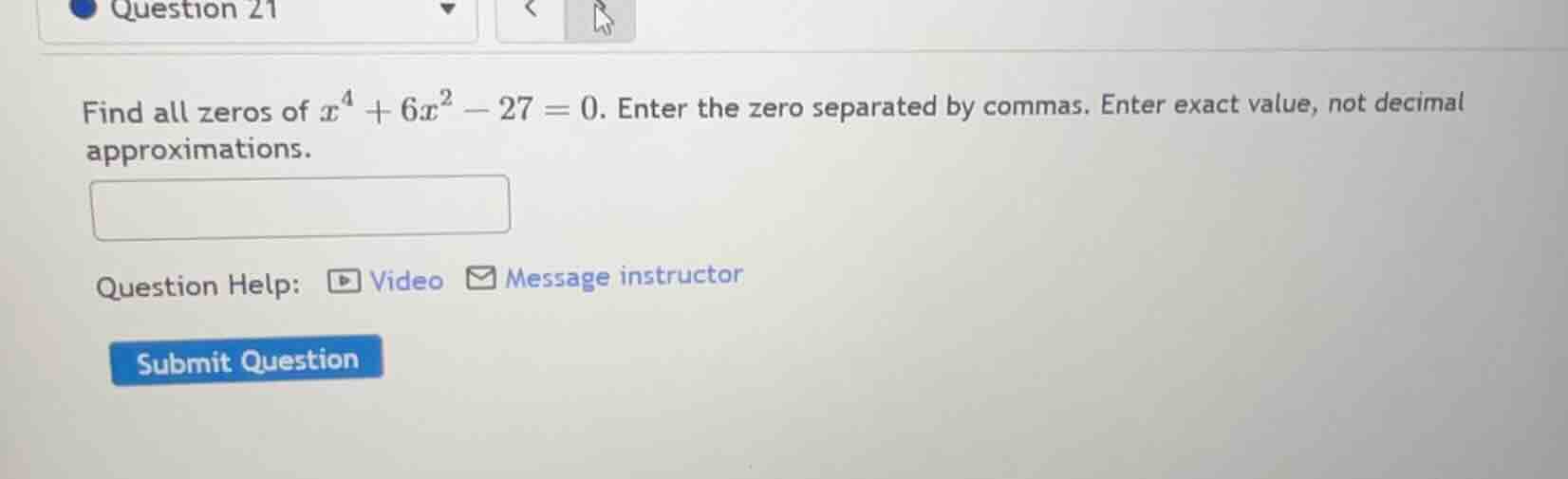
find all zeros of ( x^4 + 6x^2 - 27 = 0 ). enter the zero separated by commas. enter exact value, not decimal approximations.
Step1: Let \( y = x^2 \), rewrite the equation
The given equation is \( x^4 + 6x^2 - 27 = 0 \). Let \( y=x^{2}\), then the equation becomes a quadratic equation in terms of \( y \): \( y^{2}+6y - 27=0 \).
Step2: Solve the quadratic equation for \( y \)
We use the quadratic formula \( y=\frac{-b\pm\sqrt{b^{2}-4ac}}{2a} \) for the quadratic equation \( ay^{2}+by + c = 0 \). For \( y^{2}+6y - 27=0 \), we have \( a = 1 \), \( b=6 \), \( c=-27 \).
First, calculate the discriminant \( \Delta=b^{2}-4ac=(6)^{2}-4\times1\times(-27)=36 + 108 = 144 \).
Then \( y=\frac{-6\pm\sqrt{144}}{2\times1}=\frac{-6\pm12}{2} \).
We get two solutions for \( y \):
- When we take the plus sign: \( y=\frac{-6 + 12}{2}=\frac{6}{2}=3 \)
- When we take the minus sign: \( y=\frac{-6-12}{2}=\frac{-18}{2}=-9 \)
Step3: Solve for \( x \) from \( y = x^2 \)
Case 1: When \( y = 3 \), we have \( x^{2}=3 \), then \( x=\pm\sqrt{3} \) (since if \( x^{2}=a,a>0 \), then \( x = \pm\sqrt{a} \))
Case 2: When \( y=-9 \), we have \( x^{2}=-9 \). In the real number system, the square of a real number cannot be negative, but we can consider complex numbers. For \( x^{2}=-9 \), we can write \( x^{2}=9i^{2} \) (where \( i^{2}=-1 \)), so \( x=\pm3i \)
But the problem doesn't specify the domain (real or complex). If we assume real numbers, we consider only the real roots. If we consider complex numbers, we have all roots. But since the problem says "exact value" and doesn't specify complex, maybe we first check if it's a real - root problem. Wait, the original equation is a polynomial equation, and when we solve for zeros, if not specified, sometimes we consider all roots (real and complex). But let's check the steps again.
Wait, the problem says "Find all zeros", so we need to find all roots (real and complex).
From \( y = x^{2}=3\), \( x=\pm\sqrt{3}\); from \( y=x^{2}=-9\), \( x = \pm3i \)
But maybe the problem expects real zeros? Wait, let's check the quadratic substitution again. Wait, the equation \( x^{4}+6x^{2}-27 = 0 \), when we substitute \( y = x^{2} \), we get \( y^{2}+6y - 27=0 \). Factoring the quadratic: \( y^{2}+6y - 27=(y + 9)(y - 3)=0 \), so \( y=-9 \) or \( y = 3 \), which is the same as before.
If we are looking for real zeros, then \( x^{2}=-9 \) has no real solutions, so the real zeros are \( \pm\sqrt{3} \). But if we are looking for all zeros (including complex), then the zeros are \( \sqrt{3},-\sqrt{3},3i,-3i \)
Wait, maybe the problem is in the real number system. Let's check the original equation: \( x^{4}+6x^{2}-27 = 0 \). Let's test \( x=\sqrt{3} \): \( (\sqrt{3})^{4}+6\times(\sqrt{3})^{2}-27=9 + 18-27 = 0 \), which works. \( x = -\sqrt{3} \): \( (-\sqrt{3})^{4}+6\times(-\sqrt{3})^{2}-27=9 + 18 - 27=0 \), which works. For \( x = 3i \): \( (3i)^{4}+6\times(3i)^{2}-27=81\times i^{4}+6\times9\times i^{2}-27=81\times1+54\times(-1)-27=81 - 54 - 27=0 \), which works. Similarly for \( x=-3i \).
But maybe the problem is intended to have real roots. Wait, the problem says "exact value, not decimal approximations". Let's see the way the problem is presented, maybe it's a high - school level problem, so maybe real roots. Wait, but when we factor \( y^{2}+6y - 27=(y + 9)(y - 3) \), so \( y = 3 \) or \( y=-9 \). For real \( x \), \( y=x^{2}\geq0 \), so \( y = 3 \) is valid, \( y=-9 \) is not. So real zeros are \( \pm\sqrt{3} \)
Wait, maybe I made a mistake earlier. Let's re - solve the quadratic equation by factoring. \( y^{2}+6y - 27 \). We need two numbers that multiply to - 27 and add to 6. The numbers are 9 and - 3. So \( y^{2}+6y - 27=(y + 9)(y - 3)=…

Snap & solve any problem in the app
Get step-by-step solutions on Sovi AI
Photo-based solutions with guided steps
Explore more problems and detailed explanations
\(-\sqrt{3},\sqrt{3}\) (If considering real zeros) or \(-\sqrt{3},\sqrt{3},-3i,3i\) (If considering complex zeros). But based on the problem's context (probably real - valued zeros for a high - school problem), the answer is \(-\sqrt{3},\sqrt{3}\)