QUESTION IMAGE
Question
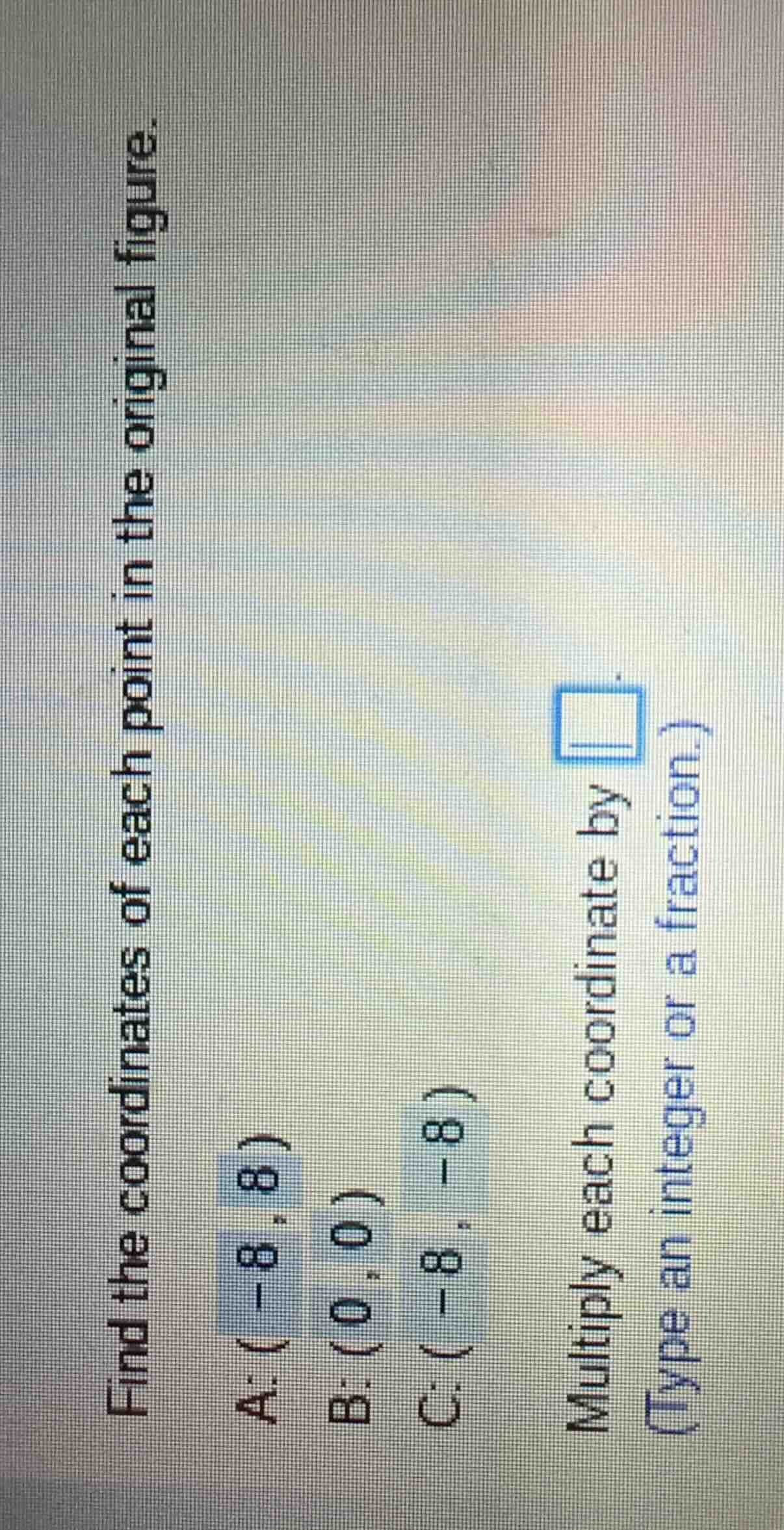
find the coordinates of each point in the original figure.
a: (-8, 8)
b: (0, 0)
c: (-8, -8)
multiply each coordinate by
(type an integer or a fraction.)
Step1: Analyze the problem
We need to find the original coordinates by reversing the transformation (multiplying each coordinate by a number to get the given coordinates). Let's assume the transformation was multiplying by a scale factor \( k \), so to find the original, we divide by \( k \) (or multiply by \( \frac{1}{k} \)). But since the problem says "Multiply each coordinate by [a number]" to get the given points, let's assume the scale factor used was -1 (since the given points for A and C have signs changed? Wait, no, let's check the points. Wait, the given points are A: (-8, 8), B: (0, 0), C: (-8, -8). Wait, maybe the transformation was multiplying by -1? Wait, no, maybe the original points were multiplied by -1 to get these? Wait, no, let's think again. Wait, the problem is "Find the coordinates of each point in the original figure. Multiply each coordinate by [ ] (Type an integer or a fraction)." Wait, maybe the transformed points are A: (-8,8), B: (0,0), C: (-8,-8), and we need to find the original by finding the factor \( k \) such that original \( \times k \) = transformed. Wait, but maybe the scale factor is -1? Wait, no, maybe the original points were (8, -8), (0,0), (8,8) and multiplied by -1 to get (-8,8), (0,0), (-8,-8). Wait, but the problem says "Multiply each coordinate by [ ]" to get the given points. Wait, maybe the scale factor is -1, so to find the original, we multiply by -1 (since original \( \times (-1) \) = transformed, so original = transformed \( \times (-1) \)). Wait, let's check point A: transformed is (-8,8), so original would be (-8,8) \( \times (-1) \) = (8, -8). Point B: (0,0) \( \times (-1) \) = (0,0). Point C: (-8,-8) \( \times (-1) \) = (8,8). But the problem says "Multiply each coordinate by [ ]" – wait, maybe the transformation was scaling by -1, so the factor is -1. Wait, but the problem is asking for the number to multiply each coordinate by to get the given points? Wait, no, the problem is "Find the coordinates of each point in the original figure. Multiply each coordinate by [ ]" – maybe the given points are the transformed ones, and we need to find the scale factor \( k \) such that original \( \times k \) = transformed. But maybe the original points were (8, -8), (0,0), (8,8) and \( k = -1 \), so transformed is original \( \times (-1) \). So to get the original, we multiply the transformed coordinates by -1? Wait, no, if original \( \times k = \) transformed, then original = transformed \( \div k \) = transformed \( \times \frac{1}{k} \). But if \( k = -1 \), then original = transformed \( \times (-1) \). Wait, let's take point A: transformed is (-8,8). If original \( \times (-1) = (-8,8) \), then original = (8, -8). Point C: transformed is (-8,-8), original \( \times (-1) = (-8,-8) \), so original = (8,8). Point B: (0,0) \( \times (-1) = (0,0) \), so original is (0,0). But the problem says "Multiply each coordinate by [ ]" – maybe the factor is -1, so we multiply the transformed coordinates by -1 to get the original. Wait, but the problem is asking for the number to multiply each coordinate by (i.e., the scale factor) to get the given points? Wait, no, the problem is "Find the coordinates of each point in the original figure. Multiply each coordinate by [ ]" – maybe the given points are the result of multiplying the original by a scale factor, and we need to find that scale factor. Wait, maybe the original points were (8, -8), (0,0), (8,8) and after multiplying by -1, we get (-8,8), (0,0), (-8,-8). So the scale factor is -1. So to get the original, we multiply the given coordinates b…

Snap & solve any problem in the app
Get step-by-step solutions on Sovi AI
Photo-based solutions with guided steps
Explore more problems and detailed explanations
-1