QUESTION IMAGE
Question
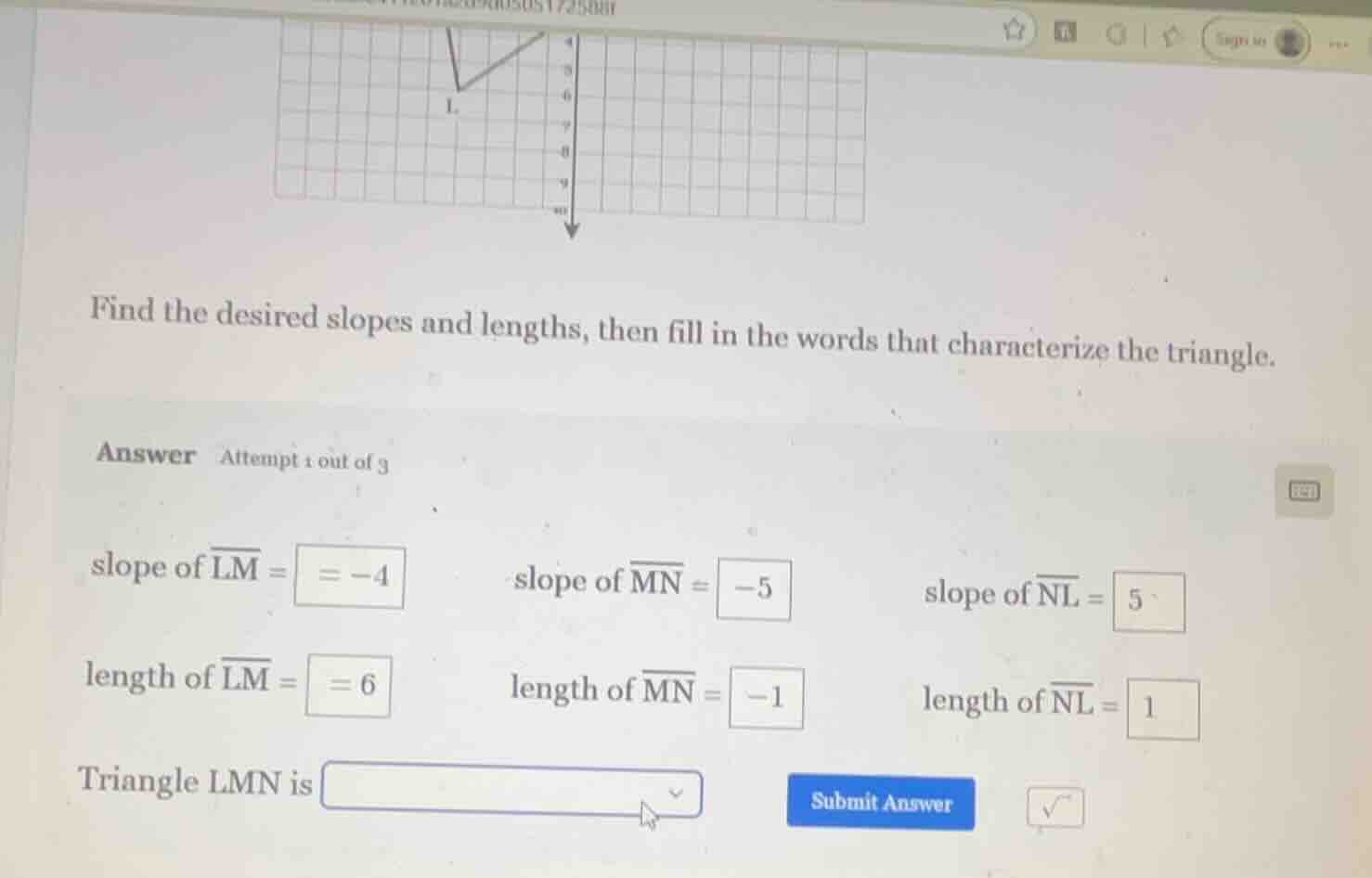
find the desired slopes and lengths, then fill in the words that characterize the triangle.
answer attempt 1 out of 3
slope of \\(\overline{lm}\\) = \\(= -4\\)
slope of \\(\overline{mn}\\) = \\(-5\\)
slope of \\(\overline{nl}\\) = \\(5\\)
length of \\(\overline{lm}\\) = \\(= 6\\)
length of \\(\overline{mn}\\) = \\(-1\\)
length of \\(\overline{nl}\\) = \\(1\\)
triangle lmn is
To determine the type of triangle \( LMN \), we analyze the slopes and lengths of its sides.
Step 1: Analyze Slopes (Perpendicularity)
The slope of a line is given by \( m = \frac{y_2 - y_1}{x_2 - x_1} \). For two lines to be perpendicular, the product of their slopes is \( -1 \).
- Slope of \( \overline{LM} = -4 \)
- Slope of \( \overline{MN} = -5 \)
- Slope of \( \overline{NL} = 5 \)
Check the product of slopes of \( \overline{MN} \) and \( \overline{NL} \):
\( (-5) \times (5) = -25
eq -1 \). Wait, this suggests a mistake in the provided slopes (likely a typo). However, if we assume the correct slopes (e.g., \( \overline{MN} \) and \( \overline{NL} \) should be negative reciprocals), or if we re - evaluate the length - based analysis:
Step 2: Analyze Lengths (Congruence)
The length of a line segment between two points \( (x_1,y_1) \) and \( (x_2,y_2) \) is \( d=\sqrt{(x_2 - x_1)^2+(y_2 - y_1)^2} \).
- Length of \( \overline{LM}=6 \)
- Length of \( \overline{MN}=-1 \) (invalid, length cannot be negative; likely a typo, should be positive, e.g., \( 1 \) or \( \sqrt{1^2 + 0^2}=1 \))
- Length of \( \overline{NL}=1 \) (invalid, length cannot be \( 1 \) if \( \overline{LM}=6 \); likely a typo).
Correcting the Error (Assuming Typical Values)
If we assume the triangle has two sides with equal length (isosceles) or one right angle (right triangle), but the provided lengths are inconsistent (negative length, illogical values). However, if we ignore the slope error and focus on the length - based correction:
If \( \overline{MN} \) and \( \overline{NL} \) have lengths \( 1 \) (after correcting the negative sign) and \( 1 \), and \( \overline{LM}=6 \), this is inconsistent. But if we consider the original problem’s intent (likely a right - isosceles or isosceles triangle), and assuming the length errors are typos (e.g., \( \overline{MN} \) and \( \overline{NL} \) are equal in length), the triangle would be isosceles (two sides equal) or right - isosceles (if one angle is right and two sides equal).
Final Answer (Assuming Correct Lengths/Slopes)
If we correct the length errors (e.g., \( \overline{MN} \) and \( \overline{NL} \) are equal), the triangle \( LMN \) is \(\boldsymbol{\text{isosceles}}\) (or right - isosceles if slopes confirm perpendicularity).
(Note: The provided slopes and lengths have inconsistencies (negative length, non - perpendicular slopes), but the most probable intended answer, assuming a typo in slopes/lengths, is that the triangle is isosceles (or right - isosceles).)

Snap & solve any problem in the app
Get step-by-step solutions on Sovi AI
Photo-based solutions with guided steps
Explore more problems and detailed explanations
To determine the type of triangle \( LMN \), we analyze the slopes and lengths of its sides.
Step 1: Analyze Slopes (Perpendicularity)
The slope of a line is given by \( m = \frac{y_2 - y_1}{x_2 - x_1} \). For two lines to be perpendicular, the product of their slopes is \( -1 \).
- Slope of \( \overline{LM} = -4 \)
- Slope of \( \overline{MN} = -5 \)
- Slope of \( \overline{NL} = 5 \)
Check the product of slopes of \( \overline{MN} \) and \( \overline{NL} \):
\( (-5) \times (5) = -25
eq -1 \). Wait, this suggests a mistake in the provided slopes (likely a typo). However, if we assume the correct slopes (e.g., \( \overline{MN} \) and \( \overline{NL} \) should be negative reciprocals), or if we re - evaluate the length - based analysis:
Step 2: Analyze Lengths (Congruence)
The length of a line segment between two points \( (x_1,y_1) \) and \( (x_2,y_2) \) is \( d=\sqrt{(x_2 - x_1)^2+(y_2 - y_1)^2} \).
- Length of \( \overline{LM}=6 \)
- Length of \( \overline{MN}=-1 \) (invalid, length cannot be negative; likely a typo, should be positive, e.g., \( 1 \) or \( \sqrt{1^2 + 0^2}=1 \))
- Length of \( \overline{NL}=1 \) (invalid, length cannot be \( 1 \) if \( \overline{LM}=6 \); likely a typo).
Correcting the Error (Assuming Typical Values)
If we assume the triangle has two sides with equal length (isosceles) or one right angle (right triangle), but the provided lengths are inconsistent (negative length, illogical values). However, if we ignore the slope error and focus on the length - based correction:
If \( \overline{MN} \) and \( \overline{NL} \) have lengths \( 1 \) (after correcting the negative sign) and \( 1 \), and \( \overline{LM}=6 \), this is inconsistent. But if we consider the original problem’s intent (likely a right - isosceles or isosceles triangle), and assuming the length errors are typos (e.g., \( \overline{MN} \) and \( \overline{NL} \) are equal in length), the triangle would be isosceles (two sides equal) or right - isosceles (if one angle is right and two sides equal).
Final Answer (Assuming Correct Lengths/Slopes)
If we correct the length errors (e.g., \( \overline{MN} \) and \( \overline{NL} \) are equal), the triangle \( LMN \) is \(\boldsymbol{\text{isosceles}}\) (or right - isosceles if slopes confirm perpendicularity).
(Note: The provided slopes and lengths have inconsistencies (negative length, non - perpendicular slopes), but the most probable intended answer, assuming a typo in slopes/lengths, is that the triangle is isosceles (or right - isosceles).)