QUESTION IMAGE
Question
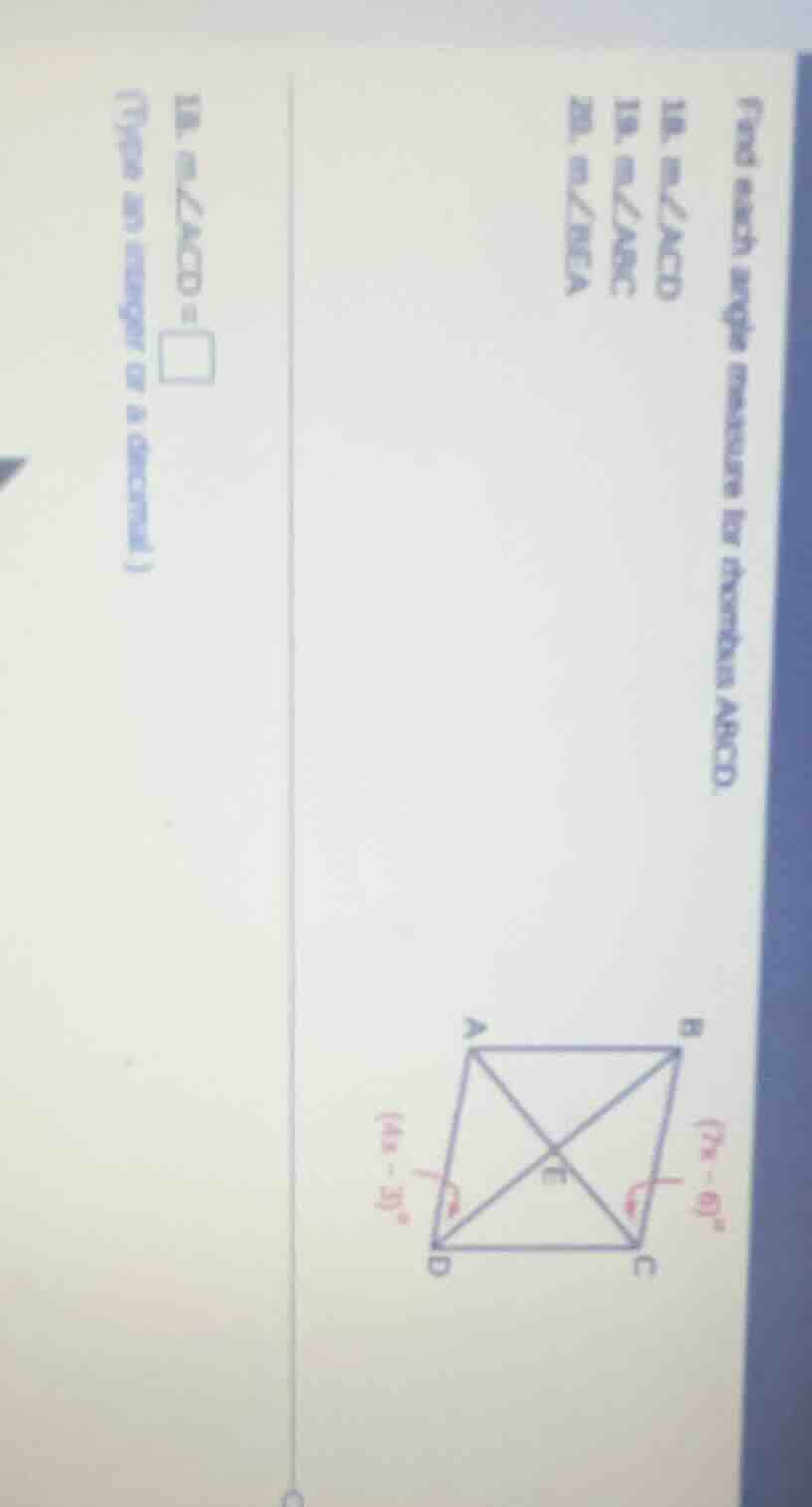
find each angle measure for rhombus abcd. 18. ( mangle acd ) 19. ( mangle abc ) 20. ( mangle bea ) 18. ( mangle acd = square ) (type an integer or a decimal.)
Step1: Identify the figure type
The figure is a parallelogram (since opposite sides are equal, as indicated by the expressions \( (7x - 9)^\circ \) and \( (4x - 3)^\circ \) for sides, but actually, in a parallelogram, opposite sides are equal, so we can set the expressions for sides equal? Wait, no, wait—the angles? Wait, no, the labels: in a parallelogram, opposite sides are equal, and adjacent angles are supplementary? Wait, no, the figure is a rhombus? Wait, no, the diagram shows a quadrilateral with diagonals intersecting at E. Wait, maybe it's a parallelogram, so \( AD = BC \)? Wait, the expressions are \( (7x - 9)^\circ \) and \( (4x - 3)^\circ \)? Wait, no, the labels: side BC is \( (7x - 9) \) and side AD is \( (4x - 3) \)? Wait, in a parallelogram, opposite sides are equal, so \( AD = BC \). So:
\( 4x - 3 = 7x - 9 \)
Step2: Solve for x
Subtract \( 4x \) from both sides:
\( -3 = 3x - 9 \)
Add 9 to both sides:
\( 6 = 3x \)
Divide by 3:
\( x = 2 \)
Wait, but that seems odd. Wait, maybe the angles? Wait, no, the problem is about \( \angle ACD \). Wait, maybe the figure is a rhombus or a parallelogram. Wait, maybe the sides are equal? Wait, no, the expressions are in degrees? Wait, no, the red text: \( (7x - 9)^\circ \) and \( (4x - 3)^\circ \) are angles? Wait, no, the labels: side BC is \( (7x - 9) \) and side AD is \( (4x - 3) \), but in a parallelogram, \( AD = BC \), so:
\( 4x - 3 = 7x - 9 \)
Solving:
\( -3 + 9 = 7x - 4x \)
\( 6 = 3x \)
\( x = 2 \)
Wait, but then sides would be \( 4(2) - 3 = 5 \) and \( 7(2) - 9 = 5 \), so that works. Now, in a parallelogram, adjacent angles are supplementary, but we need \( \angle ACD \). Wait, maybe the figure is a rhombus? No, maybe a square? Wait, no, the diagonals intersect at E. Wait, maybe it's a parallelogram, so \( AB \parallel CD \) and \( AD \parallel BC \). Then, \( \angle ACD \) is equal to \( \angle CAB \) (alternate interior angles). But maybe we need to find angles. Wait, maybe the figure is a rhombus, so all sides are equal, so \( AD = BC = AB = CD \). Wait, but we found \( x = 2 \), so sides are 5. Now, in a parallelogram, the diagonals bisect the angles. Wait, maybe \( \angle ACD \) is 45 degrees? No, wait, maybe I made a mistake. Wait, the problem is to find \( m\angle ACD \). Let's re-examine.
Wait, maybe the figure is a square? No, the diagonals intersect at E. Wait, maybe it's a rhombus, so the diagonals bisect the angles. Wait, maybe the angles at the vertices: in a parallelogram, opposite angles are equal, adjacent angles are supplementary. Wait, but we need \( \angle ACD \). Let's assume that the figure is a parallelogram, so \( AD \parallel BC \), so \( \angle DAC = \angle BCA \) (alternate interior angles). But maybe the diagonals bisect the angles. Wait, maybe the sides are equal, so it's a rhombus, so the diagonals bisect the angles. Wait, maybe \( \angle ACD \) is 45 degrees? No, let's check again.
Wait, maybe the expressions are for angles. Wait, the red text: \( (7x - 9)^\circ \) and \( (4x - 3)^\circ \) are angles of the parallelogram. In a parallelogram, adjacent angles are supplementary. Wait, but if it's a rhombus, all sides are equal, so \( AD = BC \), so \( 4x - 3 = 7x - 9 \), so \( x = 2 \), as before. Then, the sides are 5. Now, in a rhombus, the diagonals bisect the angles. So \( \angle ACD \) would be half of \( \angle BCD \). But \( \angle BCD \) and \( \angle ADC \) are adjacent angles, so they are supplementary. Wait, \( \angle ADC = (4x - 3)^\circ \)? No, \( x = 2 \), so \( 4(2) - 3 = 5^\circ \)? That can't be. Wait, I must…

Snap & solve any problem in the app
Get step-by-step solutions on Sovi AI
Photo-based solutions with guided steps
Explore more problems and detailed explanations
45