QUESTION IMAGE
Question
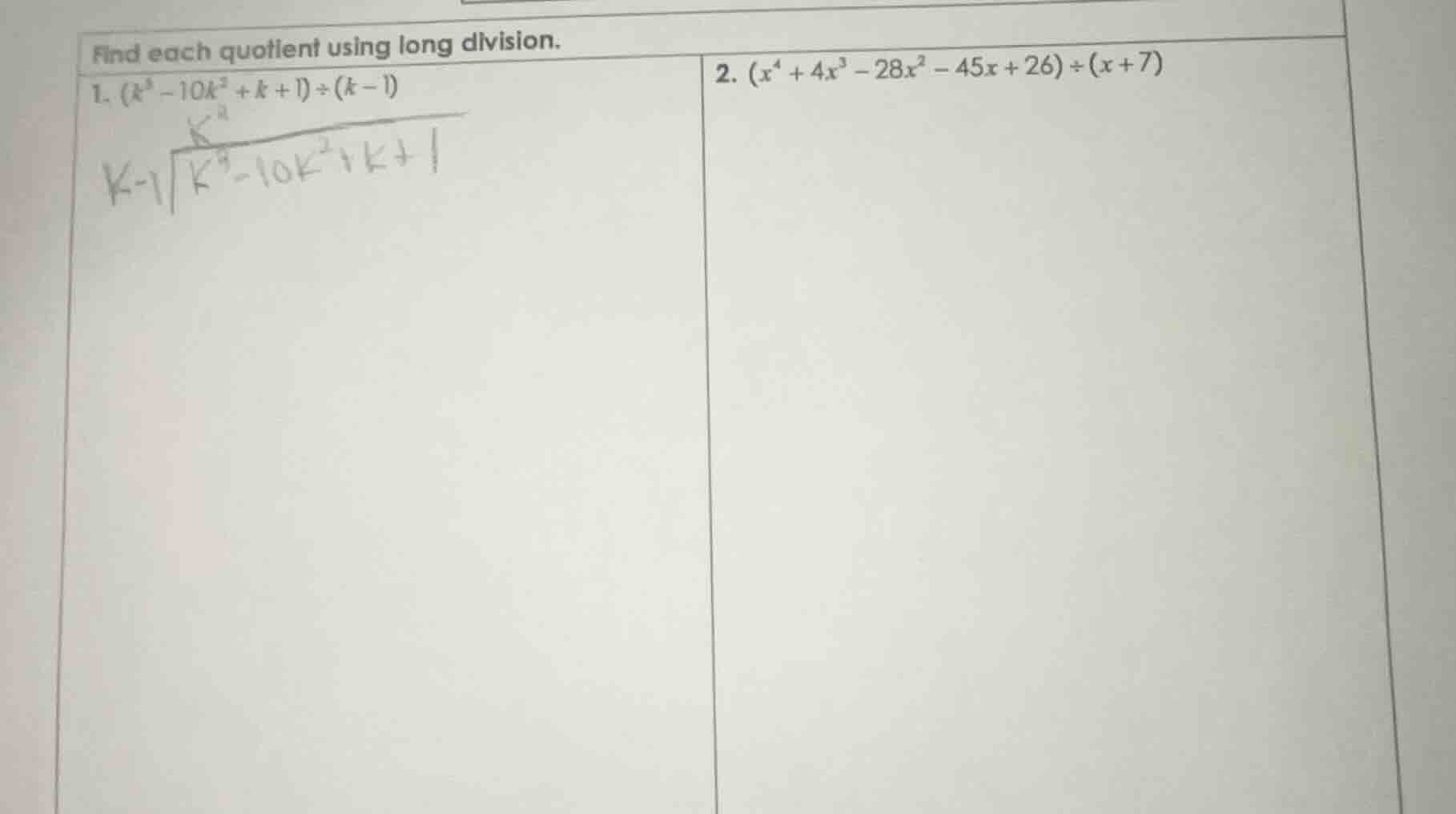
find each quotient using long division.
- ((k^{3}-10k^{2}+k + 1)div(k - 1))
- ((x^{4}+4x^{3}-28x^{2}-45x + 26)div(x + 7))
Problem 1: \((k^{3}-10k^{2}+k + 1)\div(k - 1)\)
Step 1: Divide the leading terms
Divide the leading term of the dividend \(k^{3}\) by the leading term of the divisor \(k\). We get \(k^{2}\). Multiply the divisor \((k - 1)\) by \(k^{2}\) which gives \(k^{3}-k^{2}\). Subtract this from the dividend:
\[
\]
Step 2: Divide the new leading term
Divide the leading term of \(-9k^{2}\) by \(k\) to get \(-9k\). Multiply the divisor \((k - 1)\) by \(-9k\) which gives \(-9k^{2}+9k\). Subtract this from \(-9k^{2}+k + 1\):
\[
\]
Step 3: Divide the new leading term
Divide the leading term of \(-8k\) by \(k\) to get \(-8\). Multiply the divisor \((k - 1)\) by \(-8\) which gives \(-8k + 8\). Subtract this from \(-8k + 1\):
\[
\]
Step 4: Write the quotient and remainder
The quotient is \(k^{2}-9k - 8\) and the remainder is \(-7\). So, \(\frac{k^{3}-10k^{2}+k + 1}{k - 1}=k^{2}-9k - 8-\frac{7}{k - 1}\) (or we can express it as \(k^{2}-9k - 8\) with a remainder of \(-7\))
Step 1: Divide the leading terms
Divide the leading term of the dividend \(x^{4}\) by the leading term of the divisor \(x\) to get \(x^{3}\). Multiply the divisor \((x + 7)\) by \(x^{3}\) which gives \(x^{4}+7x^{3}\). Subtract this from the dividend:
\[
\]
Step 2: Divide the new leading term
Divide the leading term of \(-3x^{3}\) by \(x\) to get \(-3x^{2}\). Multiply the divisor \((x + 7)\) by \(-3x^{2}\) which gives \(-3x^{3}-21x^{2}\). Subtract this from \(-3x^{3}-28x^{2}-45x + 26\):
\[
\]
Step 3: Divide the new leading term
Divide the leading term of \(-7x^{2}\) by \(x\) to get \(-7x\). Multiply the divisor \((x + 7)\) by \(-7x\) which gives \(-7x^{2}-49x\). Subtract this from \(-7x^{2}-45x + 26\):
\[
\]
Step 4: Divide the new leading term
Divide the leading term of \(4x\) by \(x\) to get \(4\). Multiply the divisor \((x + 7)\) by \(4\) which gives \(4x + 28\). Subtract this from \(4x + 26\):
\[
\]
Step 5: Write the quotient and remainder
The quotient is \(x^{3}-3x^{2}-7x + 4\) and the remainder is \(-2\). So, \(\frac{x^{4}+4x^{3}-28x^{2}-45x + 26}{x + 7}=x^{3}-3x^{2}-7x + 4-\frac{2}{x + 7}\) (or we can express it as \(x^{3}-3x^{2}-7x + 4\) with a remainder of \(-2\))

Snap & solve any problem in the app
Get step-by-step solutions on Sovi AI
Photo-based solutions with guided steps
Explore more problems and detailed explanations
The quotient is \(k^{2}-9k - 8\) and the remainder is \(-7\) (or \(\boldsymbol{k^{2}-9k - 8-\frac{7}{k - 1}}\))