QUESTION IMAGE
Question
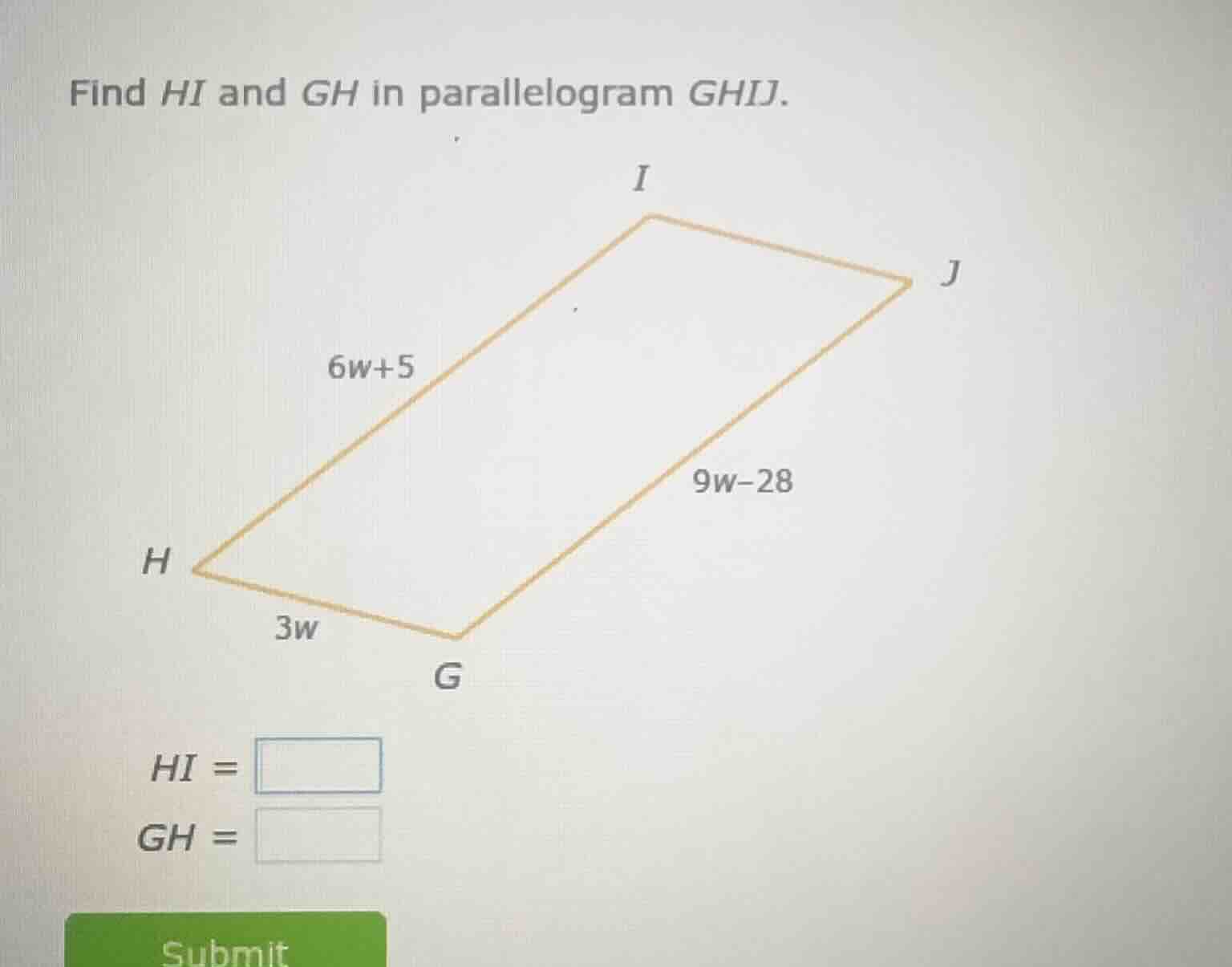
find hi and gh in parallelogram ghij.
hi =
gh =
Step1: Recall parallelogram property
In a parallelogram, opposite sides are equal. So, \( HI = GJ \) and \( GH = IJ \). Wait, looking at the labels, actually \( HI \) and \( GJ \)? Wait no, the sides: \( HI \) and \( GJ \)? Wait, no, the sides given: \( HI \) is \( 6w + 5 \)? Wait, no, the diagram: \( H \) to \( I \) is \( 6w + 5 \)? Wait, no, the labels: \( H \) to \( G \) is \( 3w \), \( G \) to \( J \) is \( 9w - 28 \), \( J \) to \( I \) is... Wait, no, in parallelogram \( GHIJ \), opposite sides are equal. So \( GH = IJ \) and \( HI = GJ \)? Wait, no, the sides: \( GH \) and \( IJ \) are opposite, \( HI \) and \( GJ \) are opposite? Wait, no, the labels: \( H \) connected to \( G \) and \( I \), \( G \) connected to \( H \) and \( J \), \( J \) connected to \( G \) and \( I \), \( I \) connected to \( J \) and \( H \). So \( GH \) is from \( G \) to \( H \) (length \( 3w \)), \( HI \) is from \( H \) to \( I \) (length \( 6w + 5 \)), \( IJ \) is from \( I \) to \( J \), and \( GJ \) is from \( G \) to \( J \) (length \( 9w - 28 \)). Wait, no, in a parallelogram, opposite sides are equal. So \( GH = IJ \) and \( HI = GJ \)? Wait, no, actually, \( GH \) and \( IJ \) are opposite, \( HI \) and \( GJ \) are opposite. Wait, but the sides given: \( HI \) is \( 6w + 5 \)? Wait, no, the diagram: \( H \) to \( I \) is \( 6w + 5 \), \( G \) to \( J \) is \( 9w - 28 \), \( H \) to \( G \) is \( 3w \). Wait, no, in a parallelogram, opposite sides are equal. So \( HI = GJ \) and \( GH = IJ \)? Wait, no, maybe I mislabeled. Wait, the sides: \( GH \) and \( IJ \) are opposite, \( HI \) and \( GJ \) are opposite. Wait, but the problem is to find \( HI \) and \( GH \). Wait, looking at the expressions: \( HI \) is \( 6w + 5 \)? No, wait, the side \( HI \) and \( GJ \) should be equal? Wait, no, the side \( HI \) and \( GJ \)? Wait, no, maybe \( HI = GJ \) and \( GH = IJ \). Wait, but the given sides: \( HI \) is \( 6w + 5 \)? Wait, no, the diagram: \( H \) to \( I \) is \( 6w + 5 \), \( G \) to \( J \) is \( 9w - 28 \), \( H \) to \( G \) is \( 3w \). Wait, no, in a parallelogram, opposite sides are equal. So \( HI = GJ \) (since they are opposite sides) and \( GH = IJ \). Wait, but we need to find \( HI \) and \( GH \). So set \( HI = GJ \)? Wait, no, \( HI \) is \( 6w + 5 \), \( GJ \) is \( 9w - 28 \)? Wait, no, maybe I got the sides wrong. Wait, the problem says "Find \( HI \) and \( GH \) in parallelogram \( GHIJ \)". So in parallelogram \( GHIJ \), \( GH \parallel IJ \) and \( HI \parallel GJ \), and \( GH = IJ \), \( HI = GJ \). Wait, but the sides given: \( GH \) is \( 3w \), \( GJ \) is \( 9w - 28 \), \( HI \) is \( 6w + 5 \). Wait, no, maybe \( HI = GJ \) and \( GH = IJ \), but \( IJ \) is not given. Wait, no, maybe the sides \( HI \) and \( GJ \) are equal, and \( GH \) and \( IJ \) are equal. Wait, but we have \( HI = 6w + 5 \) and \( GJ = 9w - 28 \)? No, that can't be. Wait, maybe the sides \( HI \) and \( GH \)'s opposite sides? Wait, no, let's re-express. Wait, in parallelogram \( GHIJ \), the vertices are \( G, H, I, J \) in order. So \( GH \) is adjacent to \( HI \), \( HI \) adjacent to \( IJ \), \( IJ \) adjacent to \( JG \), \( JG \) adjacent to \( GH \). So opposite sides: \( GH = IJ \), \( HI = JG \). So \( HI = JG \), so \( 6w + 5 = 9w - 28 \)? Wait, no, that would be if \( HI \) and \( JG \) are equal. Wait, solving \( 6w + 5 = 9w - 28 \):
Step2: Solve for \( w \)
\( 6w + 5 = 9w - 28 \)
Subtract \( 6w \) from both sides: \( 5 = 3w - 28 \)
Add 28 to both sides: \( 33 = 3w \)
Divide by 3: \( w = 11 \)
Step3: Fi…

Snap & solve any problem in the app
Get step-by-step solutions on Sovi AI
Photo-based solutions with guided steps
Explore more problems and detailed explanations
\( HI = 71 \), \( GH = 33 \)