QUESTION IMAGE
Question
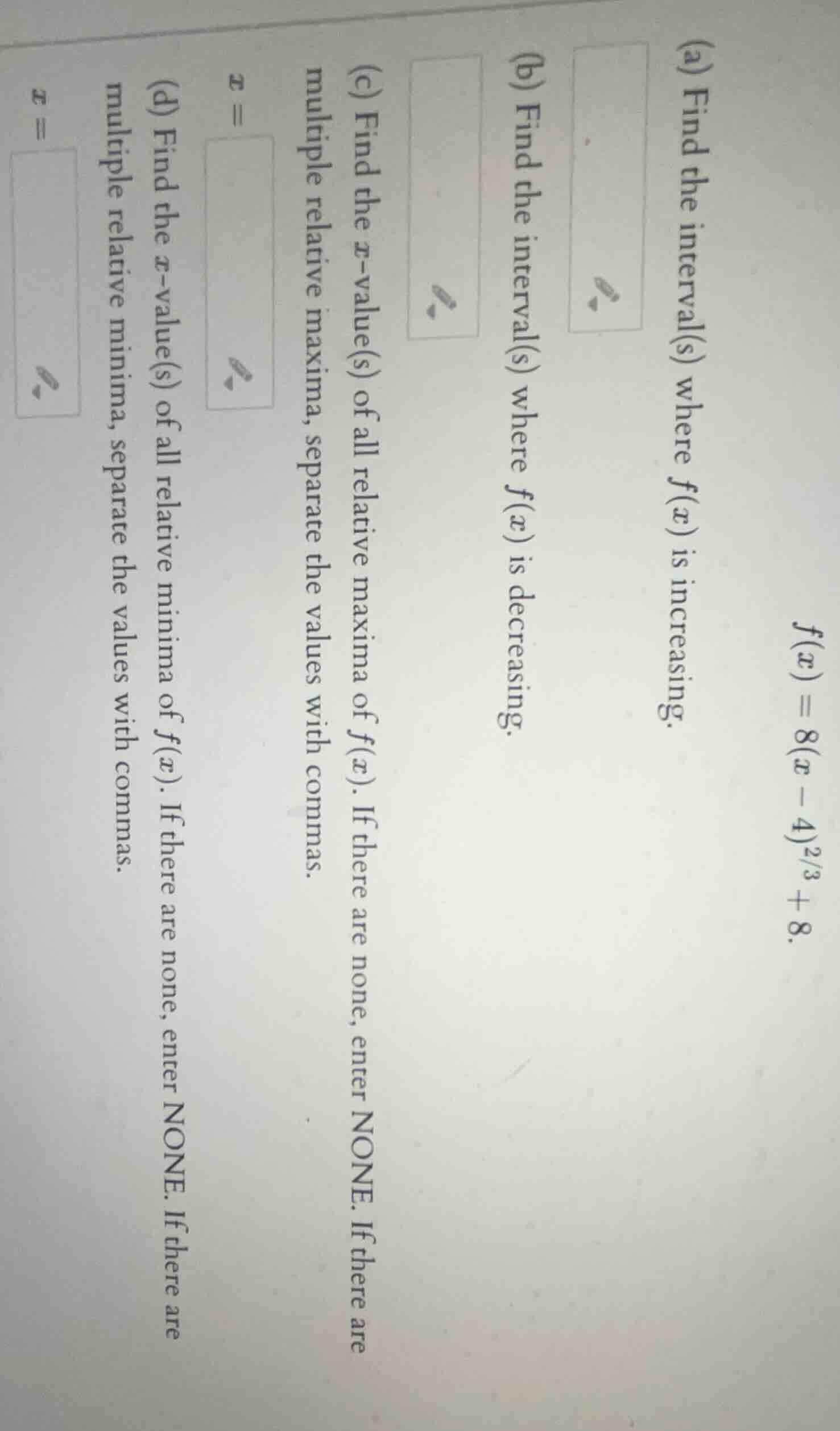
f(x) = 8(x - 4)^{2/3} + 8. (a) find the interval(s) where f(x) is increasing. (b) find the interval(s) where f(x) is decreasing. (c) find the x - value(s) of all relative maxima of f(x). if there are none, enter none. if there are multiple relative maxima, separate the values with commas. (d) find the x - value(s) of all relative minima of f(x). if there are none, enter none. if there are multiple relative minima, separate the values with commas.
To solve the problem, we analyze the function \( f(x) = 8(x - 4)^{2/3} + 8 \) by examining its derivative.
Step 1: Find the derivative of \( f(x) \)
We use the chain rule. Let \( u = x - 4 \), so \( f(u) = 8u^{2/3} + 8 \). The derivative of \( f(u) \) with respect to \( u \) is \( f'(u) = \frac{16}{3}u^{-1/3} \), and the derivative of \( u \) with respect to \( x \) is \( u' = 1 \). Thus, the derivative of \( f(x) \) with respect to \( x \) is:
\[
f'(x) = \frac{16}{3}(x - 4)^{-1/3} = \frac{16}{3\sqrt[3]{x - 4}}
\]
Step 2: Analyze the sign of \( f'(x) \)
The denominator \( 3\sqrt[3]{x - 4} \) is zero when \( x = 4 \), so \( f'(x) \) is undefined at \( x = 4 \). For \( x > 4 \), \( \sqrt[3]{x - 4} > 0 \), so \( f'(x) > 0 \). For \( x < 4 \), \( \sqrt[3]{x - 4} < 0 \), so \( f'(x) < 0 \).
Part (a): Interval where \( f(x) \) is increasing
Since \( f'(x) > 0 \) when \( x > 4 \), the function is increasing on the interval \( (4, \infty) \).
Part (b): Interval where \( f(x) \) is decreasing
Since \( f'(x) < 0 \) when \( x < 4 \), the function is decreasing on the interval \( (-\infty, 4) \).
Part (c): Relative maxima
A relative maximum occurs where the function changes from increasing to decreasing. However, \( f(x) \) changes from decreasing to increasing at \( x = 4 \), so there are no relative maxima. Thus, the answer is \( \text{NONE} \).
Part (d): Relative minima
A relative minimum occurs where the function changes from decreasing to increasing. This happens at \( x = 4 \), so the \( x \)-value of the relative minimum is \( 4 \).
Final Answers
(a) The interval where \( f(x) \) is increasing is \( \boxed{(4, \infty)} \).
(b) The interval where \( f(x) \) is decreasing is \( \boxed{(-\infty, 4)} \).
(c) The \( x \)-value(s) of all relative maxima is \( \boxed{\text{NONE}} \).
(d) The \( x \)-value(s) of all relative minima is \( \boxed{4} \).

Snap & solve any problem in the app
Get step-by-step solutions on Sovi AI
Photo-based solutions with guided steps
Explore more problems and detailed explanations
To solve the problem, we analyze the function \( f(x) = 8(x - 4)^{2/3} + 8 \) by examining its derivative.
Step 1: Find the derivative of \( f(x) \)
We use the chain rule. Let \( u = x - 4 \), so \( f(u) = 8u^{2/3} + 8 \). The derivative of \( f(u) \) with respect to \( u \) is \( f'(u) = \frac{16}{3}u^{-1/3} \), and the derivative of \( u \) with respect to \( x \) is \( u' = 1 \). Thus, the derivative of \( f(x) \) with respect to \( x \) is:
\[
f'(x) = \frac{16}{3}(x - 4)^{-1/3} = \frac{16}{3\sqrt[3]{x - 4}}
\]
Step 2: Analyze the sign of \( f'(x) \)
The denominator \( 3\sqrt[3]{x - 4} \) is zero when \( x = 4 \), so \( f'(x) \) is undefined at \( x = 4 \). For \( x > 4 \), \( \sqrt[3]{x - 4} > 0 \), so \( f'(x) > 0 \). For \( x < 4 \), \( \sqrt[3]{x - 4} < 0 \), so \( f'(x) < 0 \).
Part (a): Interval where \( f(x) \) is increasing
Since \( f'(x) > 0 \) when \( x > 4 \), the function is increasing on the interval \( (4, \infty) \).
Part (b): Interval where \( f(x) \) is decreasing
Since \( f'(x) < 0 \) when \( x < 4 \), the function is decreasing on the interval \( (-\infty, 4) \).
Part (c): Relative maxima
A relative maximum occurs where the function changes from increasing to decreasing. However, \( f(x) \) changes from decreasing to increasing at \( x = 4 \), so there are no relative maxima. Thus, the answer is \( \text{NONE} \).
Part (d): Relative minima
A relative minimum occurs where the function changes from decreasing to increasing. This happens at \( x = 4 \), so the \( x \)-value of the relative minimum is \( 4 \).
Final Answers
(a) The interval where \( f(x) \) is increasing is \( \boxed{(4, \infty)} \).
(b) The interval where \( f(x) \) is decreasing is \( \boxed{(-\infty, 4)} \).
(c) The \( x \)-value(s) of all relative maxima is \( \boxed{\text{NONE}} \).
(d) The \( x \)-value(s) of all relative minima is \( \boxed{4} \).