QUESTION IMAGE
Question
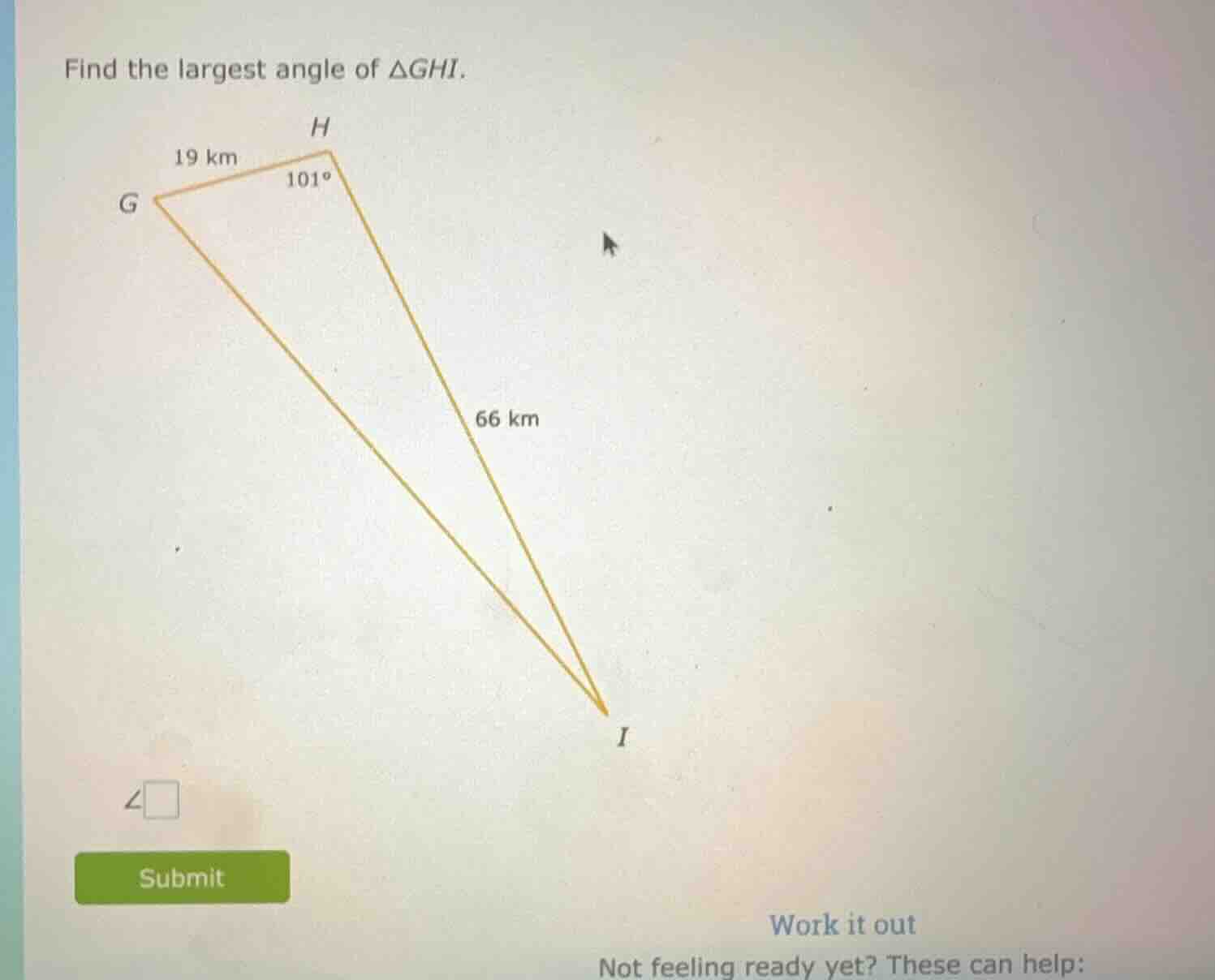
find the largest angle of δghi. h 19 km 101° g 66 km i
Step1: Use Law of Cosines to find GI
$$GI^2 = GH^2 + HI^2 - 2(GH)(HI)\cos(\angle H)$$
$$GI^2 = 19^2 + 66^2 - 2(19)(66)\cos(101^\circ)$$
$$GI^2 = 361 + 4356 - 2508(-0.1908)$$
$$GI^2 = 4717 + 478.5$$
$$GI^2 = 5195.5$$
$$GI = \sqrt{5195.5} \approx 72.08 \text{ km}$$
Step2: Identify longest side
The longest side is $GI \approx 72.08$ km, opposite $\angle H$? No, wait: longest side is opposite largest angle. Wait, $GI$ is opposite $\angle H$? No, $\angle G$ is opposite $HI$ (66 km), $\angle I$ opposite $GH$ (19 km), $\angle H$ opposite $GI$ (72.08 km). So $\angle H$ is 101°, but wait, check if $\angle G$ could be larger? Use Law of Sines to check $\angle G$:
$$\frac{\sin(\angle G)}{HI} = \frac{\sin(\angle H)}{GI}$$
$$\sin(\angle G) = \frac{66 \sin(101^\circ)}{72.08}$$
$$\sin(\angle G) = \frac{66(0.9816)}{72.08} \approx \frac{64.7856}{72.08} \approx 0.8988$$
$$\angle G \approx \arcsin(0.8988) \approx 64^\circ \text{ or } 116^\circ$$
But if $\angle G=116^\circ$, then $\angle G + \angle H = 116+101=217>180$, impossible. So $\angle G \approx 64^\circ$.
Step3: Calculate $\angle I$
$$\angle I = 180^\circ - 101^\circ - 64^\circ = 15^\circ$$
Step4: Compare all angles
Angles are $\angle H=101^\circ$, $\angle G\approx64^\circ$, $\angle I\approx15^\circ$.

Snap & solve any problem in the app
Get step-by-step solutions on Sovi AI
Photo-based solutions with guided steps
Explore more problems and detailed explanations
$\angle H = 101^\circ$