QUESTION IMAGE
Question
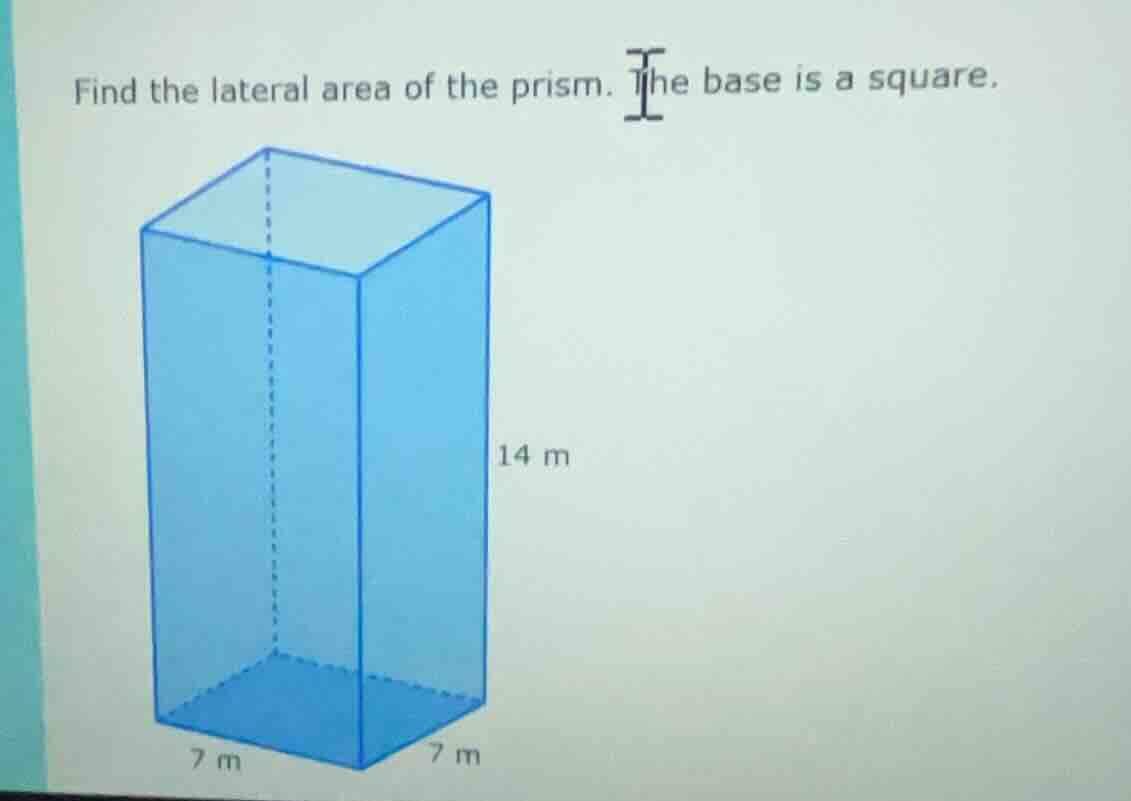
find the lateral area of the prism. the base is a square. 14 m 7 m 7 m
Step1: Recall the formula for the lateral area of a prism
The lateral area \( LA \) of a prism is given by the perimeter of the base \( P \) multiplied by the height \( h \) of the prism, i.e., \( LA = P \times h \).
Step2: Calculate the perimeter of the square base
The base is a square with side length \( s = 7 \, \text{m} \). The perimeter \( P \) of a square is \( 4 \times s \). So, \( P = 4 \times 7 = 28 \, \text{m} \).
Step3: Identify the height of the prism
From the diagram, the height \( h \) of the prism is \( 14 \, \text{m} \).
Step4: Calculate the lateral area
Using the formula \( LA = P \times h \), substitute \( P = 28 \, \text{m} \) and \( h = 14 \, \text{m} \). So, \( LA = 28 \times 14 = 392 \, \text{m}^2 \).

Snap & solve any problem in the app
Get step-by-step solutions on Sovi AI
Photo-based solutions with guided steps
Explore more problems and detailed explanations
The lateral area of the prism is \( 392 \, \text{square meters} \) (or \( 392 \, \text{m}^2 \)).