QUESTION IMAGE
Question
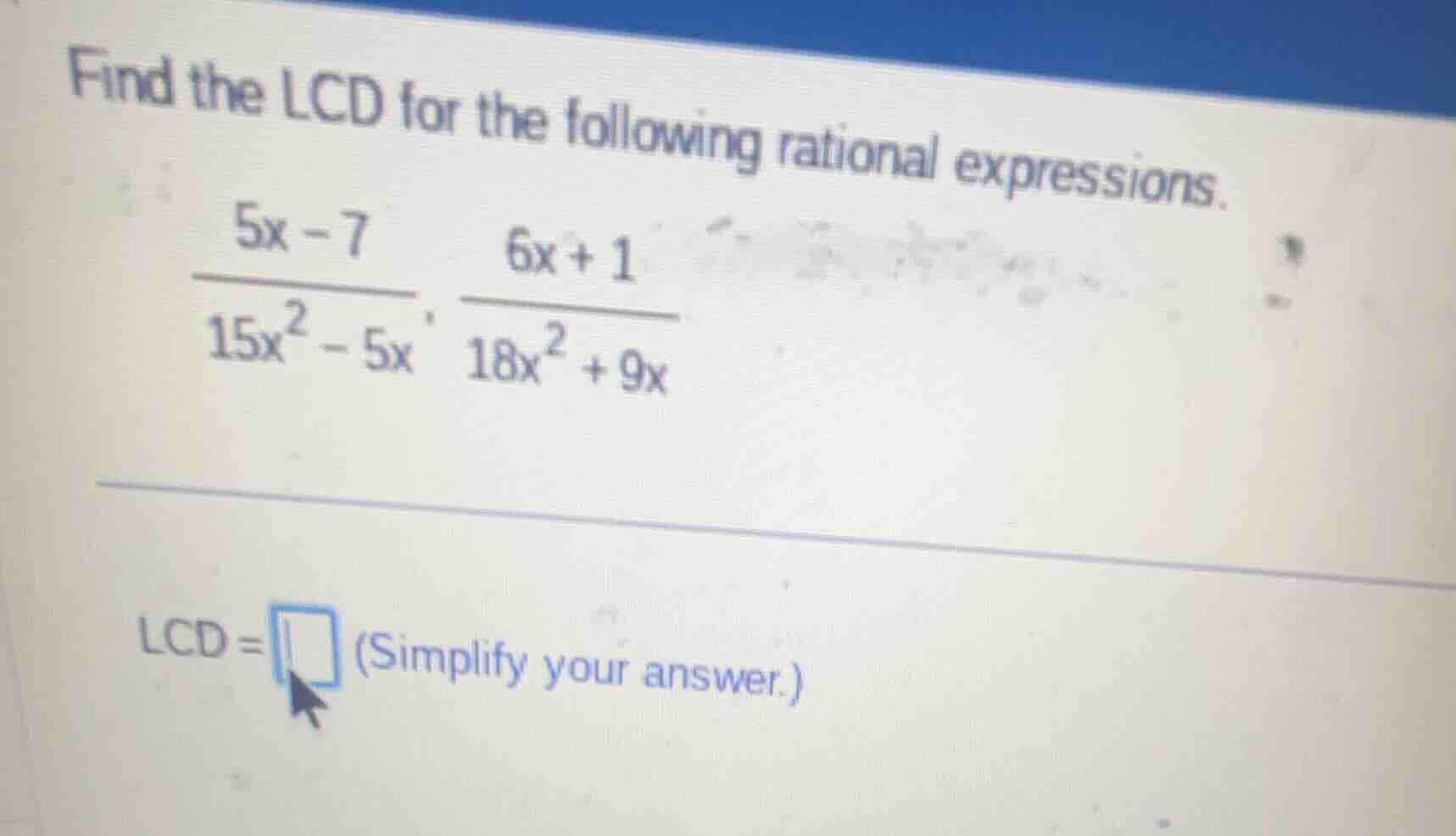
find the lcd for the following rational expressions.\\(\frac{5x - 7}{15x^2 - 5x}, \frac{6x + 1}{18x^2 + 9x}\\)\\(\text{lcd} = \boxed{} \text{(simplify your answer.)}\\)
Step1: Factor the denominators
First, factor \(15x^2 - 5x\). We can factor out \(5x\) from both terms:
\(15x^2 - 5x = 5x(3x - 1)\)
Next, factor \(18x^2 + 9x\). We can factor out \(9x\) from both terms:
\(18x^2 + 9x = 9x(2x + 1)\)? Wait, no, wait. Wait, \(18x^2 + 9x\), let's check again. The greatest common factor of \(18x^2\) and \(9x\) is \(9x\)? Wait, \(18x^2 = 9x \times 2x\) and \(9x = 9x \times 1\), so actually, \(18x^2 + 9x = 9x(2x + 1)\)? Wait, no, wait, the original denominator is \(18x^2 + 9x\). Wait, maybe I made a mistake. Wait, \(15x^2 -5x = 5x(3x - 1)\), correct. Then \(18x^2 + 9x\): let's factor out \(9x\)? Wait, \(18x^2 = 9x \times 2x\), \(9x = 9x \times 1\), so \(18x^2 + 9x = 9x(2x + 1)\)? Wait, no, wait, the coefficient of \(x^2\) is 18 and \(x\) is 9, so the GCF of 18 and 9 is 9, and GCF of \(x^2\) and \(x\) is \(x\), so GCF is \(9x\). So \(18x^2 + 9x = 9x(2x + 1)\)? Wait, no, wait, 18x² +9x = 9x(2x +1)? Let's expand: 9x2x = 18x², 9x1=9x, so yes, that's correct. Wait, but wait, the first denominator is \(15x^2 -5x = 5x(3x -1)\), the second is \(18x^2 +9x = 9x(2x +1)\)? Wait, no, wait, maybe I messed up the second denominator. Wait, let's check again. The second rational expression is \(\frac{6x + 1}{18x^2 + 9x}\). Let's factor \(18x^2 + 9x\):
\(18x^2 + 9x = 9x(2x + 1)\)? Wait, 18x² is 9x2x, 9x is 9x1, so yes. But wait, the first denominator is \(15x^2 -5x = 5x(3x -1)\). Now, to find the LCD, we need to take the LCM of the denominators. The denominators are \(5x(3x - 1)\) and \(9x(2x + 1)\)? Wait, no, wait, maybe I factored the second denominator wrong. Wait, let's check the second denominator again: \(18x^2 + 9x\). Let's factor out \(9x\): 18x² is 9x2x, 9x is 9x1, so 18x² +9x = 9x(2x +1). But wait, the first denominator is \(15x^2 -5x = 5x(3x -1)\). Now, the factors of the first denominator: \(5\), \(x\), \(3x -1\). The factors of the second denominator: \(9\) (which is \(3^2\)), \(x\), \(2x +1\). Wait, but wait, maybe I made a mistake in factoring the second denominator. Wait, 18x² +9x: let's factor out 9x? Wait, 18x² is 9x2x, 9x is 9x1, so yes. But wait, the first denominator: 15x² -5x = 5x(3x -1). Now, to find the LCD, we need to take the highest power of each prime factor and each linear factor. So first, factor each denominator into prime factors and linear factors:
First denominator: \(15x^2 - 5x = 5x(3x - 1)\). Let's factor 15: 15 = 3 5. So \(15x^2 -5x = 5x(3x -1) = 3^0 5^1 x^1 (3x -1)^1\)
Second denominator: \(18x^2 + 9x = 9x(2x + 1) = 3^2 5^0 x^1 * (2x + 1)^1\)
Now, the LCD is the product of the highest powers of all prime factors and linear factors present. So for prime factor 3: highest power is 3² (from second denominator)
For prime factor 5: highest power is 5¹ (from first denominator)
For x: highest power is x¹ (both have x¹)
For linear factor (3x -1): highest power is (3x -1)¹ (from first denominator)
For linear factor (2x +1): highest power is (2x +1)¹ (from second denominator)
So LCD = 3² 5 x (3x -1) (2x +1)
Wait, but let's compute that: 3² is 9, 95 is 45, so 45x(3x -1)(2x +1). Wait, but let's check again. Wait, maybe I made a mistake in factoring the second denominator. Wait, 18x² +9x: let's factor out 9x? Wait, 18x² is 9x2x, 9x is 9x1, so 18x² +9x = 9x(2x +1). But the first denominator is 15x² -5x = 5x(3x -1). So the denominators are 5x(3x -1) and 9x(2x +1). Now, to find the LCD, we take the LCM of 5x(3x -1) and 9x(2x +1). The LCM of the coefficients 5 and 9 is 45 (since 5 and 9 are coprime, LCM is 59=45). The LCM of the variable parts: both have x¹, so…

Snap & solve any problem in the app
Get step-by-step solutions on Sovi AI
Photo-based solutions with guided steps
Explore more problems and detailed explanations
\(45x(3x - 1)(2x + 1)\)