QUESTION IMAGE
Question
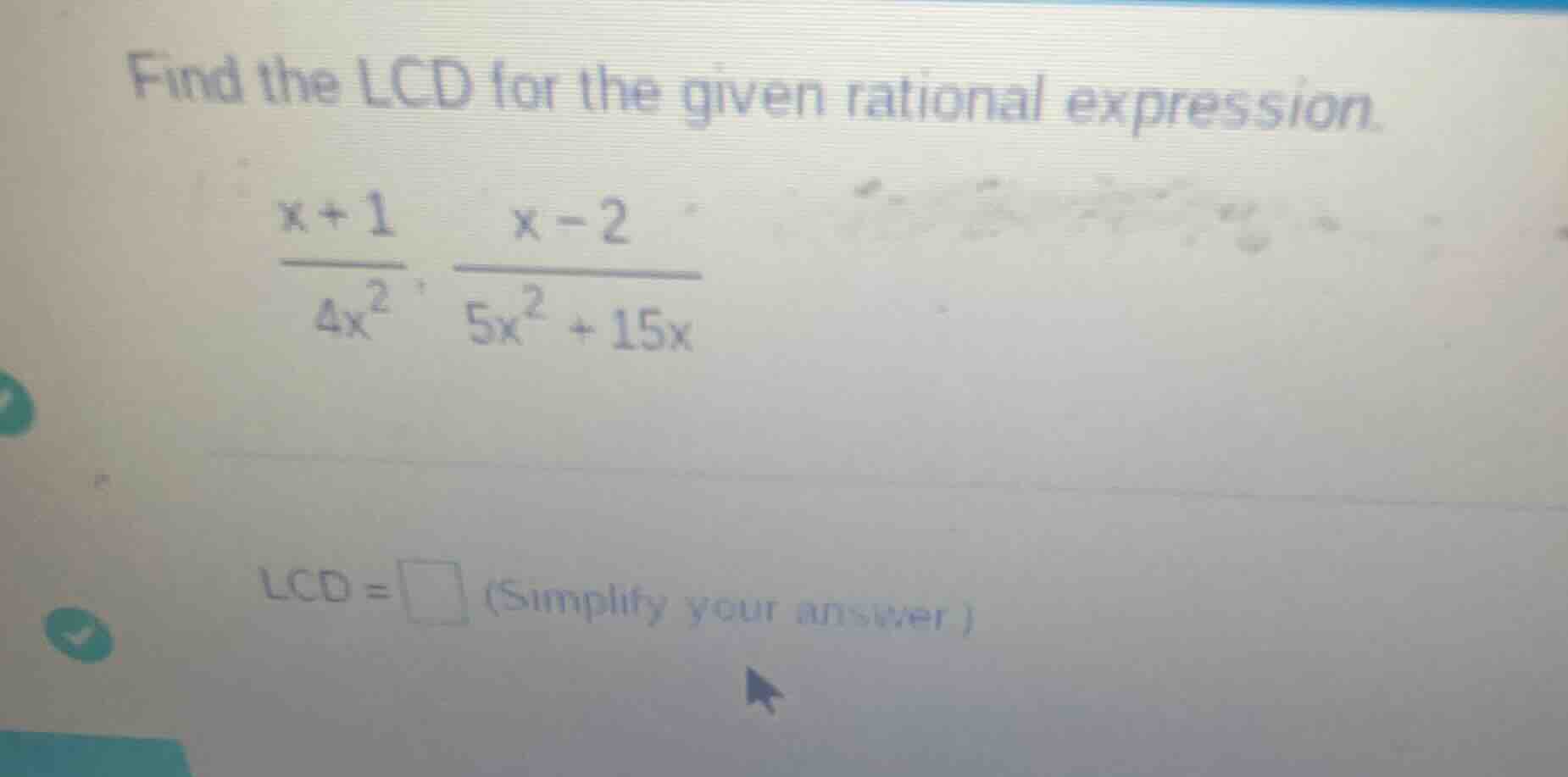
find the lcd for the given rational expression.
\\(\frac{x + 1}{4x^2}, \frac{x - 2}{5x^2 + 15x}\\)
lcd = \\(\square\\) (simplify your answer )
Step1: Factor denominators
First, factor the denominators of the two rational expressions. The first denominator is \(4x^2\), which is already factored as \(2^2 \cdot x^2\). The second denominator is \(5x^2 + 15x\), we can factor out the greatest common factor (GCF) from it. The GCF of \(5x^2\) and \(15x\) is \(5x\), so factoring gives \(5x(x + 3)\).
Step2: Identify prime factors
Now, identify the prime factors of each denominator:
- For \(4x^2 = 2^2 \cdot x^2\), the prime factors are \(2^2\) and \(x^2\).
- For \(5x(x + 3)\), the prime factors are \(5\), \(x\), and \((x + 3)\).
Step3: Determine LCD
To find the least common denominator (LCD), we take the highest power of each prime factor that appears in the factorizations.
- For the factor \(2\), the highest power is \(2^2\) (from \(4x^2\)).
- For the factor \(5\), the highest power is \(5^1\) (from \(5x(x + 3)\)).
- For the factor \(x\), the highest power is \(x^2\) (from \(4x^2\)).
- For the factor \((x + 3)\), the highest power is \((x + 3)^1\) (from \(5x(x + 3)\)).
Now, multiply these highest powers together:
\[
\text{LCD} = 2^2 \cdot 5 \cdot x^2 \cdot (x + 3)
\]
Simplify the numerical part: \(2^2 \cdot 5 = 4 \cdot 5 = 20\). So the LCD is \(20x^2(x + 3)\), and if we expand the \((x + 3)\) part (though it's not necessary, but let's check the expanded form for clarity: \(20x^2(x + 3)=20x^3 + 60x^2\), but the factored form is also correct. Wait, actually, when we factor the denominators, we can also write the LCD as the product of the distinct factors with their highest exponents. Let's re - check:
First denominator: \(4x^2=2^{2}\times x^{2}\)
Second denominator: \(5x^{2}+15x = 5x(x + 3)\)
The LCD is the product of the highest powers of all factors involved. So the factors are \(2^{2}\), \(5\), \(x^{2}\), and \((x + 3)\). Multiplying them together: \(2^{2}\times5\times x^{2}\times(x + 3)=4\times5\times x^{2}(x + 3)=20x^{2}(x + 3)\) or expanded \(20x^{3}+60x^{2}\). But usually, the factored form is preferred for LCD of rational expressions. However, let's check if we made a mistake in the factoring of the second denominator. The second denominator is \(5x^{2}+15x\), factoring out \(5x\) gives \(5x(x + 3)\), that's correct. The first denominator is \(4x^{2}=2^{2}x^{2}\). So the LCD is the LCM of \(4x^{2}\) and \(5x(x + 3)\).
To find LCM of two polynomials, we can use the formula \(LCM(a,b)=\frac{a\times b}{GCD(a,b)}\). First, find GCD of \(4x^{2}\) and \(5x(x + 3)\). The GCD of \(4x^{2}\) and \(5x(x + 3)\) is \(x\) (since the common factor between \(4x^{2}\) and \(5x(x + 3)\) is \(x\), as \(4\) and \(5\) are coprime, and the common power of \(x\) is \(x^1\)).
Then \(LCM(4x^{2},5x(x + 3))=\frac{4x^{2}\times5x(x + 3)}{x}=\frac{20x^{3}(x + 3)}{x}=20x^{2}(x + 3)\)

Snap & solve any problem in the app
Get step-by-step solutions on Sovi AI
Photo-based solutions with guided steps
Explore more problems and detailed explanations
\(20x^{2}(x + 3)\) (or \(20x^{3}+60x^{2}\))