QUESTION IMAGE
Question
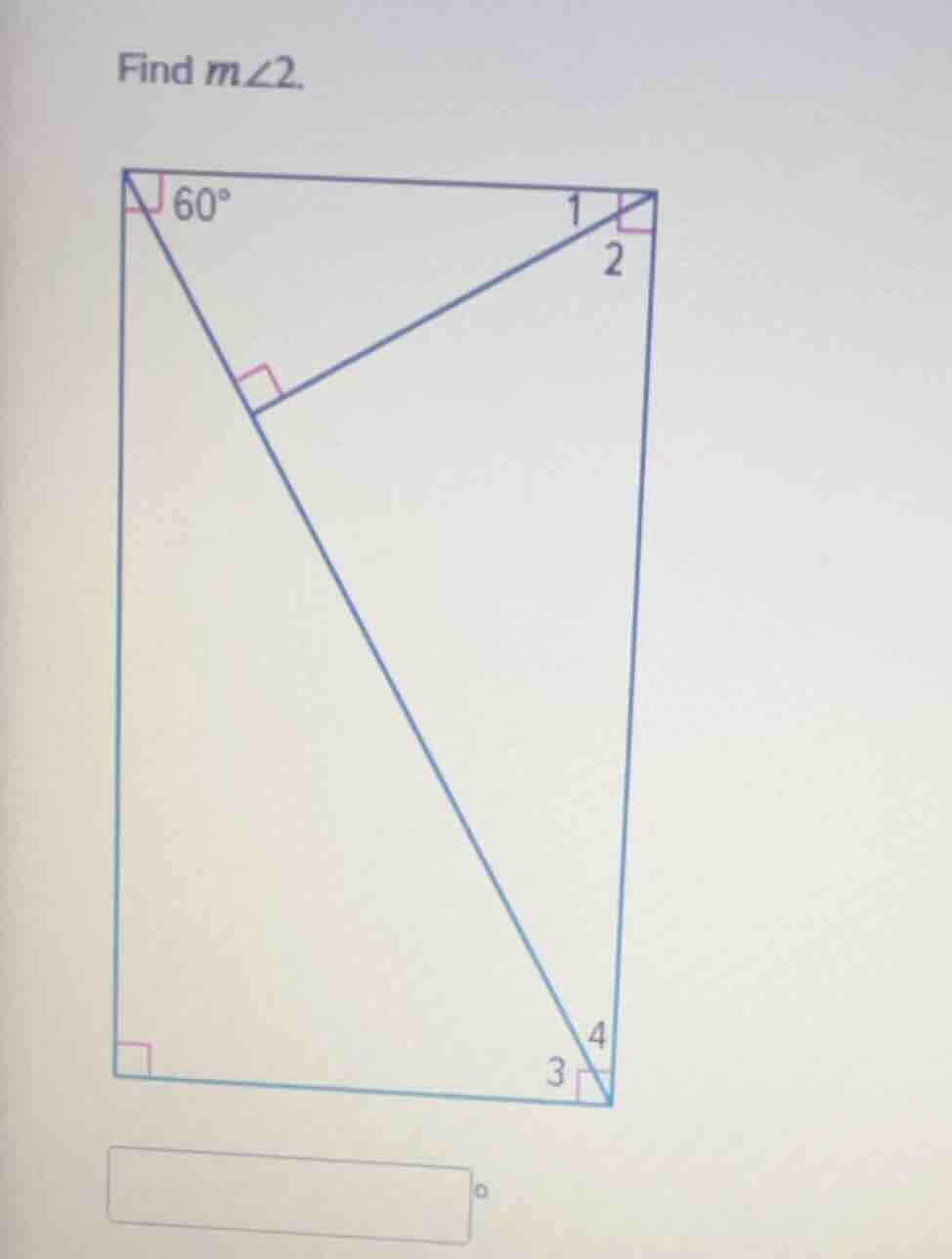
find ( mangle 2 ).
Step1: Analyze the rectangle's angles
In a rectangle, all angles are \(90^\circ\). The top - left corner has a \(60^\circ\) angle, so the angle adjacent to it (let's call it \(\angle1\)'s complementary angle in the small triangle) can be found. In the small right - triangle at the top, one angle is \(60^\circ\), and since it's a right - triangle (one angle is \(90^\circ\)), we know that the sum of angles in a triangle is \(180^\circ\). Also, the top - right corner of the rectangle is \(90^\circ\), which is split into \(\angle1\) and \(\angle2\).
First, look at the left - most right - triangle at the top. The angle at the top - left of the rectangle is \(90^\circ\), with a \(60^\circ\) angle, so the other non - right angle in that small triangle is \(90 - 60=30^\circ\).
Step2: Use the property of right - triangles and angle sums
Notice that the triangle containing \(\angle1\) and the triangle with the \(60^\circ\) angle are related. Also, the top - right angle of the rectangle is \(90^\circ\). Since the angle we found in the left - most small triangle is \(30^\circ\), and the triangles are set up such that \(\angle1\) and that \(30^\circ\) angle are equal (by the properties of rectangles and right - triangles, like similar triangles or angle - angle - angle congruence), then \(\angle1 = 30^\circ\).
Since \(\angle1+\angle2 = 90^\circ\) (because the top - right angle of the rectangle is \(90^\circ\)), we can solve for \(\angle2\): \(\angle2=90 - \angle1\). Substituting \(\angle1 = 30^\circ\), we get \(\angle2 = 60^\circ\).

Snap & solve any problem in the app
Get step-by-step solutions on Sovi AI
Photo-based solutions with guided steps
Explore more problems and detailed explanations
\(60\)