QUESTION IMAGE
Question
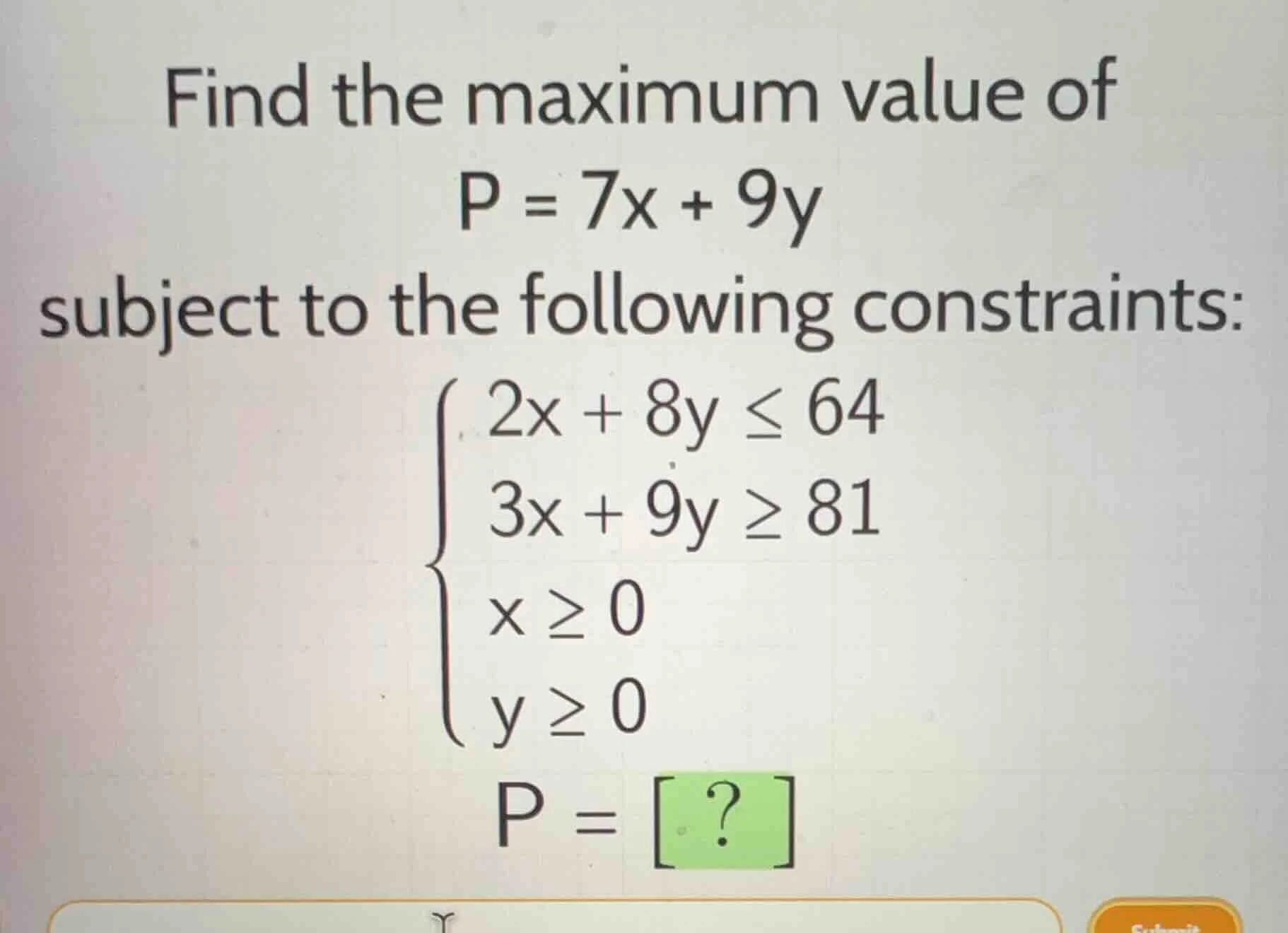
find the maximum value of
p = 7x + 9y
subject to the following constraints:
\
p = ?
Step1: Simplify Constraints
First, simplify the inequalities. For \(2x + 8y \leq 64\), divide by 2: \(x + 4y \leq 32\) or \(x = 32 - 4y\). For \(3x + 9y \geq 81\), divide by 3: \(x + 3y \geq 27\) or \(x = 27 - 3y\). Also, \(x \geq 0\), \(y \geq 0\).
Step2: Find Intersection of Constraints
To find the feasible region, we can find the intersection of \(x + 4y = 32\) and \(x + 3y = 27\). Subtract the second equation from the first: \((x + 4y)-(x + 3y)=32 - 27\) → \(y = 5\). Then substitute \(y = 5\) into \(x + 3y = 27\): \(x + 15 = 27\) → \(x = 12\).
Step3: Analyze Feasible Region Vertices
The feasible region is bounded by the constraints. The vertices are found by intersecting the boundary lines with the axes and with each other.
- Intersection of \(x + 4y = 32\) and \(x = 0\): \(0 + 4y = 32\) → \(y = 8\) (point \((0, 8)\)). But check \(x + 3y \geq 27\): \(0 + 24 = 24 < 27\), so \((0, 8)\) is not in feasible region.
- Intersection of \(x + 3y = 27\) and \(x = 0\): \(0 + 3y = 27\) → \(y = 9\). Check \(x + 4y \leq 32\): \(0 + 36 = 36 > 32\), not feasible.
- Intersection of \(x + 3y = 27\) and \(y = 0\): \(x = 27\). Check \(x + 4y \leq 32\): \(27 \leq 32\), so point \((27, 0)\).
- Intersection of \(x + 4y = 32\) and \(y = 0\): \(x = 32\). Check \(x + 3y \geq 27\): \(32 \geq 27\), so point \((32, 0)\). But wait, earlier intersection of the two main constraints is \((12, 5)\). Wait, maybe better to check the feasible region: the feasible region is where \(x + 3y \geq 27\), \(x + 4y \leq 32\), \(x \geq 0\), \(y \geq 0\). So solve \(x + 3y = 27\) and \(x = 0\): \(y = 9\) (but \(x + 4y = 36 > 32\), so not in \(x + 4y \leq 32\)). Solve \(x + 4y = 32\) and \(y = 0\): \(x = 32\) (and \(x + 3y = 32 \geq 27\), so valid). Solve \(x + 3y = 27\) and \(y = 0\): \(x = 27\) (and \(x + 4y = 27 \leq 32\), valid). And the intersection of \(x + 3y = 27\) and \(x + 4y = 32\) is \((12, 5)\) (as found earlier). Wait, but when \(y = 5\), \(x = 12\), check \(x + 4y = 12 + 20 = 32\) (good), \(x + 3y = 12 + 15 = 27\) (good). Now, check if there are other vertices. Wait, the feasible region is a polygon with vertices at \((27, 0)\), \((32, 0)\), and \((12, 5)\)? Wait no, wait when \(x = 32\), \(y = 0\): \(x + 3y = 32 \geq 27\) (yes), \(x + 4y = 32 \leq 32\) (yes). When \(x = 27\), \(y = 0\): \(x + 4y = 27 \leq 32\) (yes), \(x + 3y = 27 \geq 27\) (yes). When \(x = 12\), \(y = 5\): both constraints satisfied. Wait, but also, is there a vertex at \(y\) - axis? Let's see, for \(x = 0\), \(x + 3y \geq 27\) → \(y \geq 9\), but \(x + 4y \leq 32\) → \(y \leq 8\), which is a contradiction, so no vertex on \(x = 0\) except maybe none. So the feasible region vertices are \((27, 0)\), \((32, 0)\), and \((12, 5)\)? Wait, no, wait when \(x = 32\), \(y = 0\): \(P = 7*32 + 9*0 = 224\). When \(x = 27\), \(y = 0\): \(P = 7*27 + 9*0 = 189\). When \(x = 12\), \(y = 5\): \(P = 7*12 + 9*5 = 84 + 45 = 129\). Wait, but that can't be right, maybe I made a mistake. Wait, no, maybe the feasible region is actually where \(x + 3y \geq 27\) and \(x + 4y \leq 32\), so the region between these two lines and \(x \geq 0\), \(y \geq 0\). Wait, let's graph mentally: \(x + 3y = 27\) is a line with x-intercept 27, y-intercept 9. \(x + 4y = 32\) is a line with x-intercept 32, y-intercept 8. So the feasible region is above \(x + 3y = 27\) and below \(x + 4y = 32\), and \(x \geq 0\), \(y \geq 0\). So the intersection of \(x + 3y = 27\) and \(x + 4y = 32\) is \((12, 5)\) (as before). Then, the other vertices: where \(x + 4y = 32\) meets \(x = 0\): \(y = 8\), but \(x + 3y = 24 < 27\), so not in fe…

Snap & solve any problem in the app
Get step-by-step solutions on Sovi AI
Photo-based solutions with guided steps
Explore more problems and detailed explanations
\(224\)