QUESTION IMAGE
Question
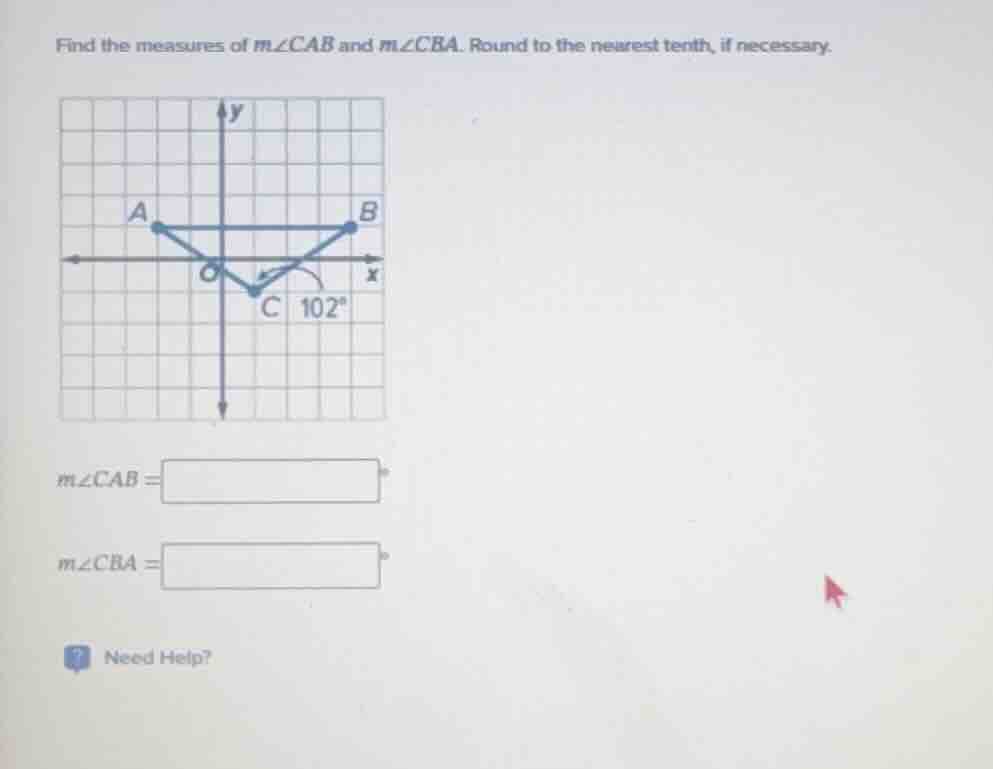
find the measures of ( mangle cab ) and ( mangle cba ). round to the nearest tenth, if necessary.( mangle cab = )( mangle cba = )need help?
Step1: Identify Triangle Type
From the grid, \( OA = OB \) (symmetric about y - axis), and \( OC \) is a common segment. So, \( \triangle OAC \cong \triangle OBC \) (by SSS or SAS). Also, \( AB \) is horizontal, \( OC \) is vertical (assuming grid lines are axis - aligned). The angle at \( C \) between \( OC \) and \( BC \) is related to the \( 102^{\circ} \) angle. Wait, actually, the triangle \( \triangle CAB \): first, we know that \( \angle AOB \) is a straight angle? No, wait, looking at the coordinates (assuming each grid square is 1 unit). Let's assume \( A=(-3,1) \), \( B=(3,1) \), \( C=(1, - 1) \)? Wait, no, better to see that \( OA = OB \), so \( AC = BC \), so \( \triangle CAB \) is isosceles with \( AC = BC \). Wait, the angle at \( C \): the angle between \( CB \) and the x - axis? Wait, the given angle is \( 102^{\circ} \), but actually, the angle \( \angle ACB \): since the angle between \( OC \) and \( BC \) is such that the total angle around the x - axis? Wait, no, let's think about the triangle sum. First, find the vertex angle at \( C \). The angle between \( AC \) and \( BC \): since \( \angle BCO \) and \( \angle ACO \): the angle between \( OC \) and the x - axis? Wait, maybe a better approach: since \( AB \) is horizontal, and \( OC \) is vertical (if we consider the grid), then \( OA = OB \), so \( AC = BC \), so \( \triangle CAB \) is isosceles with \( AC = BC \). The vertex angle \( \angle ACB \): the angle given is \( 102^{\circ} \)? Wait, no, the angle between \( CB \) and the x - axis is part of a \( 102^{\circ} \) angle? Wait, actually, the angle at \( C \) in \( \triangle CAB \): let's calculate the angle \( \angle ACB \). The angle between \( OC \) and the x - axis is \( 90^{\circ} \)? No, wait, the angle marked \( 102^{\circ} \): maybe the angle between \( BC \) and the x - axis is such that the angle between \( AC \) and \( BC \) is \( 180^{\circ}- 102^{\circ}=78^{\circ} \)? No, that's not right. Wait, let's use the fact that in \( \triangle CAB \), if \( AC = BC \), then it's isosceles with \( \angle CAB=\angle CBA \). The sum of angles in a triangle is \( 180^{\circ} \). So first, find the vertex angle \( \angle ACB \). Wait, the angle at \( C \): looking at the diagram, the angle between \( CB \) and the x - axis is \( 102^{\circ} \) from some line? Wait, maybe the angle \( \angle ACB = 180^{\circ}- 102^{\circ}=78^{\circ} \)? No, that's incorrect. Wait, actually, the angle between \( OC \) and \( BC \): if we consider the x - axis and y - axis, the angle between \( BC \) and the x - axis is \( 180 - 102=78^{\circ} \)? No, let's think differently. Since \( OA = OB \), the triangle \( OAB \) is isosceles with \( OA = OB \), and \( AB \) is horizontal. Then \( AC = BC \), so \( \triangle CAB \) is isosceles with \( AC = BC \). The vertex angle \( \angle ACB \): let's find the angle at \( C \). The angle between \( AC \) and \( BC \): since the angle between \( OC \) and \( BC \) is \( \theta \), and between \( OC \) and \( AC \) is also \( \theta \) (because of symmetry), and the angle between \( BC \) and the x - axis is \( 102^{\circ} \), but the angle between \( OC \) and the x - axis is \( 90^{\circ} \), so the angle between \( BC \) and \( OC \) is \( 102^{\circ}- 90^{\circ}=12^{\circ} \)? No, this is getting confusing. Wait, a better way: in \( \triangle CAB \), \( AC = BC \) (isosceles), so \( \angle CAB=\angle CBA \). The sum of angles in a triangle is \( 180^{\circ} \). We need to find \( \angle ACB \). The angle given is \( 102^{\circ} \), but actually, the angle \( \angle ACB = 180^{\c…

Snap & solve any problem in the app
Get step-by-step solutions on Sovi AI
Photo-based solutions with guided steps
Explore more problems and detailed explanations
\( m\angle CAB=\boxed{39^{\circ}} \)
\( m\angle CBA=\boxed{39^{\circ}} \)