QUESTION IMAGE
Question
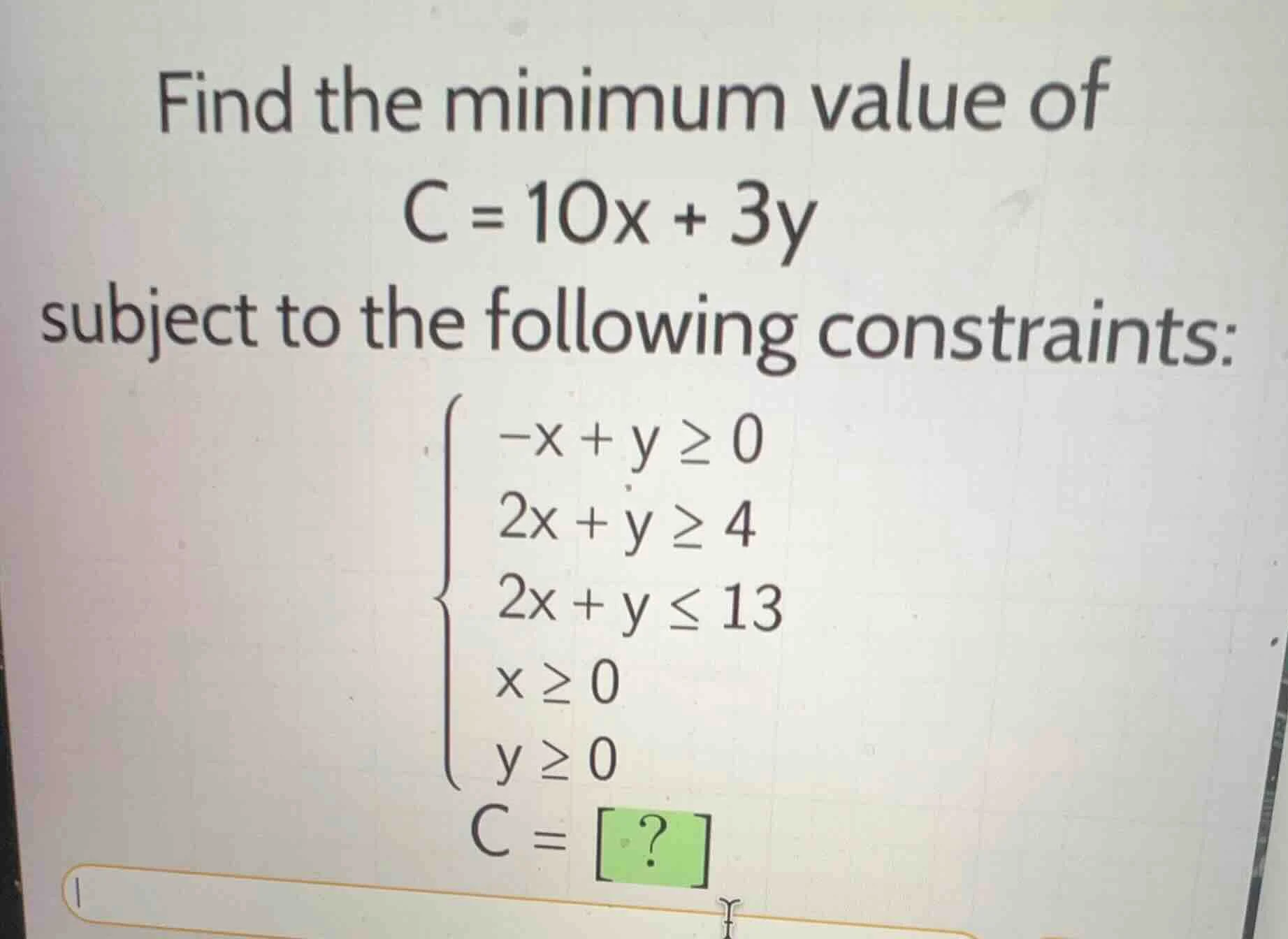
find the minimum value of
c = 10x + 3y
subject to the following constraints:
\
c = ?
Step1: Identify the feasible region vertices
First, we find the intersection points of the constraint lines.
- Intersection of \(-x + y = 0\) (i.e., \(y = x\)) and \(2x + y = 4\):
Substitute \(y = x\) into \(2x + y = 4\), we get \(2x + x = 4\), so \(3x = 4\), \(x=\frac{4}{3}\), \(y=\frac{4}{3}\). The point is \((\frac{4}{3},\frac{4}{3})\).
- Intersection of \(-x + y = 0\) and \(2x + y = 13\):
Substitute \(y = x\) into \(2x + y = 13\), we get \(2x + x = 13\), so \(3x = 13\), \(x=\frac{13}{3}\), \(y=\frac{13}{3}\). The point is \((\frac{13}{3},\frac{13}{3})\).
- Intersection of \(2x + y = 4\) and \(x = 0\):
Substitute \(x = 0\) into \(2x + y = 4\), we get \(y = 4\). The point is \((0,4)\).
- Intersection of \(2x + y = 13\) and \(x = 0\):
Substitute \(x = 0\) into \(2x + y = 13\), we get \(y = 13\). The point is \((0,13)\). Also, check the intersection with \(y = 0\), but since \(y\geq x\) and \(x\geq0\), when \(y = 0\), \(x\leq0\), but \(x\geq0\), so the only intersection on \(x = 0\) is as above.
Step2: Evaluate \(C = 10x + 3y\) at each vertex
- At \((\frac{4}{3},\frac{4}{3})\):
\(C = 10\times\frac{4}{3}+3\times\frac{4}{3}=\frac{40}{3}+\frac{12}{3}=\frac{52}{3}\approx17.33\)
- At \((0,4)\):
\(C = 10\times0 + 3\times4 = 12\)
- At \((\frac{13}{3},\frac{13}{3})\):
\(C = 10\times\frac{13}{3}+3\times\frac{13}{3}=\frac{130}{3}+\frac{39}{3}=\frac{169}{3}\approx56.33\)
- At \((0,13)\):
\(C = 10\times0+3\times13 = 39\)
Now, we also need to check the boundary where \(x\) and \(y\) are non - negative and satisfy other constraints. Wait, we missed the intersection of \(y = 0\) with other lines, but since \(y\geq x\) and \(x\geq0\), when \(y = 0\), \(x\leq0\), but \(x\geq0\), so the only valid vertices are the ones we found. Among the values of \(C\) at these vertices (\(\frac{52}{3}\approx17.33\), \(12\), \(\frac{169}{3}\approx56.33\), \(39\)), the minimum is \(12\). Wait, but let's re - check the intersection of \(2x + y = 4\) and \(y=x\) again. Wait, when \(x = 0\), \(2x + y=4\) gives \(y = 4\), and \(-x + y\geq0\) (i.e., \(y\geq x\)) is satisfied since \(4\geq0\). Now, is there a vertex between \(x = 0\) and \(x=\frac{4}{3}\)? Let's see the constraint \(-x + y\geq0\) ( \(y\geq x\)) and \(2x + y\geq4\), \(x\geq0\), \(y\geq0\). The feasible region is bounded by these lines. The vertex with the minimum \(C\) is at \((0,4)\)? Wait, no, wait when \(x=\frac{4}{3}\), \(y=\frac{4}{3}\), \(C=\frac{52}{3}\approx17.33\), and at \((0,4)\), \(C = 12\). But wait, let's check the constraint \(-x + y\geq0\) at \((0,4)\): \(-0 + 4=4\geq0\), which is satisfied. \(2x + y=4\geq4\) (satisfied), \(2x + y = 4\leq13\) (satisfied), \(x = 0\geq0\), \(y = 4\geq0\). Now, is there a point where \(x\) is between \(0\) and \(\frac{4}{3}\)? Let's take \(x = 1\), then from \(y\geq x\) ( \(y\geq1\)) and \(2x + y\geq4\) ( \(y\geq4 - 2x=2\)). So \(y\geq2\). Then \(C = 10\times1+3y=10 + 3y\), when \(y = 2\), \(C = 16\), which is more than \(12\). So the minimum occurs at \((0,4)\)? Wait, no, wait the constraint \(-x + y\geq0\) is \(y\geq x\), and \(2x + y\geq4\). When \(x = 0\), \(y\geq4\) (from \(2x + y\geq4\)) and \(y\geq0\) (from \(y\geq x = 0\)), so the lower bound for \(y\) when \(x = 0\) is \(y = 4\). When \(x\) increases, \(y\) must be at least \(x\) and at least \(4 - 2x\). The intersection of \(y = x\) and \(y=4 - 2x\) is at \(x=\frac{4}{3}\), \(y=\frac{4}{3}\), but \(4-2x=\frac{4}{3}\) when \(x=\frac{4}{3}\), and \(x=\frac{4}{3}\approx1.33\), \(y=\frac{4}{3}\approx1.33\), but \(4-2x\) when \(x = 0\) is \(4\), which is greater than \(x = 0\). So the feasi…

Snap & solve any problem in the app
Get step-by-step solutions on Sovi AI
Photo-based solutions with guided steps
Explore more problems and detailed explanations
\(12\)