QUESTION IMAGE
Question
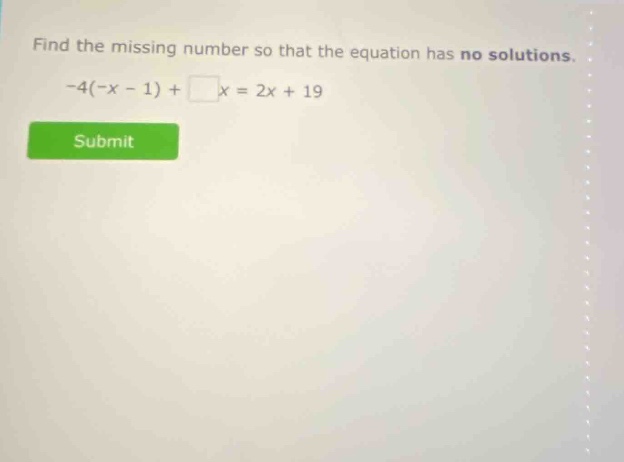
find the missing number so that the equation has no solutions.
$-4(-x - 1) + \square x = 2x + 19$
submit
Step1: Simplify left - hand side
First, expand \(-4(-x - 1)\) using the distributive property \(a(b + c)=ab+ac\). Here \(a=-4\), \(b=-x\), \(c = - 1\), so \(-4(-x-1)=(-4)\times(-x)+(-4)\times(-1)=4x + 4\).
The left - hand side of the equation becomes \(4x + 4+\square x=(4 + \square)x+4\). The equation is now \((4+\square)x + 4=2x+19\).
Step2: Analyze no - solution condition
For a linear equation of the form \(ax + b=cx + d\) to have no solutions, the coefficients of \(x\) must be equal (\(a = c\)) and the constant terms must be different (\(b
eq d\)).
We want the coefficient of \(x\) on the left - hand side to be equal to the coefficient of \(x\) on the right - hand side, i.e., \(4+\square=2\). And we also need to check the constant terms. The constant term on the left is \(4\) and on the right is \(19\), and \(4
eq19\) which satisfies the second condition for no solutions.
Solve the equation \(4+\square=2\) for \(\square\). Subtract \(4\) from both sides: \(\square=2 - 4=-2\).

Snap & solve any problem in the app
Get step-by-step solutions on Sovi AI
Photo-based solutions with guided steps
Explore more problems and detailed explanations
\(-2\)