QUESTION IMAGE
Question
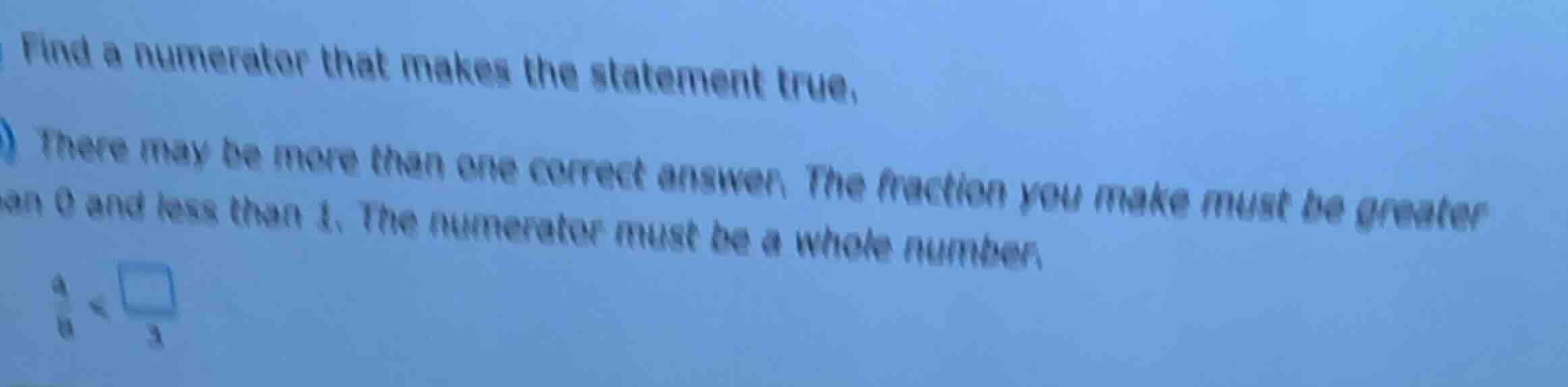
find a numerator that makes the statement true. there may be more than one correct answer. the fraction you make must be greater than 0 and less than 1. the numerator must be a whole number. \\(\frac{4}{8} < \frac{square}{3}\\)
Step1: Analyze the inequality
We have the inequality \(\frac{4}{8}<\frac{\square}{3}\), and the fraction \(\frac{\square}{3}\) must satisfy \(0 < \frac{\square}{3}< 1\), so \(\square\) must be a whole number and \(0<\square < 3\) (since if \(\frac{\square}{3}<1\), then \(\square < 3\) when multiplying both sides by 3, and \(\square>0\) for the fraction to be positive). Also, we need \(\frac{4}{8}<\frac{\square}{3}\). First, simplify \(\frac{4}{8}=\frac{1}{2} = 0.5\).
Step2: Solve the inequality \(\frac{1}{2}<\frac{\square}{3}\)
Multiply both sides of the inequality by 3 (since 3 is positive, the inequality sign remains the same) to get \(\frac{3}{2}<\square\), which is \(1.5 < \square\).
Step3: Find the whole number \(\square\)
From Step1, \(\square\) is a whole number with \(0 < \square< 3\), and from Step2, \(\square> 1.5\). The whole numbers between \(1.5\) and \(3\) are \(2\).

Snap & solve any problem in the app
Get step-by-step solutions on Sovi AI
Photo-based solutions with guided steps
Explore more problems and detailed explanations
2