QUESTION IMAGE
Question
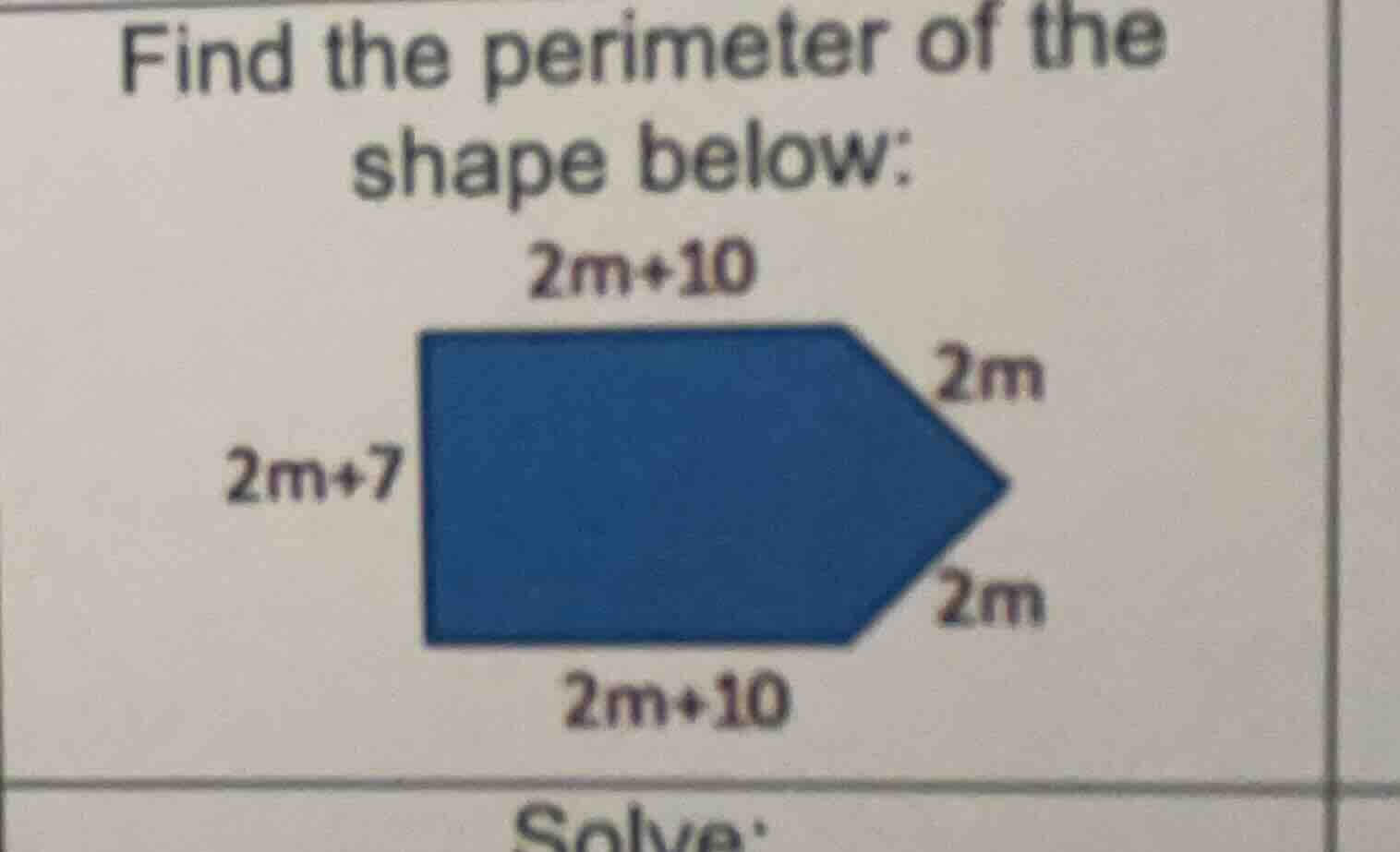
find the perimeter of the shape below: 2m+10 2m 2m+7 2m 2m+10 solve
Step1: Identify all sides
The shape has sides: \(2m + 10\), \(2m\), \(2m + 10\), \(2m\), and \(2m + 7\) (wait, no, let's re - examine. Wait, the shape: two sides of \(2m + 10\), two sides of \(2m\), and one side of \(2m+7\)? Wait, no, looking at the diagram, the shape is a rectangle with a triangle attached? Wait, no, the sides: let's count the number of sides. The left side is \(2m + 7\), the top and bottom are \(2m+10\) each, and the right side has two sides of \(2m\) each? Wait, no, the diagram: the blue shape has a left vertical side \(2m + 7\), two horizontal sides (top and bottom) each \(2m+10\), and two slant (or maybe equal) sides on the right each \(2m\). Wait, actually, to find the perimeter, we sum all the side lengths.
So the sides are: \(2m + 10\) (top), \(2m\) (right - top), \(2m\) (right - bottom), \(2m+10\) (bottom), and \(2m + 7\) (left). Wait, no, maybe I miscounted. Wait, the correct way: perimeter is the sum of all outer sides. Let's list all the sides:
- Top: \(2m+10\)
- Right - upper: \(2m\)
- Right - lower: \(2m\)
- Bottom: \(2m + 10\)
- Left: \(2m+7\)
Wait, no, that's five sides? Wait, no, maybe the left side is \(2m + 7\), and then the top, bottom, and two right sides, and another side? Wait, no, let's do it properly. Let's add all the side lengths:
Perimeter \(P=(2m + 10)+2m+2m+(2m + 10)+(2m + 7)\)
Step2: Combine like terms
First, expand the sum:
\(P=(2m+10)+2m + 2m+(2m + 10)+(2m + 7)\)
Combine the \(m\) terms: \(2m+2m + 2m+2m+2m=10m\)
Combine the constant terms: \(10 + 10+7 = 27\)
Wait, wait, no, wait: \(2m+10\) (top), \(2m\) (right1), \(2m\) (right2), \(2m + 10\) (bottom), and \(2m+7\) (left). So the \(m\) terms: \(2m+2m+2m+2m+2m\)? Wait, no, \(2m+10\) has \(2m\), \(2m\) (right1), \(2m\) (right2), \(2m + 10\) has \(2m\), and \(2m+7\) has \(2m\). So total \(m\) terms: \(2m+2m+2m+2m+2m = 10m\)? Wait, no, \(2m+10\) (top): \(2m\), \(2m\) (right1), \(2m\) (right2), \(2m + 10\) (bottom): \(2m\), and \(2m+7\) (left): \(2m\). So that's \(2m\times5\)? No, wait, no, the left side is \(2m + 7\), which is a single side. Wait, I think I made a mistake. Let's re - express the perimeter:
The shape: left side: \(2m + 7\)
Top side: \(2m+10\)
Right - upper side: \(2m\)
Right - lower side: \(2m\)
Bottom side: \(2m+10\)
So now, sum all these:
\(P=(2m + 10)+2m+2m+(2m + 10)+(2m + 7)\)
Now, combine the \(m\) terms: \(2m+2m+2m+2m+2m=10m\)
Combine the constant terms: \(10 + 10+7 = 27\)
Wait, but that would be \(10m+27\)? Wait, no, wait: \(2m+10\) (top) + \(2m\) (right - top) + \(2m\) (right - bottom) + \(2m+10\) (bottom) + \(2m + 7\) (left). Let's add the \(m\) coefficients: \(2 + 2+2+2+2=10\), and constants: \(10 + 10+7 = 27\). So \(P = 10m+27\)? Wait, no, wait, maybe the left side is not \(2m + 7\). Wait, maybe the shape is a rectangle with a triangle, but the left side is \(2m + 7\), top and bottom are \(2m+10\), and the right side is two sides of \(2m\) each. Wait, but let's check again.
Wait, another approach: the perimeter is the sum of all outer edges. Let's list each edge:
- Top: \(2m + 10\)
- Right - upper: \(2m\)
- Right - lower: \(2m\)
- Bottom: \(2m + 10\)
- Left: \(2m+7\)
Now, sum them:
\((2m + 10)+2m+2m+(2m + 10)+(2m + 7)\)
\(=2m+10 + 2m+2m+2m+10+2m+7\)
Group like terms:
\((2m+2m+2m+2m+2m)+(10 + 10+7)\)
\(=10m+27\)

Snap & solve any problem in the app
Get step-by-step solutions on Sovi AI
Photo-based solutions with guided steps
Explore more problems and detailed explanations
The perimeter of the shape is \(\boldsymbol{10m + 27}\)