QUESTION IMAGE
Question
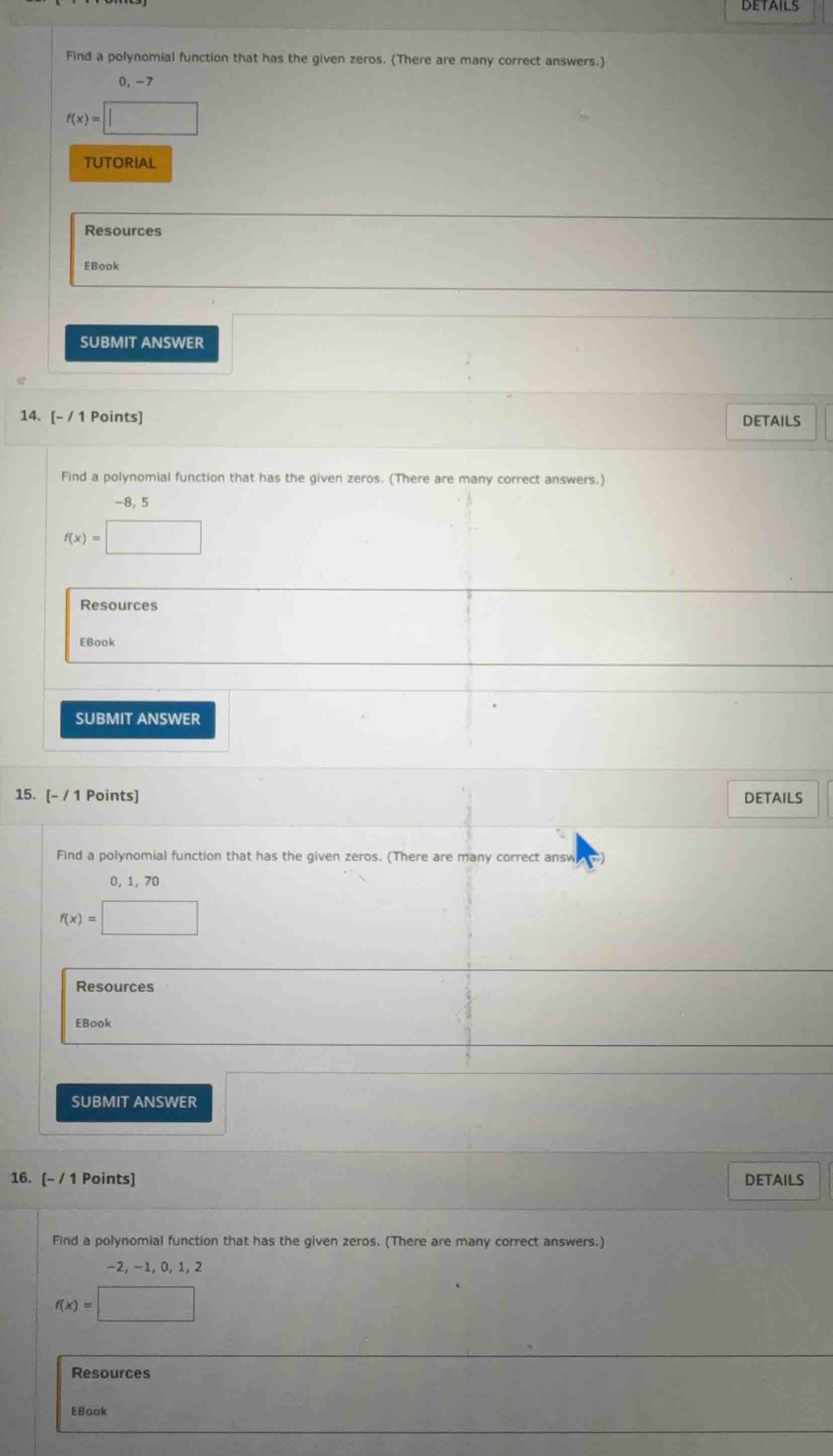
find a polynomial function that has the given zeros. (there are many correct answers.)
0, -7
f(x) =
- find a polynomial function that has the given zeros. (there are many correct answers.)
-8, 5
f(x) =
- find a polynomial function that has the given zeros. (there are many correct answers.)
0, 1, 70
f(x) =
- find a polynomial function that has the given zeros. (there are many correct answers.)
-2, -1, 0, 1, 2
f(x) =
Problem 1 (Zeros: 0, -7)
Step1: Identify factors from zeros
If \( x = 0 \), then the factor is \( x \). If \( x=-7 \), then the factor is \( (x + 7) \) (since \( x+7 = 0 \) when \( x=-7 \)).
Step2: Form the polynomial
A polynomial with these zeros can be formed by multiplying the factors. So \( f(x)=x(x + 7) \). We can expand this: \( f(x)=x^2+7x \) (or we can leave it in factored form, or multiply by a non - zero constant, but a simple one is \( x(x + 7) \) or its expansion).
Step1: Identify factors from zeros
If \( x=-8 \), the factor is \( (x + 8) \) (because \( x + 8=0\) when \( x=-8\)). If \( x = 5 \), the factor is \( (x - 5) \) (because \( x-5 = 0\) when \( x = 5\)).
Step2: Form the polynomial
Multiply the factors: \( f(x)=(x + 8)(x - 5) \). Expanding this: \( f(x)=x^{2}-5x+8x - 40=x^{2}+3x - 40 \) (or we can leave it in factored form, or multiply by a non - zero constant).
Step1: Identify factors from zeros
If \( x = 0 \), the factor is \( x \). If \( x=1 \), the factor is \( (x - 1) \) (since \( x-1=0\) when \( x = 1\)). If \( x = 70 \), the factor is \( (x - 70) \) (since \( x-70=0\) when \( x = 70\)).
Step2: Form the polynomial
Multiply the factors: \( f(x)=x(x - 1)(x - 70) \). We can also expand it, but a simple form is the product of the factors.

Snap & solve any problem in the app
Get step-by-step solutions on Sovi AI
Photo-based solutions with guided steps
Explore more problems and detailed explanations
\( f(x)=x(x + 7) \) (or \( f(x)=x^{2}+7x \), or any non - zero multiple like \( 2x(x + 7) \) etc. Here we use the simplest non - constant multiple case with leading coefficient 1)