QUESTION IMAGE
Question
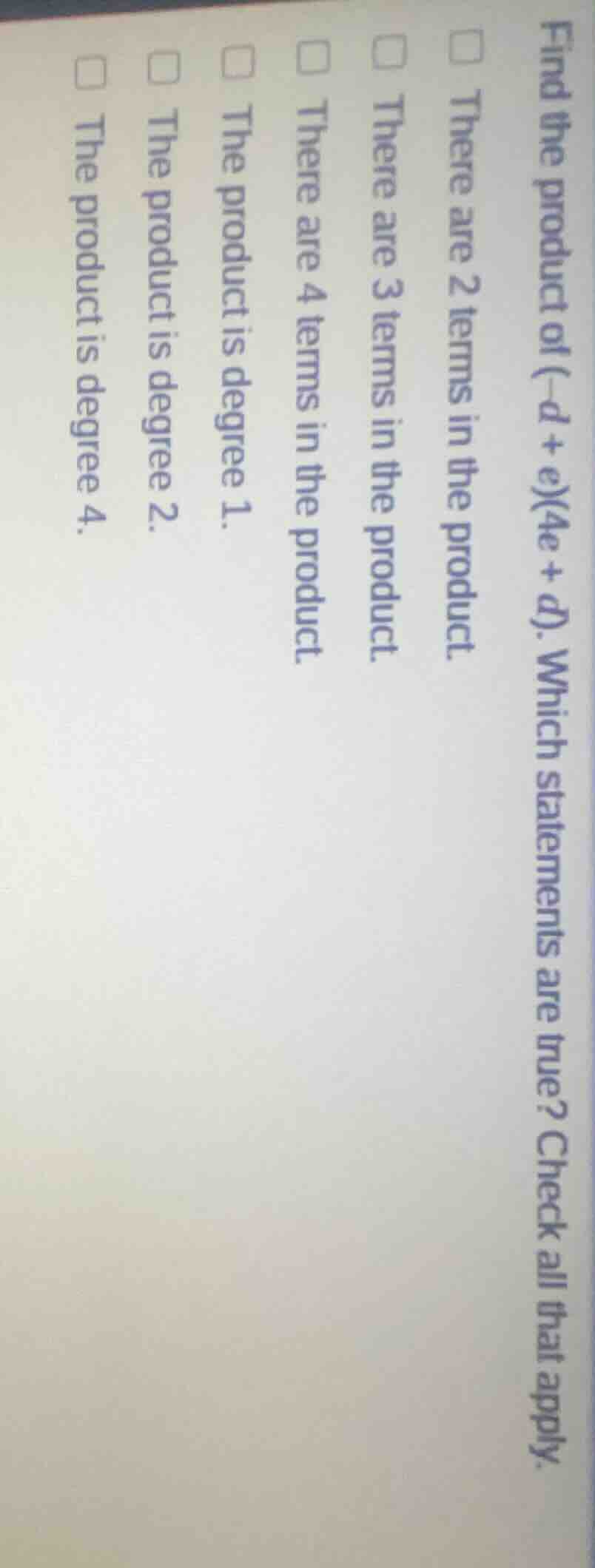
find the product of (-d + e)(4e + d). which statements are true? check all that apply. there are 2 terms in the product. there are 3 terms in the product. there are 4 terms in the product. the product is degree 1. the product is degree 2. the product is degree 4.
Step1: Expand the product
We use the distributive property (FOIL method) to expand \((-d + e)(4e + d)\).
First, multiply \(-d\) by \(4e\): \(-d\times4e=-4de\)
Then, multiply \(-d\) by \(d\): \(-d\times d=-d^{2}\)
Next, multiply \(e\) by \(4e\): \(e\times4e = 4e^{2}\)
Finally, multiply \(e\) by \(d\): \(e\times d=de\)
Now, combine like terms: \(-4de - d^{2}+4e^{2}+de=-3de - d^{2}+4e^{2}\)
Step2: Analyze the number of terms
The expanded form is \(-3de - d^{2}+4e^{2}\), which has 3 terms. So "There are 3 terms in the product" is true.
Step3: Analyze the degree of the product
The degree of a term is the sum of the exponents of its variables.
For \(-3de\): degree is \(1 + 1=2\)
For \(-d^{2}\): degree is \(2\)
For \(4e^{2}\): degree is \(2\)
The highest degree among the terms is 2, so the product is degree 2. So "The product is degree 2" is true.

Snap & solve any problem in the app
Get step-by-step solutions on Sovi AI
Photo-based solutions with guided steps
Explore more problems and detailed explanations
B. There are 3 terms in the product, E. The product is degree 2 (assuming the options are labeled as A: There are 2 terms in the product, B: There are 3 terms in the product, C: There are 4 terms in the product, D: The product is degree 1, E: The product is degree 2, F: The product is degree 4. If the original options have different labels, adjust accordingly, but based on the analysis, the correct statements are "There are 3 terms in the product" and "The product is degree 2".)