QUESTION IMAGE
Question
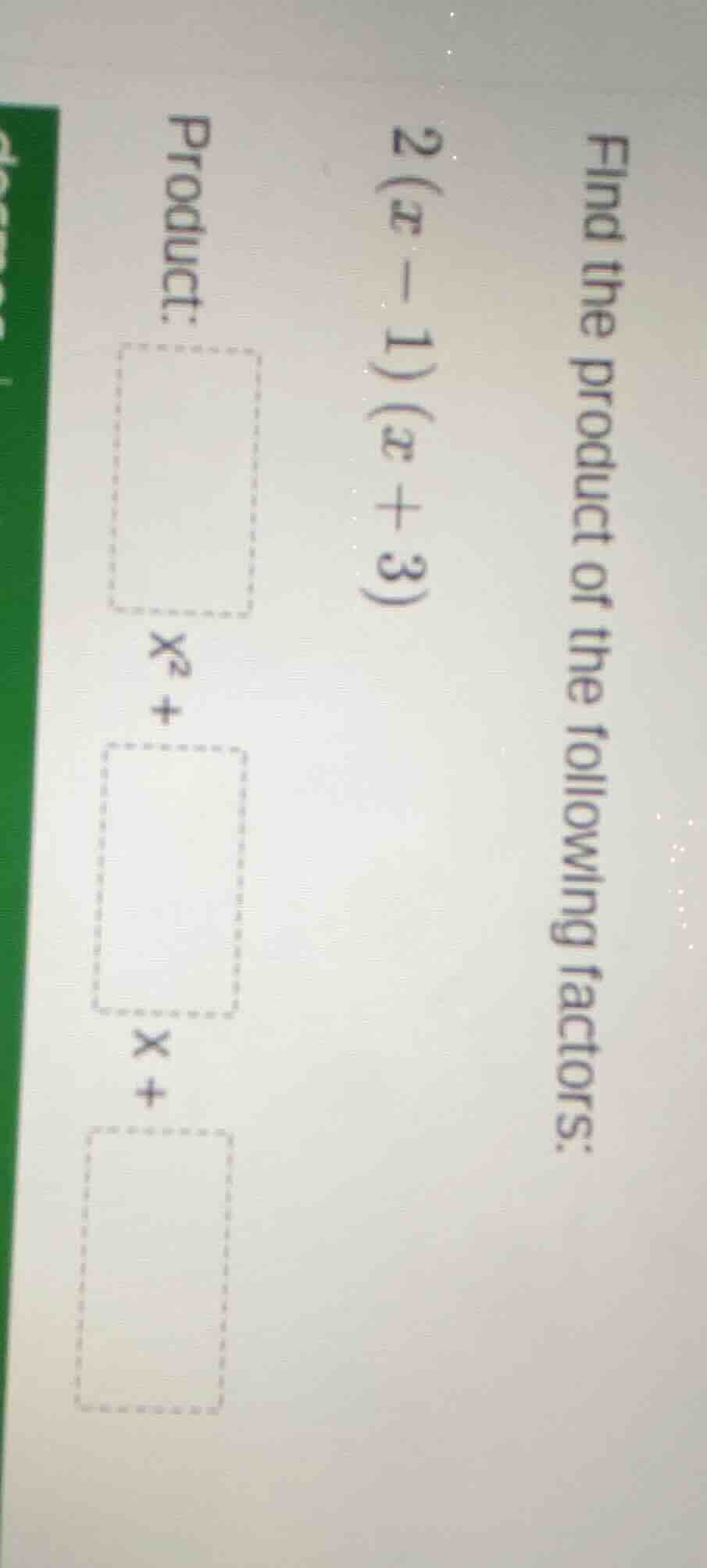
find the product of the following factors: 2(x - 1)(x + 3) product: $x^2 + \square x + \square$
Step1: Expand the product using distributive property (FOIL)
First, multiply the first terms: \(x \times x = x^2\)
Then, the outer terms: \(x \times 3 = 3x\)
Next, the inner terms: \(-1 \times x = -x\)
Finally, the last terms: \(-1 \times 3 = -3\)
Now, combine these terms: \(x^2 + 3x - x - 3\)
Step2: Combine like terms
Combine the \(x\) terms: \(3x - x = 2x\)
So the expression becomes \(x^2 + 2x - 3\)
Wait, but there's a factor of 2 in front? Wait, the original problem is \(2(x - 1)(x + 3)\)? Wait, maybe I misread. Let me check again.
Oh, the original problem is \(2(x - 1)(x + 3)\). So first, expand \((x - 1)(x + 3)\) as above to get \(x^2 + 2x - 3\), then multiply by 2.
Step3: Multiply by 2
\(2(x^2 + 2x - 3) = 2x^2 + 4x - 6\)
Wait, maybe the initial problem was written as \(2(x - 1)(x + 3)\) or maybe \((x - 1)(x + 3)\) with a 2? Let's re-express.
If the problem is \(2(x - 1)(x + 3)\):
First, expand \((x - 1)(x + 3)\):
\(x(x) + x(3) - 1(x) - 1(3) = x^2 + 3x - x - 3 = x^2 + 2x - 3\)
Then multiply by 2:
\(2(x^2 + 2x - 3) = 2x^2 + 4x - 6\)
But if the problem was \((x - 1)(x + 3)\) without the 2, then it's \(x^2 + 2x - 3\). Wait, the image shows "2(x - 1)(x + 3)"? Let me check the image again.
Looking at the image: "2 (x - 1)(x + 3)". So yes, the 2 is a factor. So let's redo:
Step1: Expand \((x - 1)(x + 3)\)
Using FOIL:
First: \(x \times x = x^2\)
Outer: \(x \times 3 = 3x\)
Inner: \(-1 \times x = -x\)
Last: \(-1 \times 3 = -3\)
Combine: \(x^2 + 3x - x - 3 = x^2 + 2x - 3\)
Step2: Multiply by 2
\(2(x^2 + 2x - 3) = 2x^2 + 4x - 6\)
But the given product has blanks: "Product: \(x^2 + \square x + \square\)". Wait, maybe the 2 was a typo? Or maybe the problem is \((x - 1)(x + 3)\) with a 2? Wait, the image shows "2 (x - 1)(x + 3)" and then "Product: \(x^2 + \square x + \square\)". Wait, maybe the 2 is a mistake, or maybe the problem is \((x - 1)(x + 3)\) and the 2 is part of the problem? Wait, no, if we expand \((x - 1)(x + 3)\) we get \(x^2 + 2x - 3\), but the product is written as \(x^2 + \square x + \square\), so maybe the 2 is a coefficient outside, but the blanks are for the middle term and constant term after expanding \((x - 1)(x + 3)\) and then maybe the 2 is a mistake. Alternatively, maybe the problem is \(2(x - 1)(x + 3)\) but the product is written as \(x^2 + \square x + \square\) with a 2? No, that doesn't make sense. Wait, maybe the original problem is \((x - 1)(x + 3)\) and the 2 is a typo. Let's assume the problem is \((x - 1)(x + 3)\) for the product form given (with \(x^2 + \square x + \square\)).
So expanding \((x - 1)(x + 3)\):
First terms: \(x \times x = x^2\)
Outer terms: \(x \times 3 = 3x\)
Inner terms: \(-1 \times x = -x\)
Last terms: \(-1 \times 3 = -3\)
Combine like terms: \(3x - x = 2x\), so the product is \(x^2 + 2x - 3\). So the middle term is 2x, and the constant term is -3. But the product is written as \(x^2 + \square x + \square\), so maybe the constant term is -3, but the box is for the coefficient of x (2) and the constant term (-3).
But if the problem is \(2(x - 1)(x + 3)\), then expanding gives \(2x^2 + 4x - 6\), but the product form is \(x^2 + \square x + \square\), which suggests the leading coefficient is 1, so maybe the 2 is a mistake. Let's proceed with \((x - 1)(x + 3)\) first.
So, expanding \((x - 1)(x + 3)\):
Step1: Apply FOIL
\((x - 1)(x + 3) = x \cdot x + x \cdot 3 - 1 \cdot x - 1 \cdot 3 = x^2 + 3x - x - 3\)
Step2: Combine like terms
\(3x - x = 2x\), so \(x^2 + 2x - 3\)
So the product is \(x^2 + 2x - 3\), so the middle term is 2x (so the box for x is 2) and t…

Snap & solve any problem in the app
Get step-by-step solutions on Sovi AI
Photo-based solutions with guided steps
Explore more problems and detailed explanations
The product is \(x^2 + 2x - 3\) (if the 2 is a typo) or \(2x^2 + 4x - 6\) (if the 2 is part of the problem). But based on the product form \(x^2 + \square x + \square\), it's likely \((x - 1)(x + 3)\) with the 2 being a mistake, so the middle term is 2 and the constant term is -3. So the product is \(x^2 + 2x - 3\), so the blanks are 2 and -3. But if the 2 is part of the problem, then it's \(2x^2 + 4x - 6\), but the form given is \(x^2 + \square x + \square\), so probably the 2 is a typo. So the answer is \(x^2 + 2x - 3\), with the middle term coefficient 2 and constant term -3.