QUESTION IMAGE
Question
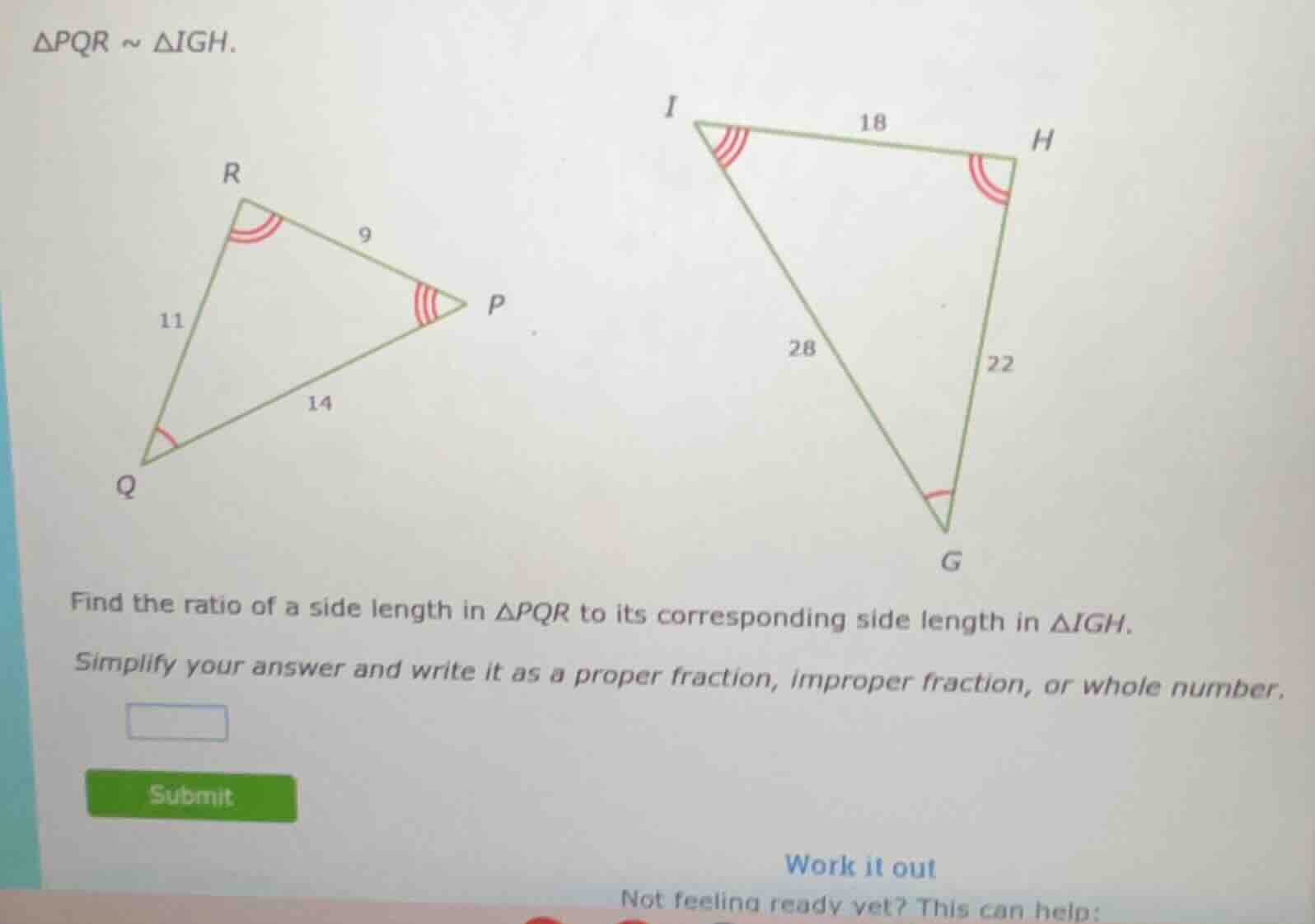
$\triangle pqr \sim \triangle igh$.
find the ratio of a side length in $\triangle pqr$ to its corresponding side length in $\triangle igh$.
simplify your answer and write it as a proper fraction, improper fraction, or whole number.
Step1: Identify corresponding sides
First, we need to find the corresponding sides of the similar triangles \( \triangle PQR \) and \( \triangle IGH \). From the angle markings, we can see the correspondence: \( P \) corresponds to \( I \), \( Q \) corresponds to \( G \), and \( R \) corresponds to \( H \). So, side \( PR = 9 \) in \( \triangle PQR \) corresponds to side \( IH = 18 \) in \( \triangle IGH \), side \( PQ = 14 \) corresponds to \( IG = 28 \), and side \( QR = 11 \) corresponds to \( GH = 22 \).
Step2: Calculate the ratio
We can take one pair of corresponding sides, say \( PR \) and \( IH \). The ratio of a side in \( \triangle PQR \) to its corresponding side in \( \triangle IGH \) is \( \frac{PR}{IH} = \frac{9}{18} \) (or we could use \( \frac{14}{28} \) or \( \frac{11}{22} \), all will simplify to the same value).
Step3: Simplify the fraction
Simplify \( \frac{9}{18} \) by dividing both the numerator and the denominator by their greatest common divisor, which is 9. So, \( \frac{9 \div 9}{18 \div 9} = \frac{1}{2} \). We can check with other pairs: \( \frac{14}{28} = \frac{1}{2} \) and \( \frac{11}{22} = \frac{1}{2} \).

Snap & solve any problem in the app
Get step-by-step solutions on Sovi AI
Photo-based solutions with guided steps
Explore more problems and detailed explanations
\( \frac{1}{2} \)