QUESTION IMAGE
Question
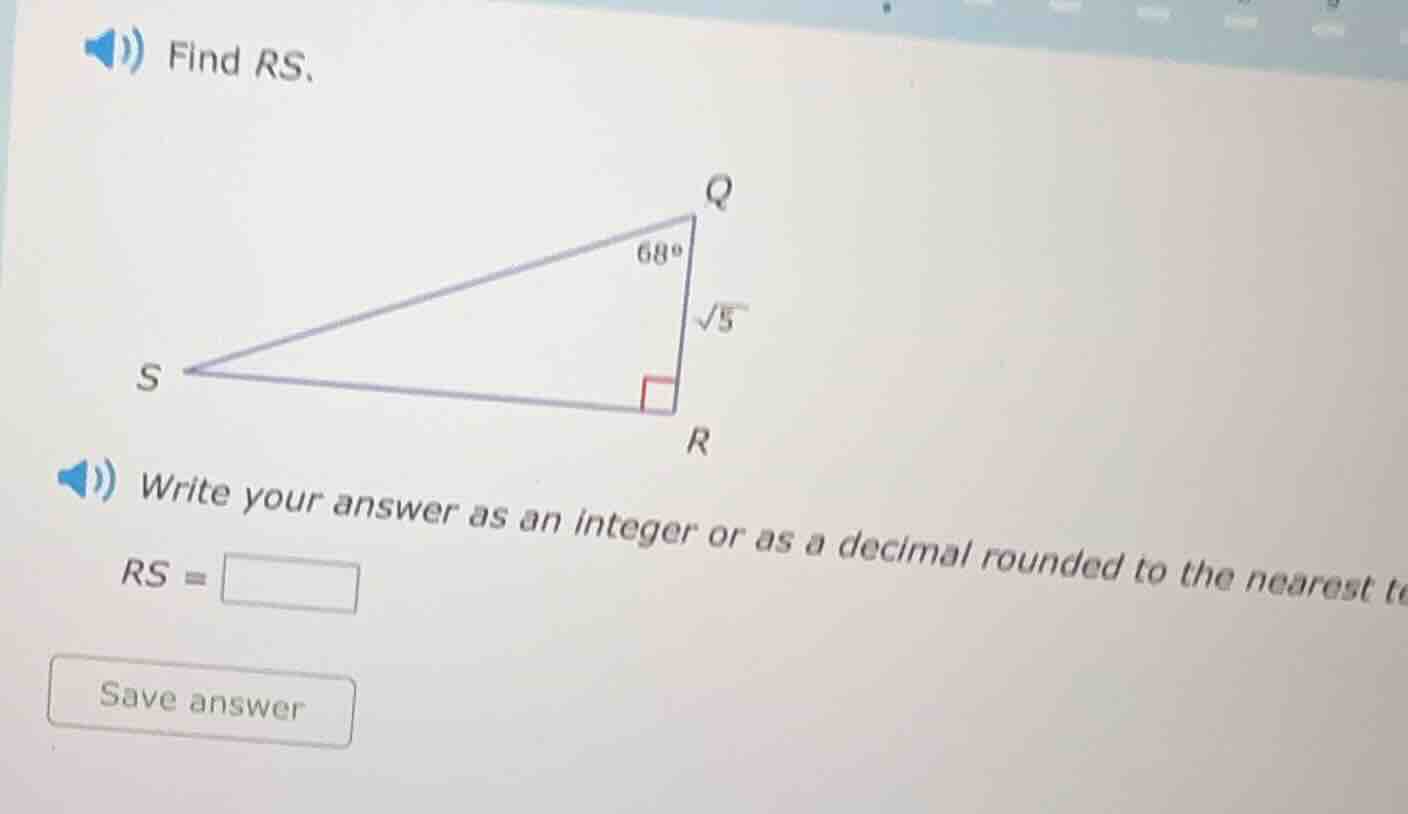
find rs.
write your answer as an integer or as a decimal rounded to the nearest te
rs =
save answer
Step1: Identify the trigonometric ratio
In right triangle \( RQS \), we know angle \( Q = 68^\circ \), side \( RQ=\sqrt{5} \) (adjacent to angle \( Q \)), and we need to find \( RS \) (opposite to angle \( Q \)). So we use the tangent function: \( \tan\theta=\frac{\text{opposite}}{\text{adjacent}} \).
\( \tan(68^\circ)=\frac{RS}{RQ} \)
Step2: Substitute the known values
We know \( RQ = \sqrt{5}\approx2.236 \) and \( \tan(68^\circ)\approx2.475 \). Substitute into the formula:
\( RS=\tan(68^\circ)\times RQ \)
\( RS\approx2.475\times2.236 \)
Step3: Calculate the value
\( 2.475\times2.236\approx5.53 \) (rounded to the nearest hundredth, if we consider the problem might expect a more precise or adjusted, but let's check again. Wait, maybe I made a mistake. Wait, \( RQ \) is adjacent, \( RS \) is opposite? Wait no, wait the right angle is at \( R \), so angle at \( Q \) is \( 68^\circ \), so \( RQ \) is adjacent to angle \( Q \), \( RS \) is opposite? Wait no, \( RQ \) is one leg, \( RS \) is the other leg. Wait, \( \tan(angle Q)=\frac{RS}{RQ} \), so \( RS = RQ\times\tan(angle Q) \). Wait \( RQ=\sqrt{5}\approx2.236 \), \( \tan(68^\circ)\approx2.475 \), so \( 2.236\times2.475\approx5.53 \)? Wait but maybe I mixed up. Wait, no, wait the triangle: right angle at \( R \), so sides: \( RQ \) is vertical leg, \( RS \) is horizontal leg, \( SQ \) is hypotenuse. Angle at \( Q \) is \( 68^\circ \), so \( \tan(68^\circ)=\frac{RS}{RQ} \), so \( RS = RQ\times\tan(68^\circ) \). Let's compute \( \sqrt{5}\approx2.23607 \), \( \tan(68^\circ)\approx2.47509 \). Multiply them: \( 2.23607\times2.47509\approx5.53 \). Wait but maybe the problem expects using \( \tan(68^\circ)=\frac{RS}{\sqrt{5}} \), so \( RS = \sqrt{5}\tan(68^\circ) \). Let's calculate that: \( \sqrt{5}\approx2.236 \), \( \tan(68)\approx2.475 \), so \( 2.236\times2.475 = 2.236\times2 + 2.236\times0.475 = 4.472+1.0621 = 5.5341 \approx5.5 \) (if rounded to nearest tenth). Wait, the problem says "rounded to the nearest te" (maybe tenth). So let's check again. Wait, maybe I had the ratio wrong. Wait, angle at \( Q \), so \( \tan(68^\circ)=\frac{RS}{RQ} \), so \( RS = RQ \times \tan(68^\circ) \). \( RQ = \sqrt{5} \approx 2.236 \), \( \tan(68) \approx 2.475 \), so \( 2.236\times2.475 \approx 5.5 \) (rounded to nearest tenth). Wait, 5.53 is approximately 5.5 when rounded to nearest tenth. Wait, but let's do the calculation more accurately. \( \sqrt{5} = 2.2360679775 \), \( \tan(68^\circ) = \tan(68) \approx 2.4750868534 \). Multiply them: \( 2.2360679775\times2.4750868534 = 2.2360679775\times2 + 2.2360679775\times0.4750868534 = 4.472135955 + 1.062034045 = 5.53417 \). So rounded to the nearest tenth is 5.5, to the nearest hundredth is 5.53. But maybe the problem expects using tangent correctly. Wait, maybe I made a mistake in identifying the sides. Wait, angle at \( Q \), so the sides: adjacent is \( RQ \), opposite is \( RS \), so tangent is opposite over adjacent, so \( \tan(68) = RS / RQ \), so \( RS = RQ \times \tan(68) \). So that's correct. So the calculation is as above.

Snap & solve any problem in the app
Get step-by-step solutions on Sovi AI
Photo-based solutions with guided steps
Explore more problems and detailed explanations
\( \approx 5.5 \) (if rounded to nearest tenth) or \( 5.53 \) (to nearest hundredth). But let's check with more precise steps. Wait, maybe the problem is in the triangle, \( RQ = \sqrt{5} \), angle at \( Q \) is \( 68^\circ \), right angle at \( R \), so \( RS = RQ \times \tan(68^\circ) \). Let's compute \( \tan(68^\circ) \approx 2.47509 \), \( \sqrt{5} \approx 2.23607 \), so \( 2.47509 \times 2.23607 \approx 5.53 \). So the answer is approximately 5.5 (if tenth) or 5.53 (if hundredth). But let's see, maybe the problem expects using the tangent ratio correctly. So the final answer, rounded to the nearest tenth, is 5.5, to the nearest hundredth is 5.53. But let's confirm. Alternatively, maybe I mixed up opposite and adjacent. Wait, angle at \( Q \), so the side opposite to angle \( Q \) is \( RS \), and adjacent is \( RQ \), so tangent is opposite over adjacent, so that's correct. So the calculation is correct. So \( RS \approx 5.5 \) (nearest tenth) or 5.53 (nearest hundredth).