QUESTION IMAGE
Question
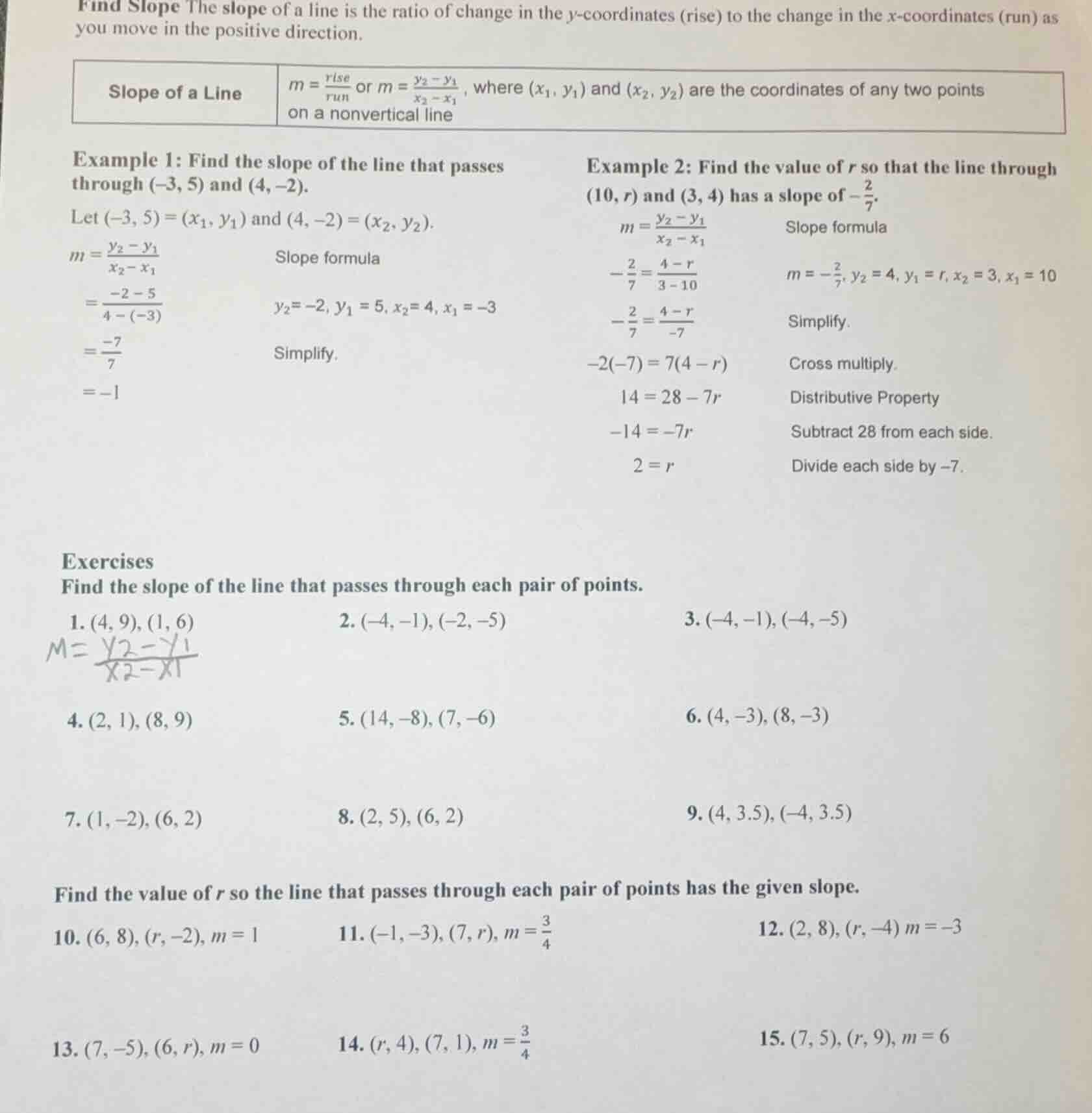
find slope the slope of a line is the ratio of change in the y-coordinates (rise) to the change in the x-coordinates (run) as you move in the positive direction.
slope of a line $m=\frac{rise}{run}$ or $m=\frac{y_2-y_1}{x_2-x_1}$, where $(x_1, y_1)$ and $(x_2, y_2)$ are the coordinates of any two points on a nonvertical line
example 1: find the slope of the line that passes through $(-3, 5)$ and $(4, -2)$.
let $(-3, 5)=(x_1, y_1)$ and $(4, -2)=(x_2, y_2)$.
$m=\frac{y_2-y_1}{x_2-x_1}$ slope formula
$=\frac{-2-5}{4-(-3)}$ $y_2=-2, y_1=5, x_2=4, x_1=-3$
$=\frac{-7}{7}$ simplify.
$=-1$
example 2: find the value of $r$ so that the line through $(10, r)$ and $(3, 4)$ has a slope of $-\frac{2}{7}$.
$m=\frac{y_2-y_1}{x_2-x_1}$ slope formula
$-\frac{2}{7}=\frac{4-r}{3-10}$ $m=-\frac{2}{7}, y_2=4, y_1=r, x_2=3, x_1=10$
$-\frac{2}{7}=\frac{4-r}{-7}$ simplify.
$-2(-7)=7(4-r)$ cross multiply.
$14=28-7r$ distributive property
$-14=-7r$ subtract 28 from each side.
$2=r$ divide each side by $-7$.
exercises
find the slope of the line that passes through each pair of points.
- $(4, 9), (1, 6)$
- $(-4, -1), (-2, -5)$
- $(-4, -1), (-4, -5)$
- $(2, 1), (8, 9)$
- $(14, -8), (7, -6)$
- $(4, -3), (8, -3)$
- $(1, -2), (6, 2)$
- $(2, 5), (6, 2)$
- $(4, 3.5), (-4, 3.5)$
find the value of $r$ so the line that passes through each pair of points has the given slope.
- $(6, 8), (r, -2), m=1$
- $(-1, -3), (7, r), m=\frac{3}{4}$
- $(2, 8), (r, -4) m=-3$
- $(7, -5), (6, r), m=0$
- $(r, 4), (7, 1), m=\frac{3}{4}$
- $(7, 5), (r, 9), m=6$
Step1: Solve Exercise 1
Let $(4,9)=(x_1,y_1)$ and $(1,6)=(x_2,y_2)$.
$m=\frac{y_2-y_1}{x_2-x_1}=\frac{6-9}{1-4}=\frac{-3}{-3}=1$
Step2: Solve Exercise 2
Let $(-4,-1)=(x_1,y_1)$ and $(-2,-5)=(x_2,y_2)$.
$m=\frac{y_2-y_1}{x_2-x_1}=\frac{-5-(-1)}{-2-(-4)}=\frac{-4}{2}=-2$
Step3: Solve Exercise 3
Let $(-4,-1)=(x_1,y_1)$ and $(-4,-5)=(x_2,y_2)$.
$m=\frac{y_2-y_1}{x_2-x_1}=\frac{-5-(-1)}{-4-(-4)}=\frac{-4}{0}$, undefined (vertical line)
Step4: Solve Exercise 4
Let $(2,1)=(x_1,y_1)$ and $(8,9)=(x_2,y_2)$.
$m=\frac{y_2-y_1}{x_2-x_1}=\frac{9-1}{8-2}=\frac{8}{6}=\frac{4}{3}$
Step5: Solve Exercise 5
Let $(14,-8)=(x_1,y_1)$ and $(7,-6)=(x_2,y_2)$.
$m=\frac{y_2-y_1}{x_2-x_1}=\frac{-6-(-8)}{7-14}=\frac{2}{-7}=-\frac{2}{7}$
Step6: Solve Exercise 6
Let $(4,-3)=(x_1,y_1)$ and $(8,-3)=(x_2,y_2)$.
$m=\frac{y_2-y_1}{x_2-x_1}=\frac{-3-(-3)}{8-4}=\frac{0}{4}=0$
Step7: Solve Exercise 7
Let $(1,-2)=(x_1,y_1)$ and $(6,2)=(x_2,y_2)$.
$m=\frac{y_2-y_1}{x_2-x_1}=\frac{2-(-2)}{6-1}=\frac{4}{5}$
Step8: Solve Exercise 8
Let $(2,5)=(x_1,y_1)$ and $(6,2)=(x_2,y_2)$.
$m=\frac{y_2-y_1}{x_2-x_1}=\frac{2-5}{6-2}=\frac{-3}{4}=-\frac{3}{4}$
Step9: Solve Exercise 9
Let $(4,3.5)=(x_1,y_1)$ and $(-4,3.5)=(x_2,y_2)$.
$m=\frac{y_2-y_1}{x_2-x_1}=\frac{3.5-3.5}{-4-4}=\frac{0}{-8}=0$
Step10: Solve Exercise 10
Use slope formula: $1=\frac{-2-8}{r-6}$
$1=\frac{-10}{r-6}$
$r-6=-10$
$r=-4$
Step11: Solve Exercise 11
Use slope formula: $\frac{3}{4}=\frac{r-(-3)}{7-(-1)}$
$\frac{3}{4}=\frac{r+3}{8}$
$3\times8=4(r+3)$
$24=4r+12$
$4r=12$
$r=3$
Step12: Solve Exercise 12
Use slope formula: $-3=\frac{-4-8}{r-2}$
$-3=\frac{-12}{r-2}$
$-3(r-2)=-12$
$r-2=4$
$r=6$
Step13: Solve Exercise 13
Use slope formula: $0=\frac{r-(-5)}{6-7}$
$0=\frac{r+5}{-1}$
$r+5=0$
$r=-5$
Step14: Solve Exercise 14
Use slope formula: $\frac{3}{4}=\frac{1-4}{7-r}$
$\frac{3}{4}=\frac{-3}{7-r}$
$3(7-r)=-12$
$21-3r=-12$
$-3r=-33$
$r=11$
Step15: Solve Exercise 15
Use slope formula: $6=\frac{9-5}{r-7}$
$6=\frac{4}{r-7}$
$6(r-7)=4$
$6r-42=4$
$6r=46$
$r=\frac{23}{3}$

Snap & solve any problem in the app
Get step-by-step solutions on Sovi AI
Photo-based solutions with guided steps
Explore more problems and detailed explanations
- $1$
- $-2$
- Undefined
- $\frac{4}{3}$
- $-\frac{2}{7}$
- $0$
- $\frac{4}{5}$
- $-\frac{3}{4}$
- $0$
- $r=-4$
- $r=3$
- $r=6$
- $r=-5$
- $r=11$
- $r=\frac{23}{3}$