QUESTION IMAGE
Question
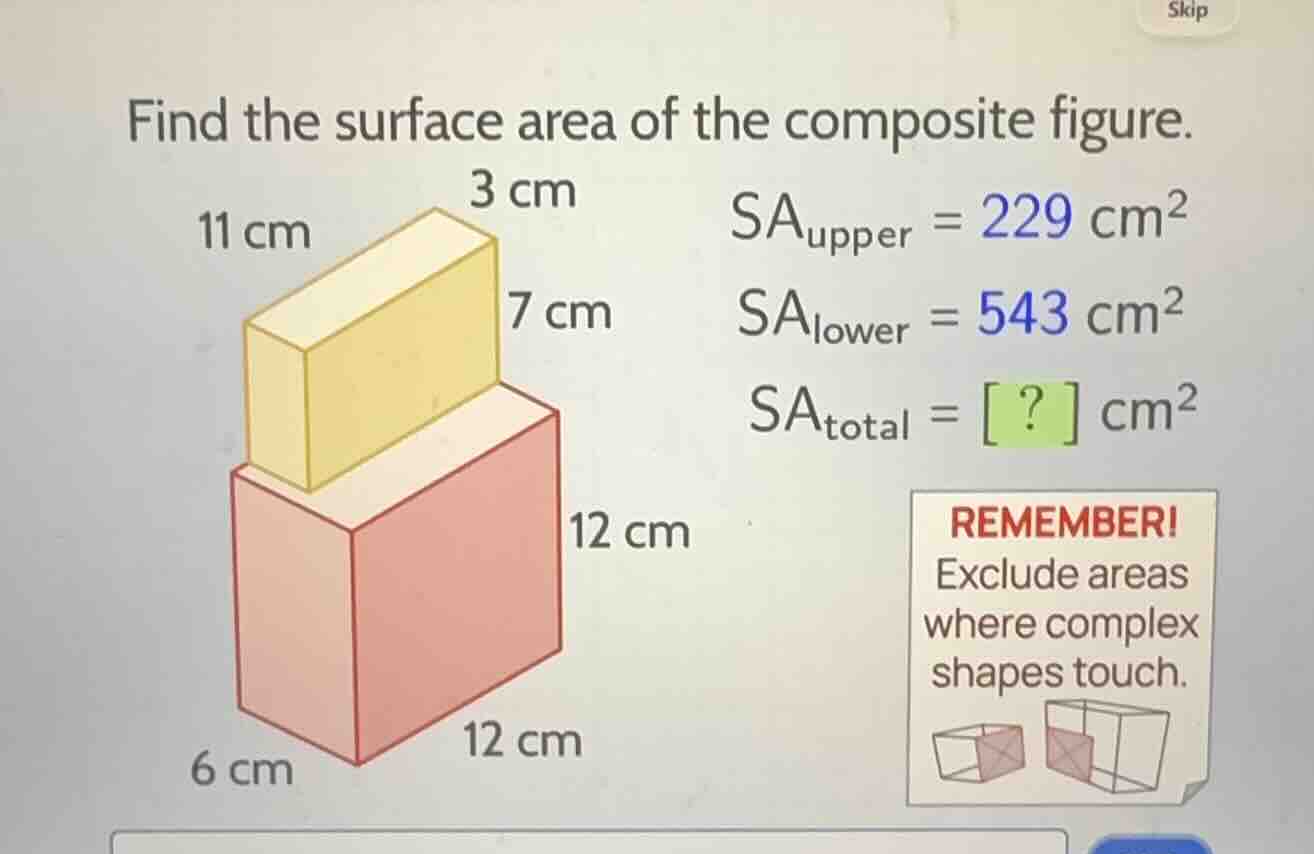
find the surface area of the composite figure.
11 cm 3 cm 7 cm
6 cm 12 cm 12 cm
sa_upper = 229 cm²
sa_lower = 543 cm²
sa_total = ? cm²
remember!
exclude areas where complex shapes touch.
Step1: Find the area of the overlapping region
The upper rectangular prism has a base with dimensions \(11\) cm (length) and \(3\) cm (width). The area of one overlapping face (the base of the upper prism) is \(11\times3 = 33\) \(cm^2\). Since the upper prism is placed on the lower prism, two such faces (one from the upper and one from the lower) are excluded from the total surface area. So the total excluded area is \(2\times33=66\) \(cm^2\).
Step2: Calculate the total surface area
We know the surface area of the upper prism (\(SA_{upper} = 229\) \(cm^2\)) and the surface area of the lower prism (\(SA_{lower}=543\) \(cm^2\)). When we combine them, we have to subtract the excluded area (the area where they touch) from the sum of their individual surface areas.
First, find the sum of the individual surface areas: \(229 + 543=772\) \(cm^2\).
Then subtract the excluded area: \(772- 66 = 706\) \(cm^2\).

Snap & solve any problem in the app
Get step-by-step solutions on Sovi AI
Photo-based solutions with guided steps
Explore more problems and detailed explanations
\(706\)