QUESTION IMAGE
Question
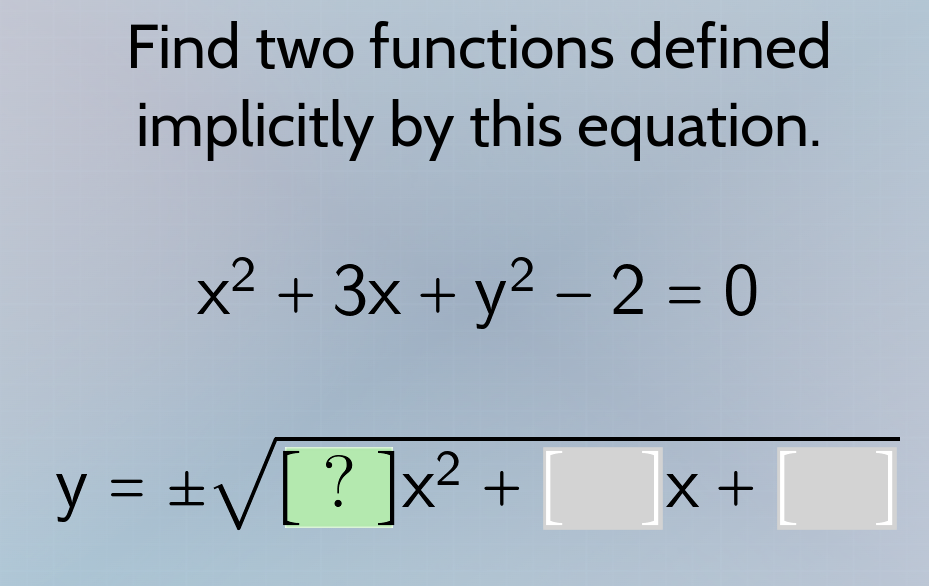
find two functions defined implicitly by this equation.\\(x^2 + 3x + y^2 - 2 = 0\\)\\(y = pm sqrt{?x^2 + x + }\\)
Step1: Isolate \( y^2 \)
Start with the equation \( x^2 + 3x + y^2 - 2 = 0 \). We want to solve for \( y^2 \), so we move the other terms to the right side.
\( y^2 = -x^2 - 3x + 2 \)
Step2: Express in the form under the square root
We can factor out a negative sign from the right side to match the form \( y=\pm\sqrt{ax^2 + bx + c} \).
\( y^2 = -x^2 - 3x + 2 = (-1)x^2 + (-3)x + 2 \), but when we take the square root, we have \( y=\pm\sqrt{-x^2 - 3x + 2} \), which can also be written by factoring out the negative sign inside the square root as \( y=\pm\sqrt{-(x^2 + 3x - 2)} \), but more directly, from \( y^2=-x^2 - 3x + 2 \), taking square roots gives \( y = \pm\sqrt{-x^2 - 3x + 2} \). So comparing to \( y=\pm\sqrt{[?]x^2 + [\ ]x + [\ ]} \), the coefficient of \( x^2 \) is -1, the coefficient of \( x \) is -3, and the constant term is 2. Wait, actually, let's re-express the original equation solving for \( y^2 \) correctly. Starting over:
Original equation: \( x^2 + 3x + y^2 - 2 = 0 \)
Subtract \( x^2 + 3x - 2 \) from both sides: \( y^2 = -x^2 - 3x + 2 \)
So when we write \( y = \pm\sqrt{ax^2 + bx + c} \), then \( ax^2 + bx + c = -x^2 - 3x + 2 \), so \( a = -1 \), \( b = -3 \), \( c = 2 \).
Wait, maybe I made a mistake earlier. Let's do it step by step:
- Start with \( x^2 + 3x + y^2 - 2 = 0 \)
- Move all terms except \( y^2 \) to the right: \( y^2 = -x^2 - 3x + 2 \)
- Now, take the square root of both sides: \( y = \pm\sqrt{-x^2 - 3x + 2} \)
So in the form \( y=\pm\sqrt{[?]x^2 + [\ ]x + [\ ]} \), the coefficient of \( x^2 \) (the green box) is -1, the next box (coefficient of x) is -3, and the last box (constant term) is 2.
Wait, but let's check again. Let's solve for \( y^2 \):
\( x^2 + 3x + y^2 - 2 = 0 \)
\( y^2 = -x^2 - 3x + 2 \)
Yes, so the expression under the square root is \( -x^2 - 3x + 2 \), so the coefficients are:
- Coefficient of \( x^2 \): -1
- Coefficient of \( x \): -3
- Constant term: 2
So filling in the boxes:
\( y = \pm\sqrt{\boldsymbol{-1}x^2 + \boldsymbol{-3}x + \boldsymbol{2}} \)
Wait, but maybe there's a different way. Wait, let's rearrange the original equation:
\( x^2 + 3x + y^2 = 2 \)
\( y^2 = 2 - x^2 - 3x \)
\( y^2 = -x^2 - 3x + 2 \)
Yes, so that's correct. So the coefficient of \( x^2 \) is -1, coefficient of \( x \) is -3, constant term is 2.

Snap & solve any problem in the app
Get step-by-step solutions on Sovi AI
Photo-based solutions with guided steps
Explore more problems and detailed explanations
The coefficient of \( x^2 \) (green box) is \(-1\), the coefficient of \( x \) (gray box) is \(-3\), and the constant term (last gray box) is \( 2 \). So the filled form is \( y = \pm\sqrt{\boldsymbol{-1}x^2 + \boldsymbol{-3}x + \boldsymbol{2}} \). So the green box (coefficient of \( x^2 \)) is \(-1\), the first gray box (coefficient of \( x \)) is \(-3\), and the last gray box (constant term) is \( 2 \).