QUESTION IMAGE
Question
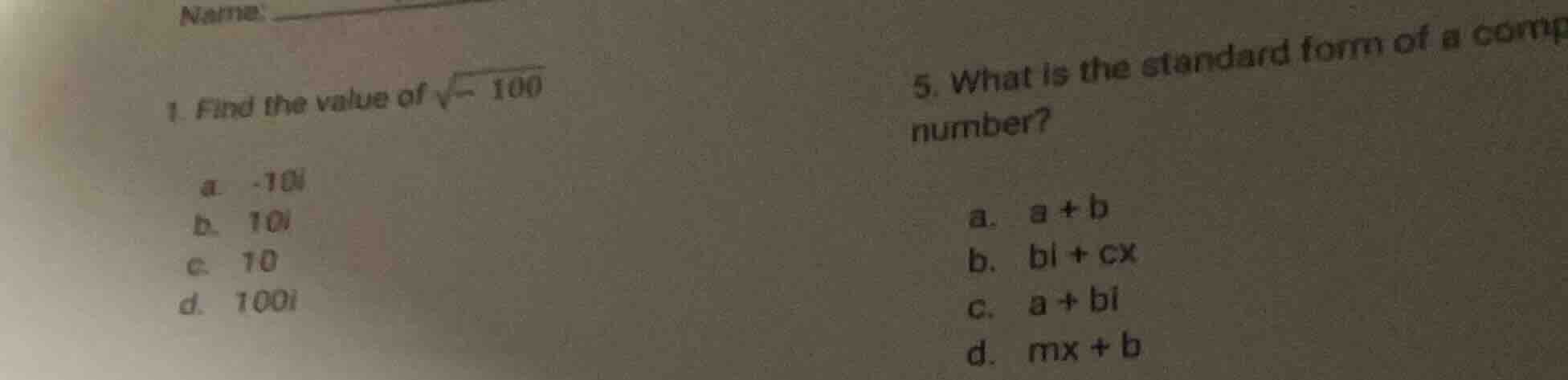
- find the value of \\(sqrt{-100}\\)
a. -10i
b. 10i
c. 10
d. 100i
- what is the standard form of a complex number?
a. a + b
b. bi + cx
c. a + bi
d. mx + b
Question 1:
Step1: Recall the imaginary unit
The imaginary unit \( i \) is defined as \( i = \sqrt{-1} \). So we can rewrite \( \sqrt{-100} \) as \( \sqrt{100 \times (-1)} \).
Step2: Use the property of square roots
Using the property \( \sqrt{ab}=\sqrt{a}\times\sqrt{b} \) (for \( a\geq0, b\geq0 \), here we extend it for complex numbers), we have \( \sqrt{100\times(-1)}=\sqrt{100}\times\sqrt{-1} \).
Step3: Calculate the square roots
We know that \( \sqrt{100} = 10 \) and \( \sqrt{-1}=i \), so \( \sqrt{100}\times\sqrt{-1}=10\times i = 10i \).
The standard form of a complex number is defined as \( a + bi \), where \( a \) is the real part and \( bi \) is the imaginary part (\( a,b \) are real numbers and \( i=\sqrt{-1} \)). Option a is just a sum of two real numbers, option b has an extra \( x \) which is not part of the standard complex number form, and option d is the slope - intercept form of a linear equation, not related to complex numbers.

Snap & solve any problem in the app
Get step-by-step solutions on Sovi AI
Photo-based solutions with guided steps
Explore more problems and detailed explanations
b. 10\(i\)