QUESTION IMAGE
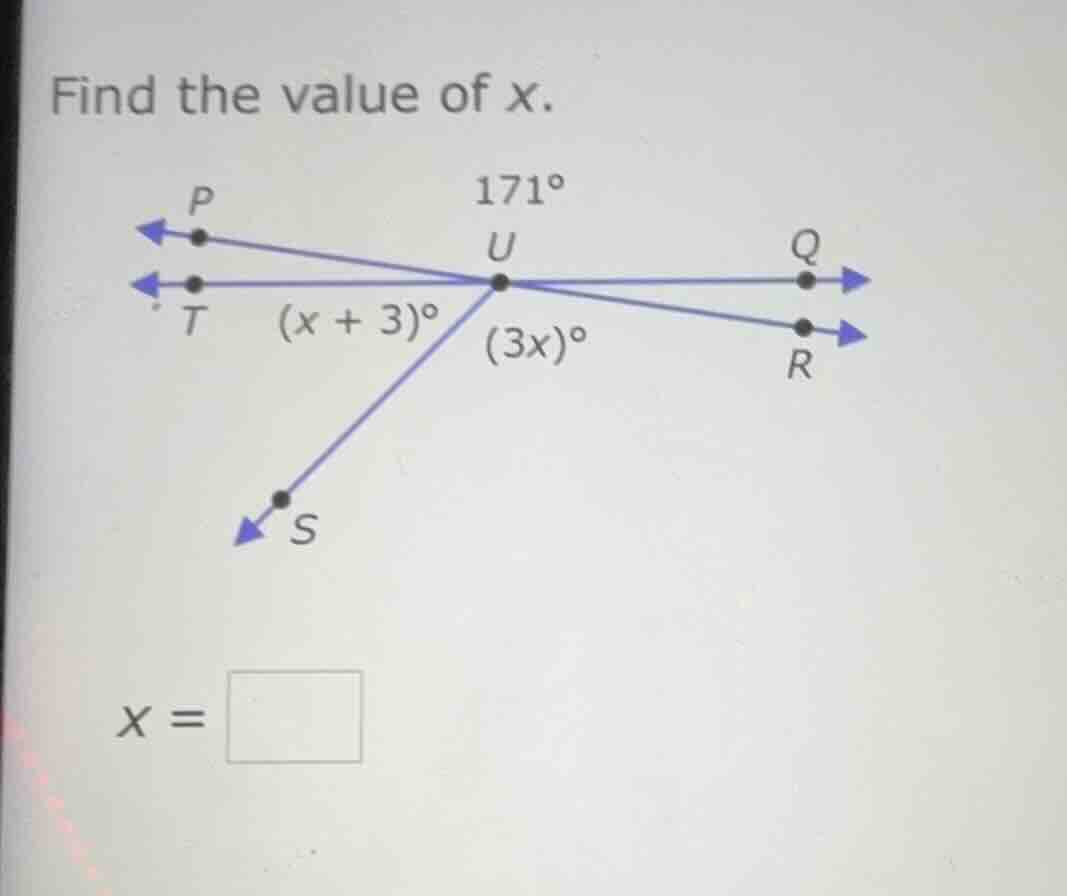
Question
find the value of x.
x = \square
Step1: Identify the straight line angle sum
Angles on a straight line sum to \(180^\circ\). The angles around point \(U\) on the straight line (considering the horizontal line with \(P, T\) on one side and \(Q, R\) on the other) and the other angles should sum such that the total around the straight line is \(180^\circ\)? Wait, no, actually, the angle \(171^\circ\) and the sum of \((x + 3)^\circ\), \((3x)^\circ\) should relate? Wait, no, looking at the diagram, \(PT\) and \(QR\) are parallel? No, actually, the angles at point \(U\): the angle \(171^\circ\) and the adjacent angles (the ones with \(x\)) should form a linear pair? Wait, no, let's re - examine. The sum of angles on a straight line is \(180^\circ\). So the angle \(171^\circ\) and the sum of \((x + 3)^\circ\) and \((3x)^\circ\) should satisfy \(171+(x + 3)+3x=180\)? Wait, no, maybe the angle supplementary to \(171^\circ\) is equal to \((x + 3)+3x\). The supplementary angle of \(171^\circ\) is \(180 - 171=9^\circ\)? No, that can't be. Wait, no, let's think again. The total around a point on a straight line is \(180^\circ\). So the angle \(171^\circ\) and the sum of \((x + 3)^\circ\) and \((3x)^\circ\) should add up to \(180^\circ\). So:
\(171+(x + 3)+3x = 180\)
Step2: Simplify the equation
First, combine like terms:
\(171+x + 3+3x=180\)
\(174 + 4x=180\)
Step3: Solve for \(x\)
Subtract \(174\) from both sides:
\(4x=180 - 174\)
\(4x = 6\)
Wait, that gives \(x=\frac{6}{4}=1.5\), which seems wrong. Maybe my initial assumption is wrong. Let's re - look at the diagram. Maybe \(PT\) and \(QS\)? No, another approach: the angle between \(PT\) and \(PS\) is \((x + 3)^\circ\), between \(PS\) and \(PR\) is \((3x)^\circ\), and the angle opposite to \(171^\circ\)? No, maybe the sum of \((x + 3)^\circ\) and \((3x)^\circ\) is equal to \(180 - 171 = 9^\circ\)? No, that would mean \(x+3 + 3x=9\), \(4x=6\), \(x = 1.5\) again. But that seems odd. Wait, maybe the diagram is such that the angle \(171^\circ\) and the angle \((x + 3)+3x\) are vertical angles? No, vertical angles are equal. Wait, maybe I made a mistake in the angle sum. Let's start over.
The sum of angles around a point on a straight line is \(180^\circ\). So the angle \(171^\circ\) and the angles \((x + 3)^\circ\) and \((3x)^\circ\) are on a straight line. So:
\(171+(x + 3)+3x=180\)
\(171+x + 3+3x=180\)
\(174 + 4x=180\)
\(4x=180 - 174\)
\(4x = 6\)
\(x=\frac{6}{4}=1.5\). But this seems incorrect. Wait, maybe the angle \(171^\circ\) is adjacent to the angle \((x + 3)+3x\) and they are supplementary. Wait, supplementary angles add up to \(180^\circ\), so \((x + 3)+3x=180 - 171\)
\(4x+3 = 9\)
\(4x=6\)
\(x = 1.5\). Hmm. Maybe that's correct.

Snap & solve any problem in the app
Get step-by-step solutions on Sovi AI
Photo-based solutions with guided steps
Explore more problems and detailed explanations
\(x = \frac{3}{2}\) or \(x = 1.5\)