QUESTION IMAGE
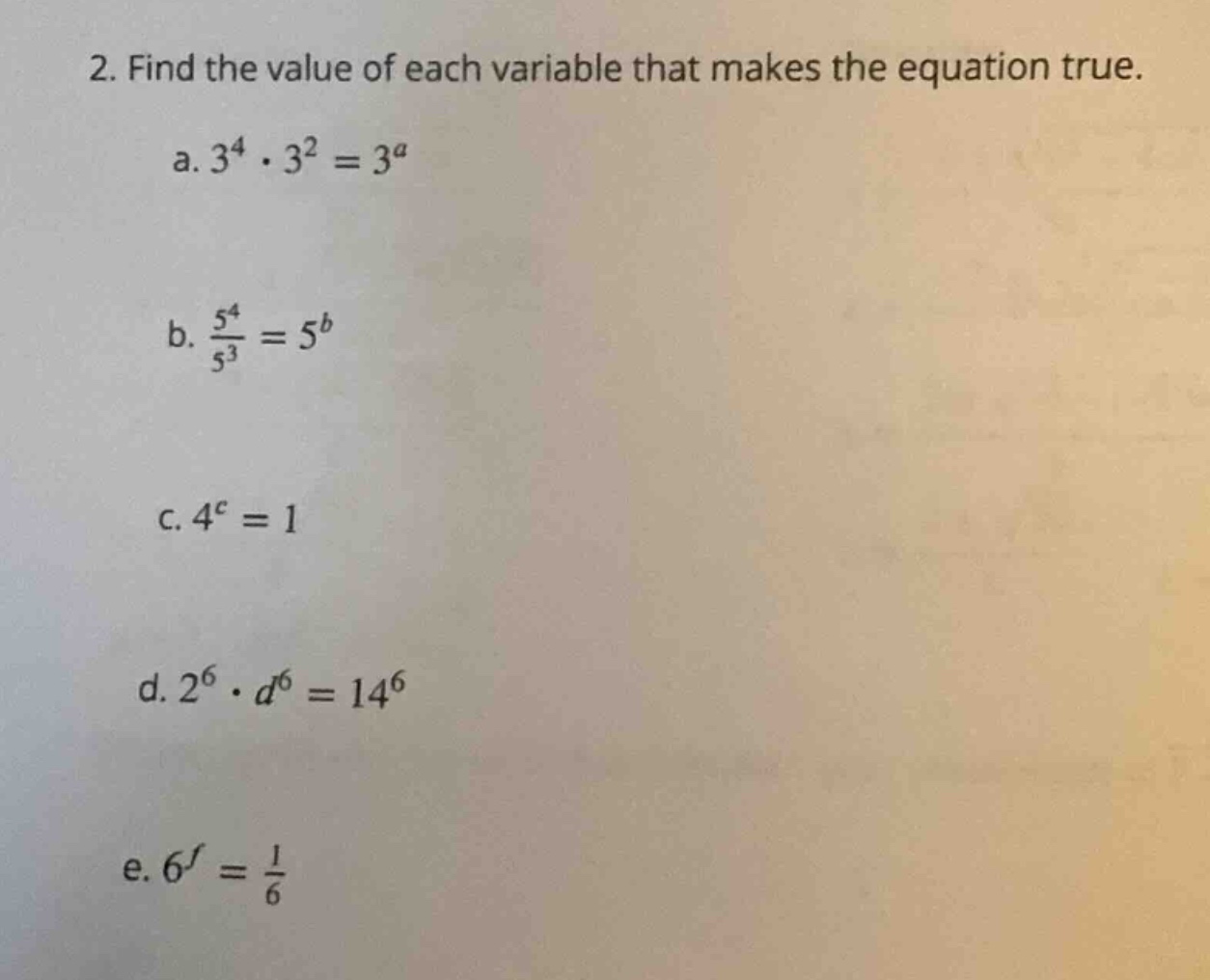
Question
- find the value of each variable that makes the equation true.
a. $3^4 \cdot 3^2 = 3^a$
b. $\frac{5^4}{5^3} = 5^b$
c. $4^c = 1$
d. $2^6 \cdot d^6 = 14^6$
e. $6^f = \frac{1}{6}$
Part a
Step1: Use exponent product rule
When multiplying exponents with the same base, we add the exponents: \(a^m \cdot a^n = a^{m + n}\). So for \(3^4 \cdot 3^2\), we have \(3^{4+2}\).
\(3^4 \cdot 3^2 = 3^{4 + 2}=3^6\)
Step2: Equate exponents
Since \(3^4 \cdot 3^2 = 3^a\) and \(3^4 \cdot 3^2 = 3^6\), then \(3^6=3^a\). For exponential equations with the same base, the exponents must be equal, so \(a = 6\).
Step1: Use exponent quotient rule
When dividing exponents with the same base, we subtract the exponents: \(\frac{a^m}{a^n}=a^{m - n}\). So for \(\frac{5^4}{5^3}\), we have \(5^{4-3}\).
\(\frac{5^4}{5^3}=5^{4 - 3}=5^1\)
Step2: Equate exponents
Since \(\frac{5^4}{5^3}=5^b\) and \(\frac{5^4}{5^3}=5^1\), then \(5^1 = 5^b\). So \(b=1\).
Step1: Recall the zero - exponent rule
Any non - zero number raised to the power of 0 is 1, i.e., \(a^0 = 1\) for \(a
eq0\). We have \(4^c=1\), and since \(4
eq0\), we can use the zero - exponent rule.
Step2: Solve for \(c\)
If \(4^c = 1\) and \(a^0=1\) (with \(a = 4\)), then \(c = 0\) because \(4^0=1\).

Snap & solve any problem in the app
Get step-by-step solutions on Sovi AI
Photo-based solutions with guided steps
Explore more problems and detailed explanations
\(a = 6\)