QUESTION IMAGE
Question
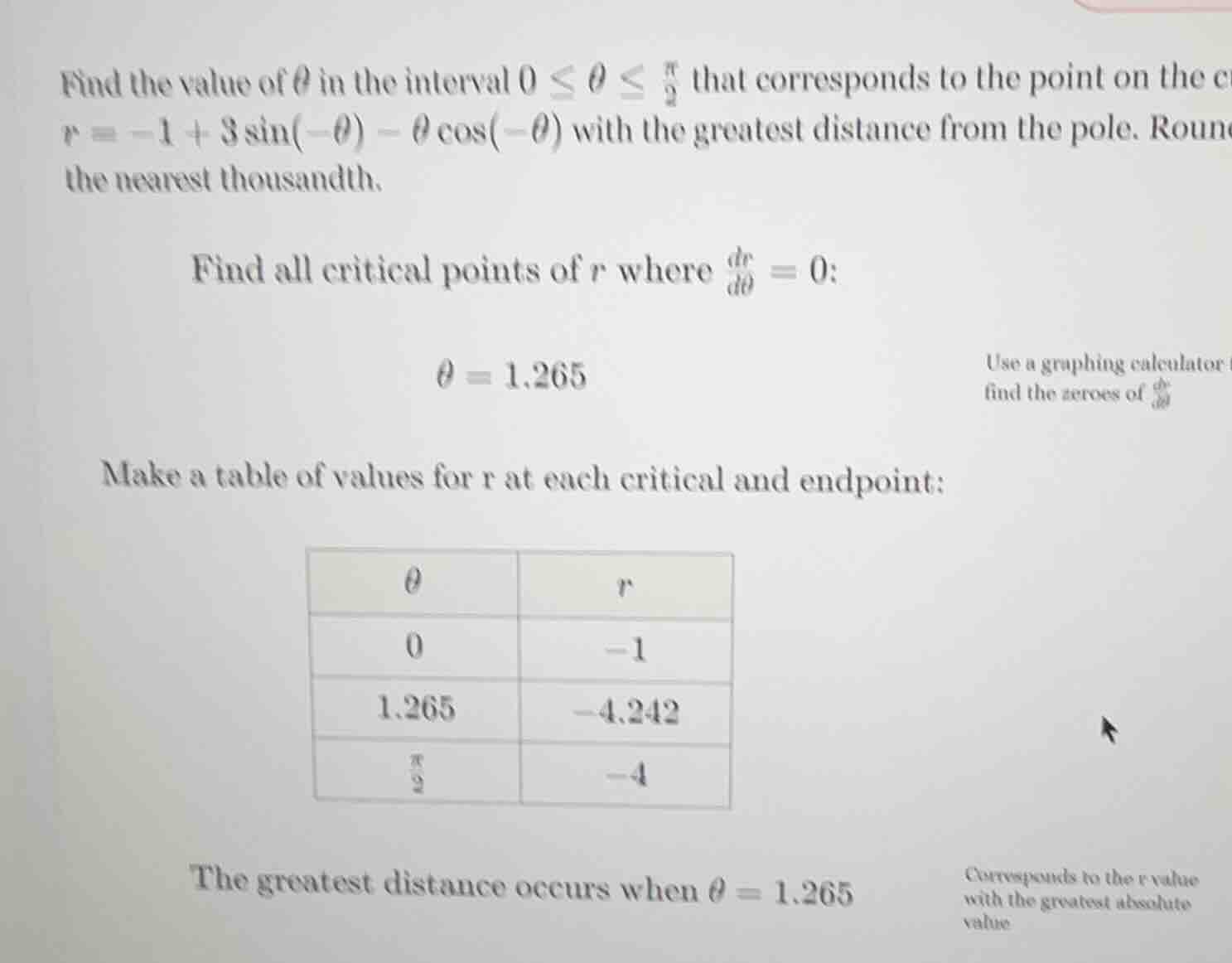
find the value of \\( \theta \\) in the interval \\( 0 \leq \theta \leq \frac{\pi}{2} \\) that corresponds to the point on the c\\( r = -1 + 3\sin(-\theta) - \theta\cos(-\theta) \\) with the greatest distance from the pole. round the nearest thousandth.
find all critical points of \\( r \\) where \\( \frac{dr}{d\theta} = 0\\):
\\( \theta = 1.265 \\) use a graphing calculator find the zeroes of \\( \frac{dr}{d\theta}
make a table of values for \\( r \\) at each critical and endpoint:
| \\( \theta \\) | \\( r \\) |
|---|---|
| 1.265 | -4.242 |
| \\( \frac{\pi}{2} \\) | -4 |
the greatest distance occurs when \\( \theta = 1.265 \\) corresponds to the \\( r \\) value with the greatest absolute value
Step1: Analyze the problem
We need to find the value of \(\theta\) in the interval \(0\leq\theta\leq\frac{\pi}{2}\) that gives the greatest distance from the pole for the polar curve \(r = - 1+3\sin(-\theta)-\theta\cos(-\theta)\). The distance from the pole is given by \(|r|\), so we need to consider the absolute value of \(r\) at critical points (where \(\frac{dr}{d\theta}=0\)) and endpoints of the interval.
Step2: Identify critical points and endpoints
- Critical point: We are given that \(\frac{dr}{d\theta} = 0\) at \(\theta=1.265\).
- Endpoints: \(\theta = 0\) and \(\theta=\frac{\pi}{2}\approx1.571\).
Step3: Evaluate \(|r|\) at each point
- At \(\theta = 0\): \(r=- 1\), so \(|r| = 1\).
- At \(\theta=1.265\): \(r=-4.242\), so \(|r| = 4.242\).
- At \(\theta=\frac{\pi}{2}\): \(r = - 4\), so \(|r|=4\).
Step4: Compare the absolute values
We compare \(1\), \(4.242\), and \(4\). The largest absolute value is \(4.242\), which occurs at \(\theta = 1.265\).

Snap & solve any problem in the app
Get step-by-step solutions on Sovi AI
Photo-based solutions with guided steps
Explore more problems and detailed explanations
\(\theta=\boxed{1.265}\)